
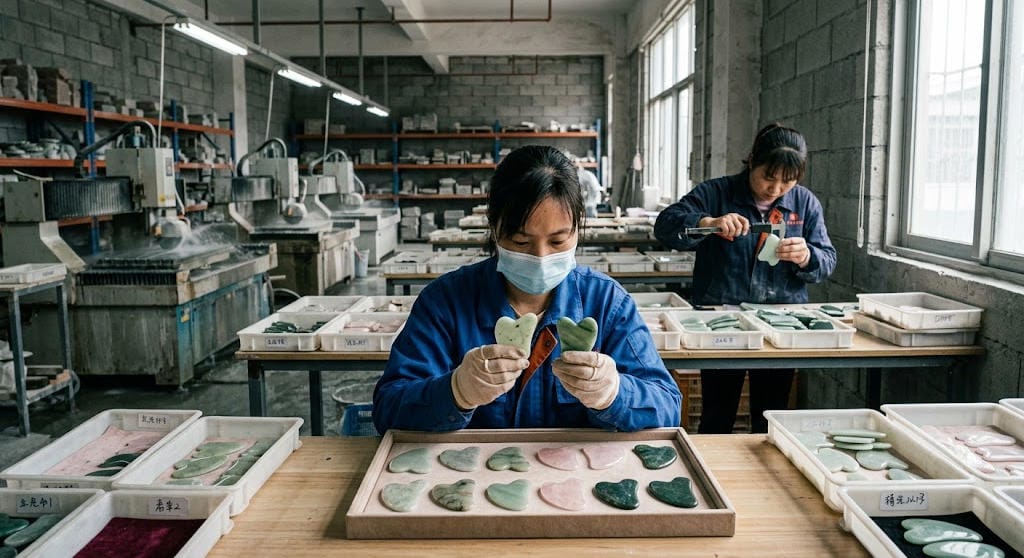
A 5,000-piece gua sha order can swing by three to ten days in lead time, and the deciding factor is rarely the total quantity — it’s which single quality requirement gets tightened. That’s one of the first things a working gua sha manufacturer learns on the floor, and it’s rarely explained to the buyer placing the order. You’ve probably been told the trade-off comes down to a simple rule: fast delivery or tight quality control, pick one. On a cutting floor that processes natural jade and crystal boards every day, that rule falls apart under real numbers. Color sorting, dimensional tolerance, and surface finishing each pull on a different part of the schedule, and usually only one of them needs the extra days you’re being quoted for. This article walks through how a working gua sha factory actually manages that tension, where the real risk sits inside a wholesale contract, and what you should ask before you sign one.
Why Speed and Quality Look Like Enemies Inside a Gua Sha Factory
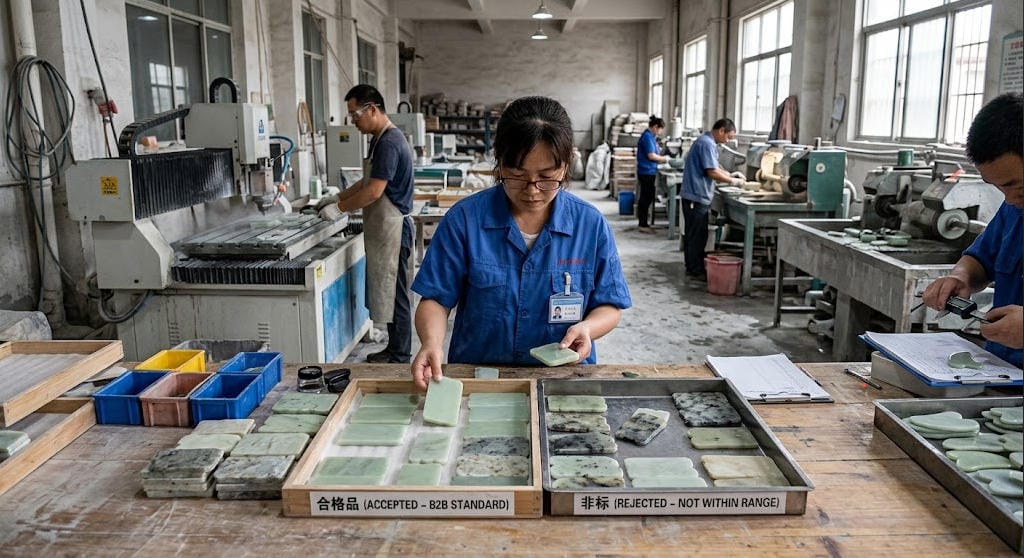
From the floor, the tension is real, not imagined. A buyer ordering 5,000 pieces of natural jade gua sha boards usually wants four things at once: a fast ship date, near-identical color across the whole batch, almost no visible surface flaws, and dimensions that hold within a tight tolerance. Each of those demands pulls on a different resource. Faster delivery means the line wants to start cutting immediately. Tighter color matching means someone has to spend extra hours sorting raw stone by hue before a single blade touches it. Fewer visible flaws means more hands doing visual inspection and more pieces getting pulled off the line. Tighter dimensions mean stricter machining parameters and more frequent gauge checks. Put those together and you get the pattern most buyers assume is universal: higher quality demand equals more sorting, more processing, more inspection, which equals a slower ship date.
That assumption isn’t wrong, but it’s incomplete, and the gap matters to your quote. Raising one quality bar does not have to slow the entire production run — usually it only adds time to one specific stage. Color consistency mostly adds hours to raw-material grading and sorting, not to the actual cutting or polishing. Dimensional consistency mostly adds machining-parameter control and inline gauge checks, not sorting time. Surface finish mostly adds hours to fine grinding, buffing, and final inspection, not to material selection. This means when a gua sha supplier quotes you extra days for “higher quality,” the useful follow-up question is which stage is actually absorbing that time — because that number should be traceable to a specific department, not a vague blanket statement.
The 5,000-Piece Order Every Gua Sha Manufacturer Recognizes
Picture a 5,000-piece order for natural jade boards where you’ve asked for close color matching. Sorting raw blanks tightly enough to hit a narrow hue band can remove a meaningful share of the incoming stone — in practice, often somewhere in the range of 15% to 25% of raw material gets set aside before cutting even starts, depending on the mine lot and season. That sorting step happens almost entirely before machining, which is exactly why it shows up as added days at the front of your timeline rather than a slower cutting or polishing line. Any gua sha manufacturer who has run large color-matched batches will recognize this pattern immediately, because it repeats on nearly every natural-stone order above a few thousand pieces.
One Tight Spec Slows One Step — Not the Whole Line
The practical takeaway is that a 25-day quote for a color-matched batch is usually being driven by two or three extra days in the sorting room, not by a factory that runs slower across the board. Once sorted stone reaches the machining stage, cutting speed, polishing cycle time, and packing all move at close to normal pace. This means you can ask your gua sha supplier to break the quoted lead time into stages, and a straight answer — “sorting adds four days, everything downstream is standard” — tells you a lot more about whether the quote is reasonable than a single lump-sum number ever will.
The Real Question Isn’t Fast vs. Perfect — It’s Which Flaw Actually Matters
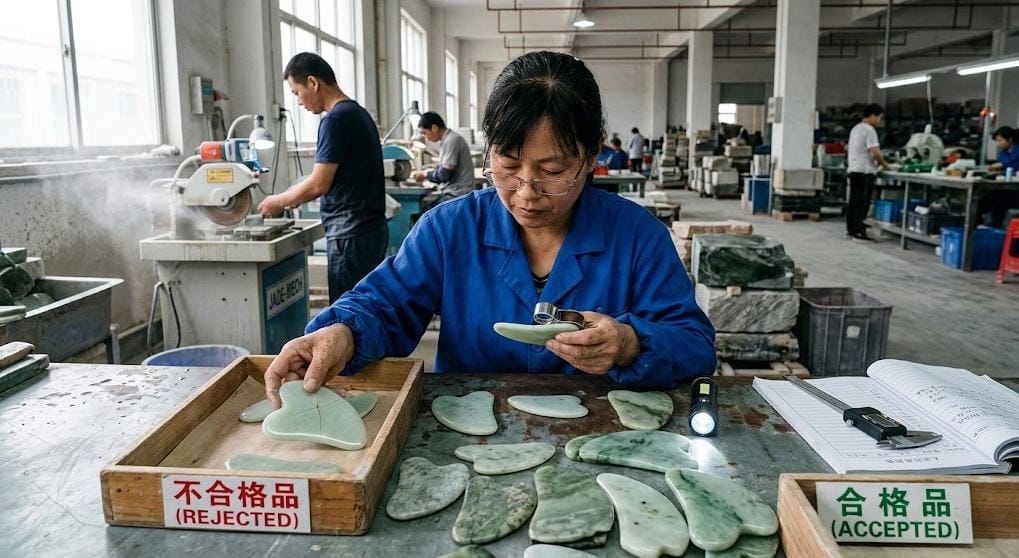
Not every visible mark on a piece of natural stone carries the same weight, and treating them as equal is where a lot of budget and time gets wasted for no real benefit to you. A crack, a chipped corner, an out-of-tolerance dimension, a misplaced logo, a faint natural vein, and a tiny mineral inclusion are six very different things, even though a rushed quality check might lump them all under “defect.” A crack is a structural risk. A faint natural vein in jade is, more often than not, simply what the stone looked like before anyone touched it.
This distinction is backed by how gemological references actually describe these stones. The GIA jade quality guide lists color under multiple light sources, transparency, and fine polish as the factors trade buyers weigh most heavily, and treats actual structural fractures — not natural markings — as the issue that most strongly affects value. On the nephrite side specifically, the International Gem Society’s nephrite reference documents small chromite or graphite “black dots” and pale internal streaks known as “water lines” as recognized natural characteristics of the material, not as manufacturing errors. If a gua sha factory rejects every piece carrying one of these natural marks, it isn’t protecting your order — it’s discarding usable stone and pushing up your unit cost for a standard you never actually asked for.
How a Gua Sha Manufacturer Separates a Crack From a Natural Vein
A structural crack changes how a board performs and how long it lasts, so it sits in a different category from day one. A natural vein or a small internal inclusion changes only how the piece looks, and in most orders it doesn’t affect function at all. This means the right question for your production partner isn’t “is this piece perfect,” it’s “does this specific mark change how the board works or how it looks in a way you actually specified.” A factory that can answer that question stage by stage, rather than defaulting to “we’ll make it flawless,” is generally the one keeping your reject rate and your unit cost under control.
Turning “Good Gua Sha” Into Numbers Your Gua Sha Supplier Can Run On
The phrase “we need good gua sha” gives a production line almost nothing to work with, and that’s the honest truth of it. You get a far more useful outcome by translating that phrase into five concrete categories: appearance (whether natural texture, light color variation, or faint polish marks are acceptable, and where the line for a rejected scratch sits), dimensions (length, width, thickness, hole diameter, edge tolerance), material (specific stone type, grade, color range, and what level of natural inclusion or hairline is acceptable), surface treatment (polished, matte, frosted, or smooth-edge finish), and logo placement (position, size, color, and allowed offset). Once those five categories carry numbers instead of adjectives, a gua sha wholesale order stops depending on interpretation and starts depending on a spec sheet everyone on the line can check against. This means fewer disputes at final inspection and a much shorter list of surprises when the shipment lands at your warehouse.
The Three-Tier Priority Model Behind Reliable Gua Sha Production
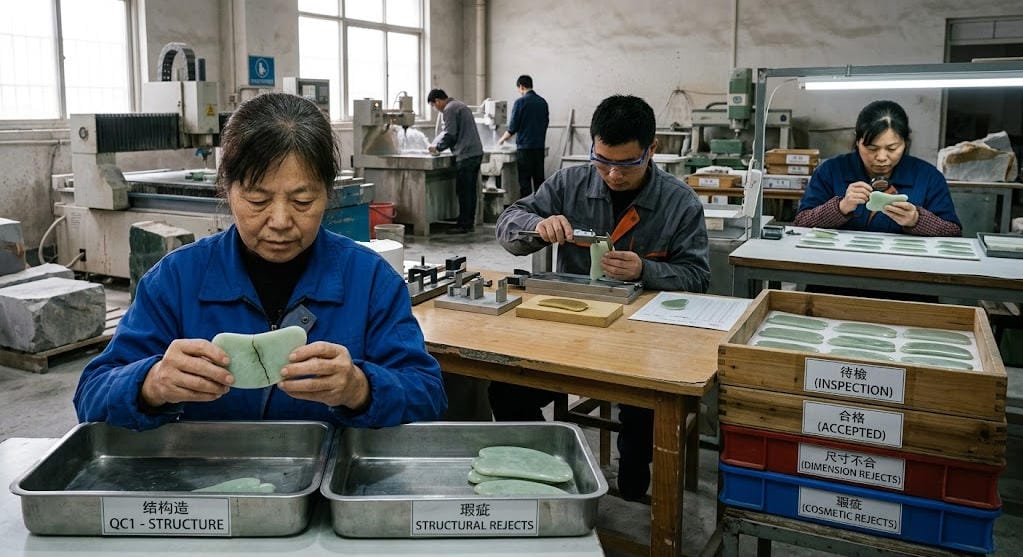
When a deadline and a quality requirement genuinely collide, sorting every issue into one of three tiers gives both sides a way to talk about trade-offs without guessing. This kind of tiered classification isn’t a novel idea invented for this article. GIA’s own research on the nephrite trade documents comparable tier systems already in use: one grading standard applies a four-level scale — Excellent, Good, Fine, and Poor — based on color, texture, and clarity, while another trade operation grades output into five tiers from AAA down to C, with the top AAA tier reportedly accounting for only around 3 percent of total production. The logic transfers directly to gua sha production.
Tier 1 — What No Gua Sha Manufacturer Should Ever Rush
Tier 1 covers anything that makes the piece unsafe or unusable: a crack that creates breakage risk, a severe chipped edge, a structural dimension that’s clearly wrong, material that doesn’t match what the order specified, or a logo error serious enough to misrepresent the product. None of these should be waved through just because a shipment date is close. This means that if a supplier tells you a Tier 1 issue is “close enough” to hit a deadline, that’s the moment to slow down and ask more questions, not the moment to relax — in disciplined gua sha production, Tier 1 issues decide whether a batch ships at all, not how fast it ships.
Tier 2 — Build Consistency Into the Process, Not the Final Check
Tier 2 covers requirements that genuinely matter but don’t need to be solved by a person squinting at every finished piece: dimensional consistency, surface smoothness, logo position, edge rounding, and color uniformity. These get handled far more efficiently through fixtures, locked CNC parameters, standardized processing steps, a confirmed Golden Sample, first-article approval, and in-process quality checks with sampling inspection. This means consistency is built into the machine settings and the workflow itself rather than bolted on at the very end, which raises both your pass rate and your throughput at the same time instead of trading one for the other.
Tier 3 — Let Your Order Decide
Tier 3 covers things that may or may not matter depending on what you’re actually selling: a faint natural vein in a non-visible area, a slight color variation that doesn’t affect function, a small internal inclusion, or a minor cosmetic difference that has no bearing on how the product performs. Whether these get rejected should follow your stated standard, not a blanket instinct toward visual perfection. If your market accepts natural variation, forcing your gua sha manufacturer to eliminate it anyway only lowers yield and lengthens your timeline for a standard nobody asked for.
Catching Problems Before Mass Production, Not After
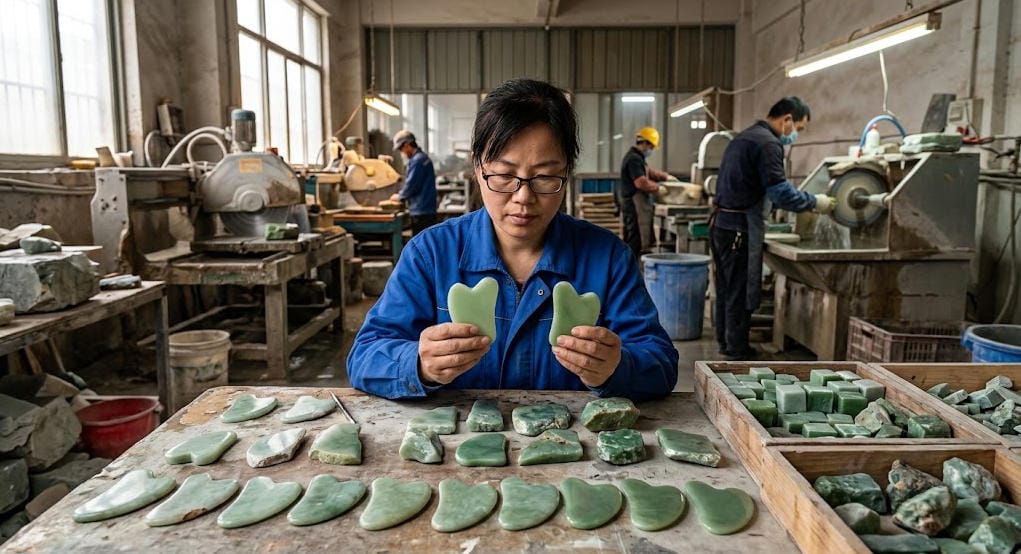
Here’s where a surprising number of orders actually lose their efficiency, and it usually isn’t where buyers expect. Picture a 5,000-piece order of natural green jade boards, tight color matching required, 25-day deadline. If the color standard isn’t locked down before production starts, the order can move all the way through sourcing, cutting, machining, and polishing before anyone notices the color doesn’t match what you had in mind — and by then, reworking it is expensive and slow in a way that upfront confirmation never would have been. A far more reliable sequence looks like this: your requirements first, then a raw-material sorting standard, then a Golden Sample, then a small trial batch, then first-article confirmation, then full production, then in-process checks, then outgoing inspection, then packing. This means the further upstream you catch a mismatch, the cheaper it is to fix and the less it costs you in schedule slippage — a sequencing habit that separates predictable gua sha production from production that only looks organized on a schedule chart.
Why the Golden Sample Is Every Gua Sha Manufacturer’s Shared Language
A lot of people treat the Golden Sample as a pure quality-control tool, but it does just as much for speed. If a customer only says “same color as before,” four different people can walk away with four different interpretations: purchasing thinks shade A is fine, the production team thinks shade B works, quality control insists on shade C, and you receive the finished goods convinced the whole batch is off-tone. That mismatch is exactly what triggers rework, re-sorting, replacement units, and missed dates. This means a physical reference sample — one that everyone touches and agrees on before cutting begins — removes the guesswork that causes most of these delays in the first place.
A Five-Ton Color-Match Order, Walked Through Correctly
Once your Golden Sample is confirmed, sourcing knows exactly which raw stone lots qualify, cutting and polishing teams know what “acceptable” looks like without asking, and outgoing inspection has an object to compare against instead of a written description open to interpretation. Fewer disagreements at the end of the line translate directly into fewer returned batches and fewer emergency reorders. This means the Golden Sample step you might be tempted to skip to save two days at the start is usually the exact thing preventing a ten-day delay near the finish line, which is exactly the kind of swing that shows up in your final gua sha lead time.
What Actually Determines Your Gua Sha Lead Time
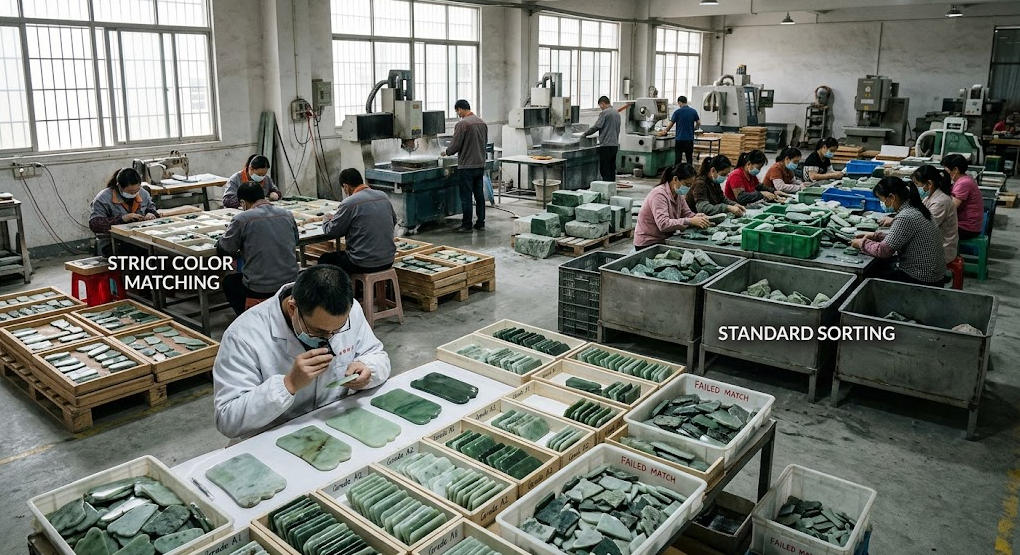
For natural stone processing, lead time isn’t simply order quantity divided by daily output — that formula only works for undifferentiated, low-spec goods. A more accurate way to think about it treats gua sha lead time as the sum of several distinct stages: raw-material preparation, raw-material sorting, machining, yield loss from rejected pieces, surface finishing, quality inspection, packing, and a buffer for the unexpected. A bottleneck in any single one of those stages can move your final ship date, even if every other stage runs exactly on schedule — which is why a one-line quote can never really tell you how a gua sha lead time was actually built.
The Formula Behind Every Gua Sha Manufacturer’s Quote
Take the same 5,000-piece order and run it two ways. If you only require ordinary color consistency, raw-material sorting is fast, yield stays high, and the batch moves into machining almost immediately. If you require that all 5,000 pieces land as close as possible to one single shade, what actually grows isn’t the machining time — it’s the sorting time, the material loss from rejected stone, and the extra batching needed to keep matched lots together through the whole process. This means the honest explanation to give a customer isn’t “higher quality means a longer wait,” it’s “this specific requirement added time to this specific stage,” and that framing makes the whole conversation easier to have. It is also the difference between a gua sha lead time you can plan a launch around and one you are simply hoping will hold.
Same 5,000 Pieces, Two Color Standards, Two Timelines
A gua sha wholesale buyer who understands this formula can make a faster decision when a deadline is tight, because the trade-off becomes concrete instead of abstract: accept a slightly wider color range and likely save several days, or hold the tighter standard and accept the added sorting time. Neither choice is automatically right — it depends on what your end customer actually needs — but having the number in front of you beats guessing when your gua sha lead time is the thing your own launch date depends on.
Talking to a Gua Sha Factory When You’re Rushed but Still Want Standards Held
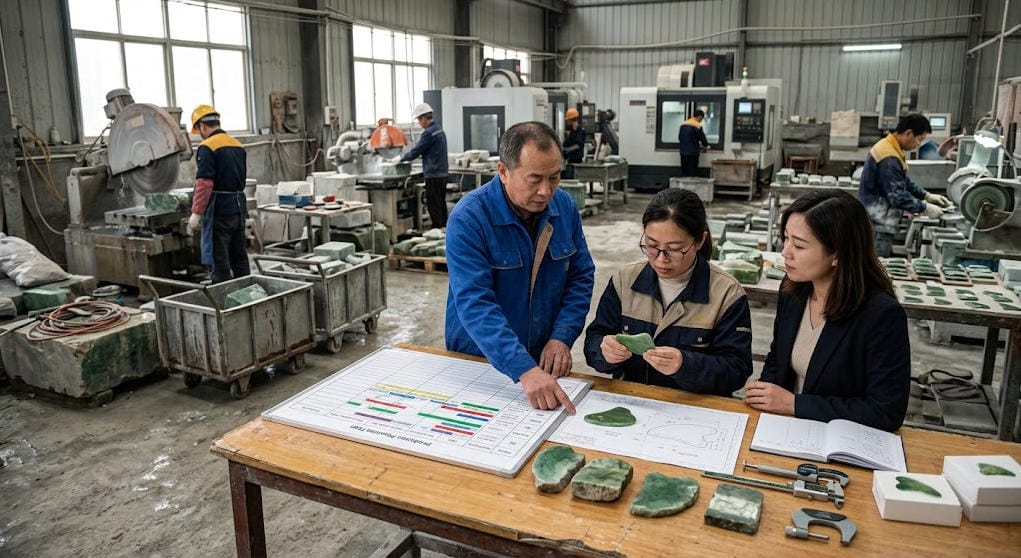
The weakest response any gua sha factory can give to “we need it fast and we need it right” is a flat “you can’t have both.” A more useful conversation breaks the request into three separate questions instead of treating it as one impossible ask, and it works whether you are managing gua sha production in-house or coordinating it through a partner factory.
Three Questions to Ask Before You Push Back on a Deadline
First, which requirements genuinely cannot be relaxed — no cracks, dimensions matching the drawing, correct logo, a product that functions as intended. Second, which requirements can be solved through better production planning rather than by cutting corners — faster machining cycles, better scheduling, pre-staged raw material, parallel processing steps, packaging prepared in advance, or additional inspection staff brought in for the run. Third, which requirements genuinely require you to make a choice — for example, a very tight color match usually adds a handful of days for extra sorting, so you can choose high color uniformity with a longer timeline, or accept natural color variation in exchange for faster delivery. This means the deadline conversation stops being a standoff and turns into a short list of specific, answerable trade-offs, which is exactly the negotiation a gua sha wholesale buyer should expect to have before, not after, a deposit is paid.
Two Extremes That Quietly Cut Real Output at Any Gua Sha Manufacturer
Two opposite failure modes show up constantly, and both quietly reduce the real efficiency of an order even though each looks efficient in the moment. Chasing speed alone — rushing production, rushing packing, rushing the ship date — looks fast on paper, but it tends to raise reject rates, customer complaints, rework, replacement shipments, returns, and lost trust, so the order’s true efficiency ends up lower than a properly paced one. Chasing perfection alone — rejecting every natural vein, discarding every faint color variation, reworking every minor cosmetic mark — drives down material yield, raises cost, extends the timeline, and reduces overall capacity, often for a standard your own customer never requested. This means the target worth aiming for isn’t “fastest” and it isn’t “flawless.” It’s the right quality standard delivered at a reasonable, sustainable pace — nothing more, nothing less — and that balance is what keeps gua sha production sustainable across repeat orders instead of just on one rush job.
Compliance Corner: Where GIA, IGS and SSEF Standards Fit Into a Gua Sha Wholesale Order
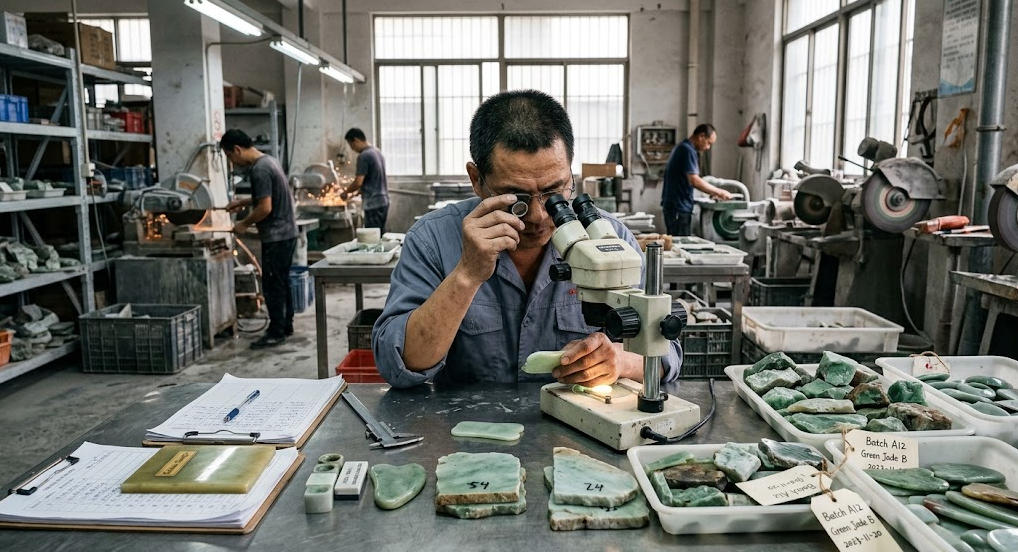
If your gua sha boards are made from natural jade, the material identification underneath your spec sheet matters more than most buyers realize, and it’s worth understanding even if you never order lab testing yourself. Jade is a general trade term covering two mineralogically distinct materials — jadeite and nephrite — plus green omphacite under certain conditions and the GIA gem encyclopedia entry on jade classifies these by different chemical compositions, hardness ranges, and refractive indices, rather than treating “jade” as a single uniform substance. Getting this identification right at the sourcing stage protects both your gua sha manufacturer’s material claims and your own resale claims downstream.
Why Independent Grading Changes What a Gua Sha Supplier Can Promise You
Independent laboratories work directly with color, transparency, and texture because those three factors are the primary drivers of value across the trade, and understanding them helps you evaluate whether a quoted material grade actually matches what you’re paying for. The GIA jade quality guide lays out how buyers assess color under different lighting, judge transparency, and weigh clarity against the presence of fractures. The International Gem Society’s nephrite reference goes further and documents small mineral inclusions and pale internal streaks as expected, natural characteristics of the material rather than defects — which is exactly the distinction a responsible gua sha supplier should be applying at final inspection instead of rejecting stone that meets spec.
What a Compliant Gua Sha Manufacturer’s Spec Sheet Should Reference
For higher-value or investment-grade natural stone orders, third-party laboratories such as the Swiss Gemmological Institute (SSEF) identify material through mineralogical and chemical testing methods including FTIR, Raman spectroscopy, and ED-XRF, and disclose whether a piece has been treated. SSEF’s published material on jade terminology also references the ISO-aligned Fei Cui testing standard adopted across parts of the Asian trade, which is one of the reference points a compliant sourcing standard can point to. This means that for a gua sha manufacturer working with higher-grade natural material, requesting written confirmation of stone type and treatment status — even without a full lab certificate — is a reasonable, low-cost step, and it’s one you’re entitled to ask for before committing to a large gua sha wholesale run.
Risk Disclosure: Questions to Ask Any Gua Sha Supplier Before You Sign
Every gua sha wholesale relationship carries some risk, and the honest way to reduce yours is to ask specific questions before the deposit goes out, not after production starts. This section exists because too many disputes in this category trace back to assumptions nobody checked at the quoting stage.
Red Flags in a Gua Sha Manufacturer’s Quote
A quote that promises both the fastest possible delivery and the tightest possible tolerance, with no mention of trade-offs anywhere, deserves a second look — the physics of sorting, cutting, and finishing natural stone don’t disappear just because a sales team wants the order. Similarly, be cautious of a gua sha factory that can’t tell you which stage of production a quality surcharge actually pays for, since a legitimate cost increase in gua sha production should map to a specific step: sorting, tooling, inspection staffing, or rework allowance. A refusal to provide or confirm a Golden Sample before a large production run is another signal worth taking seriously, since it usually means disputes over color and finish will surface only after the goods are already made.
What You’re Actually Responsible for Confirming
On your side of the table, the risk usually comes from vague specifications rather than a dishonest partner. If you send a request that only says “good quality” without dimensions, tolerances, and acceptable-inclusion language, you’re leaving the interpretation entirely up to the production floor, and that’s not a fair position to put either side in. This means your best protection isn’t a longer contract clause — it’s a spec sheet detailed enough that a stranger on the line could follow it, plus a confirmed Golden Sample everyone has physically seen before mass production starts.
About This Gua Sha Manufacturer — 12 Years on the Production Floor
Donghua has spent more than 12 years designing, processing, manufacturing, and selling natural jade and crystal gua sha tools as an origin factory rather than a trading intermediary. That structure means you’re working directly with the people running the sorting room, the machining line, and the QC bench of gua sha production, rather than through a layer that adds cost without adding control over your specification. If you’re evaluating a gua sha manufacturer for a gua sha wholesale program, that direct line between your spec sheet and the production floor is generally the detail worth checking first, ahead of price.
Frequently Asked Questions About Gua Sha Manufacturer Partnerships
1. What is a realistic gua sha lead time for a 5,000-piece wholesale order?
It depends heavily on which quality requirements are tightened, but a reasonable planning range for a standard natural-jade order sits between 20 and 30 days, with tighter color-matching typically adding several days to raw-material sorting rather than to machining.
2. How does a gua sha manufacturer control quality without slowing down every order?
By pushing consistency into fixtures, locked machining parameters, and a confirmed Golden Sample rather than relying entirely on a final visual check, which is the core idea behind the Tier 2 approach described above.
3. What’s the difference between a natural texture and a real defect in gua sha production?
A structural crack or an out-of-tolerance dimension affects function and safety; a faint natural vein or a small mineral inclusion is typically a normal characteristic of natural stone and doesn’t affect how the product performs.
4. Do gua sha suppliers require a Golden Sample before mass production?
A responsible one will recommend it, especially for color-sensitive orders, because it removes the ambiguity that causes most late-stage rework and disputes.
5. Can I request a faster lead time from a gua sha factory without lowering quality standards?
Often yes, if the extra time in the original quote was going toward optional Tier 3 requirements rather than Tier 1 safety and function checks — ask your supplier to break down the quote by stage before assuming speed and quality are mutually exclusive.