
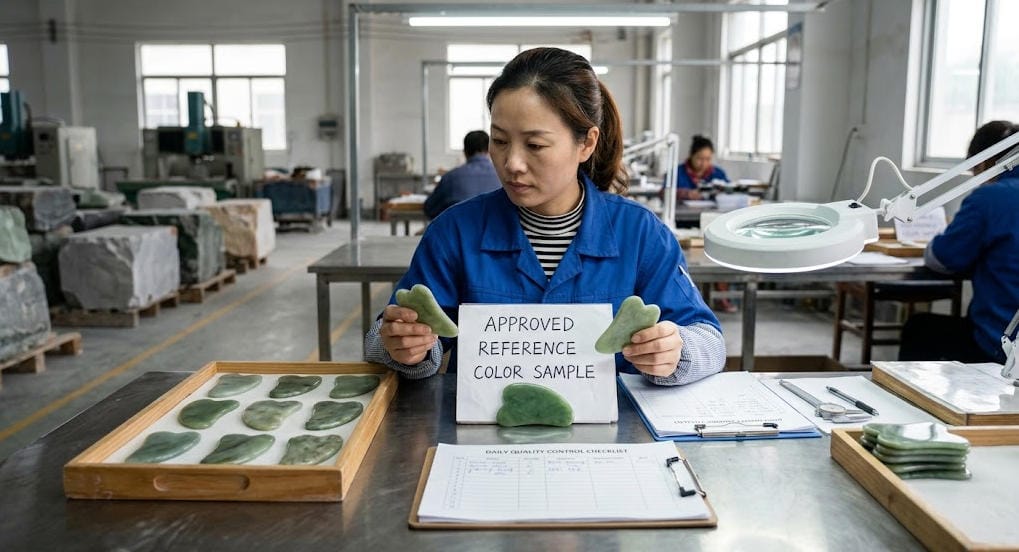
Natural stone color is not a single value that a gua sha manufacturer can guarantee from a color name alone. Terms like “light green jade” or “clear crystal” describe a range, not a fixed shade, because the minerals that produce those colors — chromium and iron in jade, iron combined with natural irradiation in amethyst — vary by mineral pocket, mining batch, and even by position within a single piece of rough material. This is precisely why ASTM D2244, the U.S. standard used to calculate color differences between materials, states that the purchaser and the seller shall agree on the permissible color tolerance and the method for calculating it before comparing samples, rather than leaving color acceptance to opinion after goods arrive. For a wholesale buyer, the real question is not whether natural stone gua sha tools will show some variation — they will — but whether that variation was defined in writing before production started. Without an approved color sample, the largest risk isn’t one bad batch. It’s a full production run that both sides can honestly believe is correct, and still argue about.
Natural Stone Color Is a Range, Not a Fixed Value
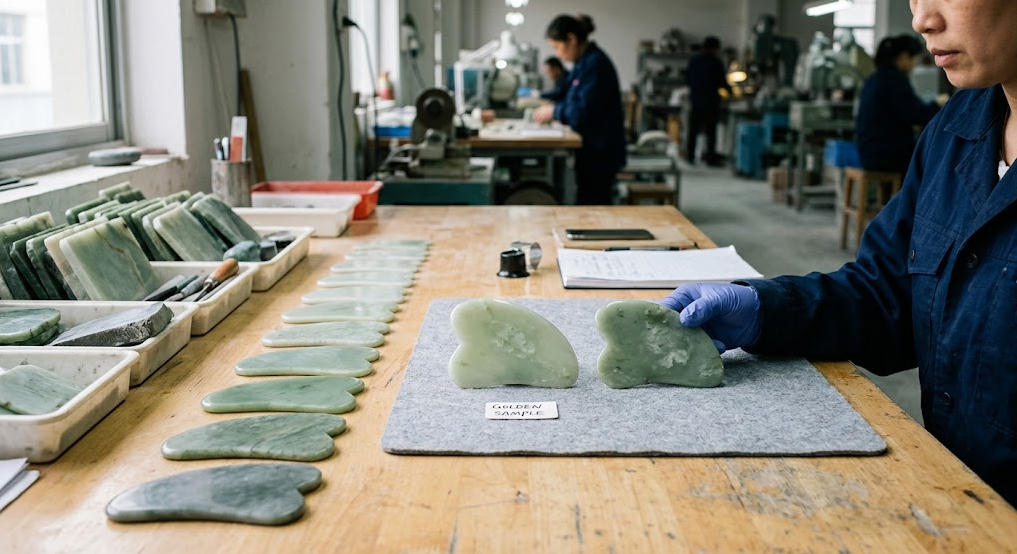
This is a documented mineralogical fact, not a manufacturing opinion. Nephrite jade, the material behind most “green jade” gua sha boards, is a calcium-magnesium silicate whose color runs from white to black depending on its exact chemistry, with the Wyoming State Geological Survey noting that variations in composition — from actinolite to tremolite — are directly responsible for that range. Trace amounts of chromite, magnetite, and other minor minerals sit inside the rock at concentrations below one percent, but they are enough to shift a stone from pale celadon to a deeper, grayer green, according to mineralogical data compiled by Mindat.org. Rose quartz, amethyst, and other crystal materials behave the same way for different reasons: amethyst’s purple comes from trace iron that has been altered by natural background radiation over geological time, and the amount of iron plus the duration of exposure both vary from pocket to pocket within the same deposit, as Geology.com explains in its overview of amethyst formation.
The practical consequence is that “white crystal,” “light green jade,” and “purple amethyst” are category labels, not color codes. Two pieces cut from the same mountain, sometimes the same boulder, can sit at different points on the same color range. A gua sha manufacturer working with natural material is not being imprecise when it describes a batch as “within normal variation” — it is describing a real physical property of the stone. The problem only appears when neither side has agreed, in advance, on where the edges of that acceptable range actually sit.
Why a Color Name Cannot Function as a Production Spec for Gua Sha Wholesale Orders
A recurring production issue is that buyers and factories genuinely picture different shades when they read the same English word. “Light green jade” might mean a soft mint tone to one buyer and a slightly deeper sage to a merchandiser who has seen a different reference photo on a supplier’s site. Color perception is also inherently subjective without a shared numerical system to describe it — this is well documented in gemology, where, as the International Gem Society explains, professional grading only became consistent once organizations like GIA broke color down into hue, tone, and saturation instead of relying on descriptive words alone.
For gua sha wholesale buyers sourcing from overseas, this gap is amplified by distance and by the fact that screens display color differently depending on calibration, lighting, and file compression. A product photo that looks pale jade-green on one monitor can look noticeably darker on another. When an order is confirmed on the basis of a written description or an uncalibrated photo, both sides can walk away from the same conversation with a different mental picture of “acceptable,” and neither one is wrong by their own definition. The dispute that follows is rarely about dishonesty. It’s about the absence of a shared, physical reference point that both sides checked before cutting stone.
Turning a Subjective Judgment Into an Objective QC Checkpoint
The fix used across serious stone processing is the Approved Color Sample, sometimes called a Golden Sample: a physical piece, confirmed by both the buyer and the gua sha supplier before mass production, that becomes the reference point for every batch that follows. Once this sample exists, quality control stops asking “does this look good?” and starts asking a narrower, testable question: “does this piece still fall inside the range we already agreed on?” That shift — from aesthetic judgment to a documented match-or-no-match check — is what makes color a manageable QC parameter instead of a debate.
In production, sorting teams compare incoming rough or semi-finished pieces against the physical reference sample under a single, consistent light source, because a common failure mode is comparing colors under different lighting and getting a different answer each time. Two materials that appear identical under one light source can appear distinctly different under another — a phenomenon called metamerism, which is specifically why ASTM D2244 recommends verifying instrumental color readings against a visual check when metamerism is suspected. This is an industry practice worth naming directly: color comparison done inconsistently — different rooms, different times of day, different bulbs — will produce inconsistent QC decisions even when the material itself hasn’t changed. A Golden Sample only works as a standard if it is checked under conditions that don’t change between comparisons.
Alongside the physical sample, a written description using a shared vocabulary — pale, medium, deep; warm-toned or cool-toned; the degree of visible veining or cloudiness — gives both sides a way to confirm the standard remotely when a physical sample can’t be shipped for every conversation. This doesn’t replace the physical Golden Sample; it supports it when quick decisions are needed mid-production.
Manufacturing Analysis: Where Color Variation Enters the Production Line
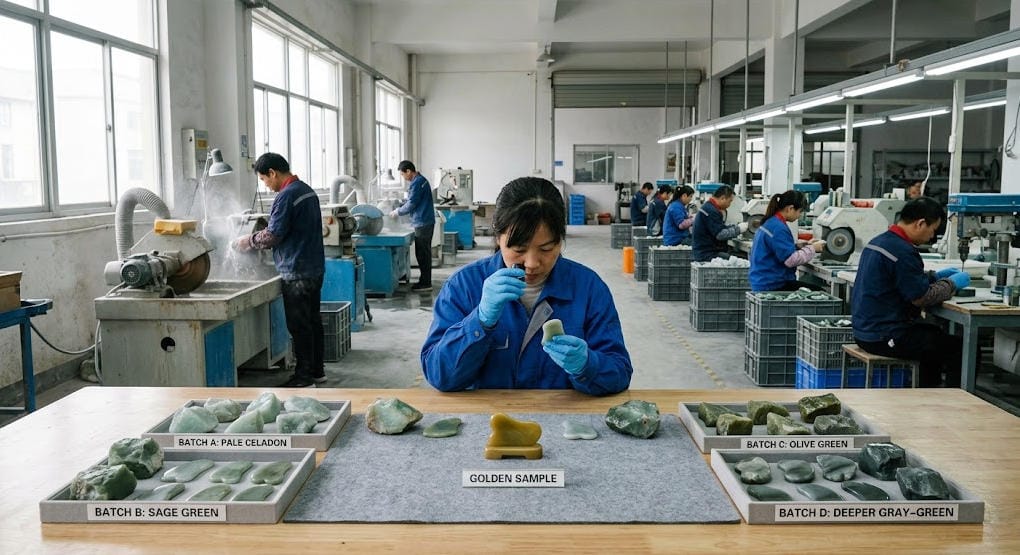
Color risk doesn’t appear at one single point in a gua sha order. It accumulates across several stages, and each one calls for a different kind of check.
Material Behavior: Why Even One Mine Produces a Range of Colors
As covered above, the chemistry inside a single deposit is not uniform. What this means for a guasha tools manufacturer buying rough material is that even a long-term, reliable stone supplier cannot promise perfectly uniform color across tons of raw material extracted over months. Grading rough material into color groups before cutting is a standard step precisely because the deposit itself doesn’t arrive pre-sorted.
Batch Variation and Raw Material Sorting Before Cutting
Large gua sha orders are rarely produced from one continuous piece of stone. Raw material typically arrives in separate lots — sometimes purchased weeks apart, sometimes from slightly different sections of the same quarry — and each lot needs to be checked against the Golden Sample before it enters the cutting line. If this sorting step is skipped, a factory can end up processing three material lots of visibly different depth into what is supposed to be one uniform SKU, discovering the mismatch only when finished pieces are laid out side by side.
How Grinding, Polishing and Drilling Can Shift Apparent Color
Grinding and polishing change more than shape — they change how light interacts with the surface, which changes how color reads to the eye. A rough or matte-finished piece often looks darker and less saturated than the same material after it has been polished to a smooth, glassy finish, because polishing increases translucency and surface reflection. During QC, this means a color check on unfinished blanks is not a reliable substitute for checking finished pieces; the same stone can appear to shift shade purely as a function of surface finish, with no change in the underlying mineral. Drilling for cord holes can also leave fine stone dust embedded in the hole and surrounding area, which, if not cleaned before inspection, can make a section of an otherwise correctly toned piece look artificially pale or dull under QC lighting.
QC Checkpoints: IQC, IPQC, OQC and the Reference Sample
A Golden Sample earns its value by being used consistently across the full production sequence, not only at the final inspection. Incoming Quality Control (IQC) checks raw material or semi-finished blanks against the sample before cutting begins. In-Process Quality Control (IPQC) checks color again after grinding and polishing, since, as noted above, finishing can shift how a color reads. Outgoing Quality Control (OQC) performs a final check before packaging and shipment, catching anything that passed earlier stages but drifted during handling or storage. Running the same reference sample through all three checkpoints is what allows a factory to say, with evidence rather than assurance, that a shipment matches what was approved at the start.
Illustrative Case Study: A 5,000-Unit Order Split Across Three Raw Material Batches
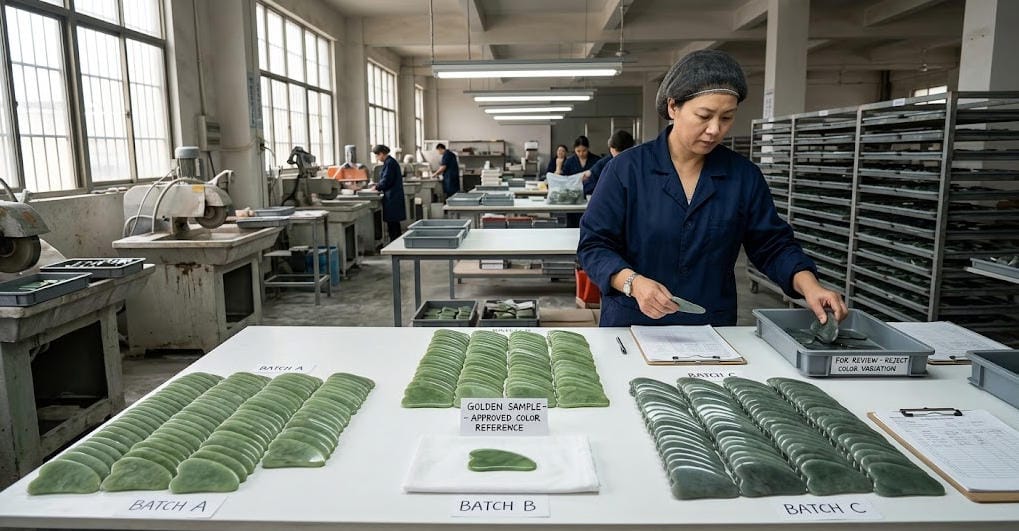
This is a real-world case study involving a European client. As the brand specializes in high-end, sophisticated beauty spas, it maintains rigorous standards for product quality. Due to commercial confidentiality, we are unable to disclose specific details about the client.
Situation. This brand orders 5,000 pieces of a green jade gua sha board, confirmed against a single Golden Sample and a product description reading “medium green, natural variation acceptable.”
Production Condition. Because of the order size, raw material arrives in three separate lots over six weeks: Batch A (lighter green), Batch B (matching the Golden Sample closely), and Batch C (visibly deeper green with more gray undertone).
Risk. Without a written color-range document — only the single Golden Sample and a verbal description — the factory’s cutting team treats all three batches as acceptable “green jade,” since none of them is an obviously different stone.
Detection. During OQC, an inspector lays finished pieces from all three batches side by side under one light source and notices that Batch C is visibly outside the tone range represented by the Golden Sample, while Batch A sits at the pale edge of what most buyers would still call “acceptable natural variation.”
Root Cause. The order was confirmed against one physical sample with no written boundary for how far lighter or darker a piece could go before requiring separate buyer approval — the gap identified earlier between having a reference point and having a defined range.
Corrective Action. Batch C is set aside and re-sorted; some pieces are downgraded to a separate, disclosed SKU rather than shipped as the confirmed color, and the buyer is notified before shipment rather than after delivery.
Result. The order ships roughly one week later than planned, with Batch C pieces sold at a reduced price under a disclosed secondary listing instead of being rejected outright or shipped without disclosure.
Lesson. A single physical sample answers “what does acceptable look like,” but it doesn’t answer “how far can this drift before it stops being acceptable.” Both questions need to be answered in writing before raw material purchasing begins, not after finished goods are on a pallet.
Cost, Yield and Lead-Time Risk When a Color Standard Is Missing
Color disputes carry a cost structure with both fixed and variable components. The fixed cost is administrative: time spent photographing disputed batches, exchanging emails, and negotiating a resolution — hours that don’t scale down for a small order and don’t scale up much for a large one. The variable cost tracks with order size and with how much of the batch is affected: sorting labor, potential re-cutting from fresh raw material, and the schedule impact of holding a shipment while the dispute is resolved.
As an illustrative calculation, not a reported figure: if a 5,000-piece order has 12% of units fall outside an undefined “acceptable” range — a plausible outcome given the batch variation described above — that’s 600 pieces needing a decision: ship as-is and risk a rejection, sort and delay, or scrap and re-cut from new material. Each path has a different cost, and none of them are available for negotiation once the goods are already packed and the ship date is close. Yield risk compounds this: a factory that doesn’t sort by color range early may not discover the shortfall until finishing is complete, at which point replacing the affected units means a new raw material cycle, not just a new shift on the polishing line. Lead-time risk follows directly — the point at which a color mismatch is discovered determines whether it costs a day or costs a month.
What “Acceptable Natural Variation” Actually Means
This is where a color standard has to do real work, because “natural variation is acceptable” is not the same statement as “any color is acceptable.” Industry practice on this point is that an approved sample defines a center point, and the written standard defines how far a batch can move from that center — slightly lighter or slightly darker along the same hue — before it requires separate buyer sign-off. What generally falls outside that range is a shift in hue itself: a piece that reads yellow-green instead of green, a jade that shows unexpected gray or brown undertone, or a crystal piece with visibly more cloudiness than the reference sample.
This distinction matters because it protects both sides from two different failure modes. A buyer who treats every natural variation as a defect will reject a normal portion of any natural-stone order and strain the relationship with a gua sha factory that is producing correctly. A factory that treats “natural stone always varies” as a blanket excuse can ship material that has genuinely drifted outside what was agreed, and call it normal. A written range — expressed in relative terms like “one shade lighter or darker than the Golden Sample is acceptable; a shift in undertone requires approval” — gives both sides the same test to apply.
Order Size and Color Risk: Why a Gua Sha Supplier Treats 100 Pieces Differently From 5,000
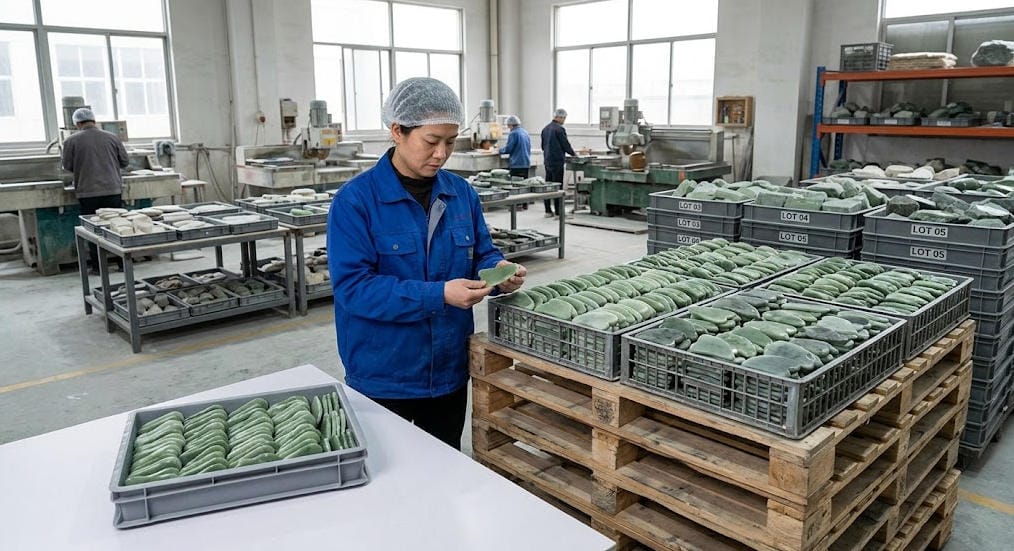
Color tolerance isn’t a fixed policy; it scales with quantity. A 100-piece order is usually produced from a small, contiguous run of raw material, so the natural range within that batch tends to be narrow simply because there’s less material and less time involved. A 5,000 or 10,000-piece order almost always draws from multiple raw material lots purchased over weeks, which mechanically increases the chance that the batch spans a wider slice of the mine’s natural color range.
For a brand buying at that scale, the product being purchased isn’t 5,000 individual gua sha boards — it’s 5,000 units that need to look consistent together on a retail shelf, in e-commerce photography, and across repeat SKU orders placed months apart. A visible color split within one shipment shows up in customer photos, in return requests, and in the gap between the product photo and what actually arrives. The larger the order, the more a gua sha manufacturer’s sorting discipline — not just its raw material quality — determines whether the finished shipment reads as one consistent product line.
A Color Standard Also Protects the Gua Sha Manufacturer, Not Just the Buyer
It’s worth stating plainly that a color standard isn’t a one-directional concession from factory to buyer. Once a Golden Sample and a written range are confirmed by both parties before production, the factory has a defined basis for every color decision made afterward. If a buyer later claims a shipment is “too dark,” the conversation has something concrete to return to: does this batch fall inside the agreed range, measured the way both sides agreed to measure it, or does it not? Without that reference, a factory is exposed to an open-ended standard — “make it look right” — that can be redefined after the fact by whichever side is more dissatisfied with the outcome. A written standard closes that gap for both parties equally.
A Practical Decision Framework: Building a Color Standard Package With Your Guasha Tools Manufacturer
A single Golden Sample is a starting point, not a complete standard. Before committing to production, especially at wholesale volume, it’s worth assembling a fuller package with a supplier:
- Physical Golden Sample — the primary reference, confirmed and retained by both sides.
- Reference photography — taken under consistent, disclosed lighting, for remote confirmation between physical sample checks.
- A written natural-variation description — stating what range of tone, veining, or transparency is acceptable relative to the Golden Sample.
- Documented unacceptable examples — a short, specific description or photo of what would count as outside range (hue shift, unexpected gray or brown, excess cloudiness).
- Material grade notes — so a lower grade of the same stone type isn’t substituted into an order confirmed on a higher grade.
- Batch records — tracking which raw material lot went into which production run, so a color issue can be traced back to its source.
- A defined QC checkpoint plan — specifying at which stage (IQC, IPQC, OQC) color is checked, and by whom.
A workable written clause for a purchase order or production agreement can be built around language like this: color must remain within the approved Golden Sample range; natural variation in tone, veining, inclusions, and transparency is acceptable within the agreed range; a clear deviation in hue or overall appearance requires buyer approval before shipment. The specific wording matters less than the fact that it exists in writing and both sides signed off on it before raw material purchasing began — that’s the step that turns “we’ll know it when we see it” into something a QC team can actually apply.
The Bottom Line
Natural stone color problems in gua sha production almost never come from bad material. They come from two parties agreeing on a color name without agreeing on a color range, and discovering the gap only after a full batch is finished. A physical Golden Sample, a written variation range, and a checkpoint plan that runs from incoming material through outgoing inspection turn a subjective argument into a question either side can answer by checking a sample. For a buyer weighing suppliers, the more useful question isn’t “does this factory work with natural stone” — most do — but “does this factory confirm a color standard before cutting begins, and can it show how that standard gets checked at each stage of the order.”
Faqs About Gua Sha Manufacturer Color Samples
1. Why does the color of natural stone gua sha tools vary between batches?
Natural crystal and jade get their color from trace minerals like chromium and iron, whose concentration varies by mine, batch, and even within one piece of rough material. This makes color a natural range, not a fixed shade, which is why a written standard matters before production.
2. What is a Golden Sample in gua sha manufacturing?
A Golden Sample is a physical piece confirmed by both buyer and manufacturer before mass production. It becomes the reference point QC checks every batch against, turning color approval from a subjective opinion into an objective, repeatable comparison.
3. How much color variation is acceptable for natural stone gua sha products?
Acceptable variation usually means being slightly lighter or darker than the Golden Sample along the same hue. A shift in hue itself, such as added gray, brown, or yellow undertone, typically falls outside range and requires buyer approval.
4. Does natural color variation mean a gua sha product has a quality problem?
Not necessarily. Natural stone is expected to show some variation in tone, veining, and transparency. The real issue is not variation itself, but whether that variation was defined and agreed upon before production started.
5. When should a buyer request a color sample from a gua sha supplier?
Before mass production begins, ideally during the development sample stage. Confirming a Golden Sample early lets QC check raw material and finished pieces against one agreed standard through IQC, IPQC, and OQC.
References
- ASTM International. D2244 Standard Practice for Calculation of Color Tolerances and Color Differences from Instrumentally Measured Color Coordinates.
- Wyoming State Geological Survey. Jade.
- Mindat.org. Nephrite: Mineral Information, Data and Localities.
- Geology.com. Amethyst: The Most Popular Purple Gem, February Birthstone.
- International Gem Society. What Does the GIA Colored Gem Grading Code Mean?
Written by the Manufacturing Content Team — production and quality-control specialists working across natural stone (crystal, jade, agate) and stainless steel gua sha tool manufacturing, drawing on direct sourcing, cutting, polishing, and QC process observation.
Manufacturing Disclaimer: This article was prepared by a gua sha manufacturing team to share general industry information about color standards and production risk in natural stone gua sha tools. It is intended to be educational and objective rather than promotional. Some figures, such as the batch percentage and cost example in the case study section, are illustrative estimates used to explain a risk pattern and do not represent verified production statistics or a specific real order. Actual outcomes depend on the specific stone material, mine source, order quantity, processing methods, equipment, and the quality-control standards agreed between buyer and supplier. References to ASTM D2244 describe a voluntary technical practice used in color-difference measurement; this article does not constitute legal, regulatory, or compliance advice, and buyers with specific certification or standards requirements should confirm directly with the relevant standards body or a qualified professional.