
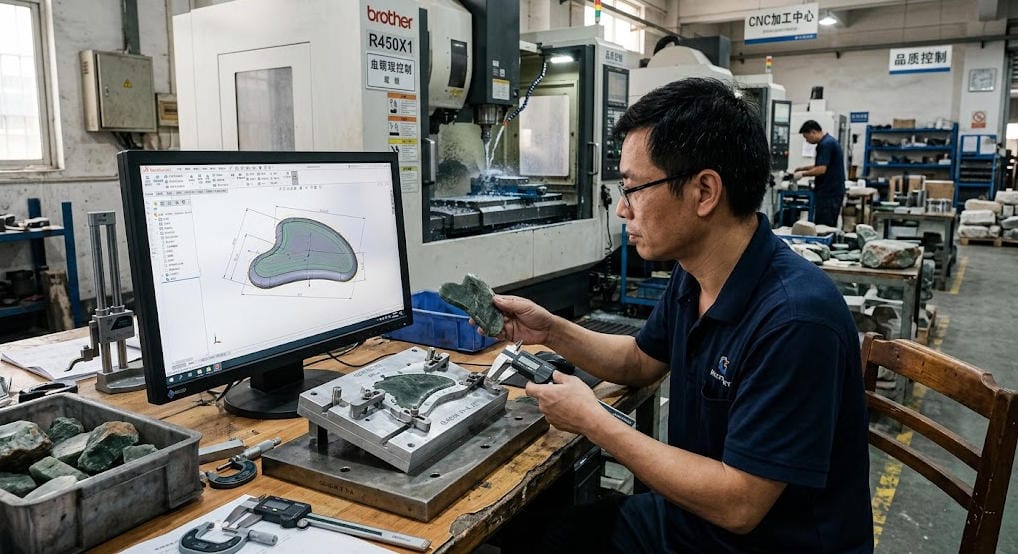
When you request a gua sha custom order under 500 pieces, the price per piece rises for a reason that has nothing to do with markup. It comes down to fixed costs that refuse to shrink no matter how few units you order. This is the exact cost breakdown Donghua walks customers through before quoting a low moq gua sha custom run, because a single new shape can carry roughly $300 in front-end development work — mold or fixture setup, CNC programming, and first-article confirmation. Spread across 100 pieces, that cost adds $3.00 to each unit. At 300 pieces, it drops to $1.00. At 500 pieces, it falls to $0.60. At 5,000 pieces, it shrinks to just $0.06. You are not paying for “more crystal.” You are paying to unlock a cost structure that only becomes efficient once volume clears a certain threshold — and that threshold sits closer to 500 pieces than most buyers expect.
Why Fixed Costs Refuse to Shrink on a Small Gua Sha Custom Order
The Line Items Hidden Inside Every New Gua Sha Custom Mold
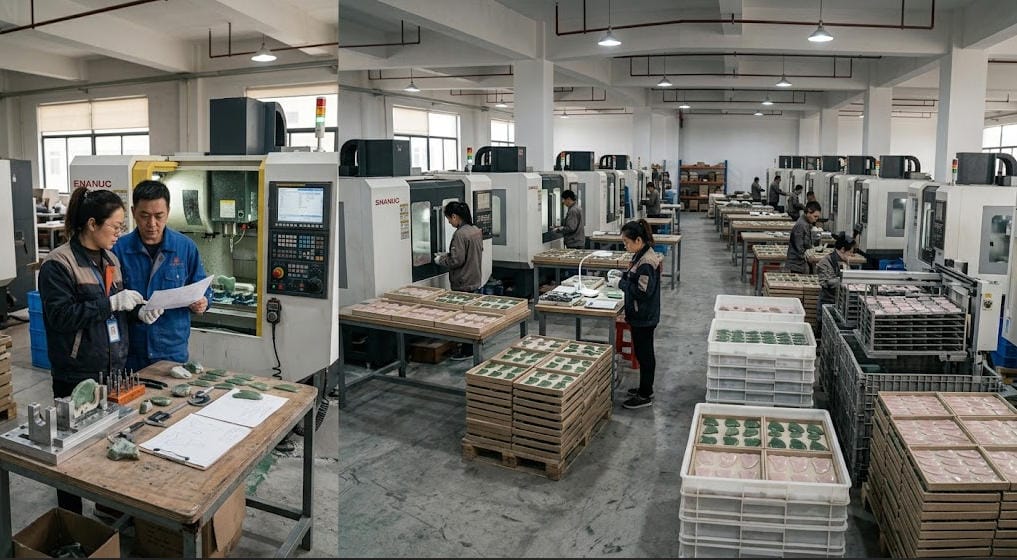
Ask any gua sha manufacturer what happens before the first finished piece rolls off the line, and the answer rarely starts with cutting stone — it starts with paperwork, programming, and testing that has almost nothing to do with quantity. Your new shape needs a 3D or CAD file translated into machine language, a CNC program written and tested, a jig or fixture built to hold the stone, and a first article checked against your approved design before mass production begins.
None of that work scales down just because your order does. This means you absorb the same development labor whether you order 300 pieces or 30,000 — the difference is only how many units that labor gets divided across. A jig takes the same number of hours to build for a 300-piece run as it does for a 3,000-piece run, and a CNC program needs the same testing cycles either way. This means your per-piece price on a small gua sha custom batch isn’t inflated — it’s simply carrying a heavier share of costs that a bigger order would spread thin.
Packaging setup, QC standard creation, and abrasive or tool calibration for a new stone shape add further weight to that same fixed pile. Should a factory be expected to absorb these costs quietly just to win a small order? Most can’t do that without cutting corners somewhere else in the process, and that’s rarely the trade-off you want on a custom project.
What the Numbers Look Like Once You Divide Them Per Piece
Take the $300 development example and follow it through four order sizes. At 100 pieces, that cost lands at $3.00 per unit — a number that can double or triple your total unit price on a simple design. At 300 pieces, it falls to $1.00. At 500 pieces, it drops to $0.60. At 5,000 pieces, it becomes nearly invisible at $0.06 per piece.
This progression tells you something a simple “quantity discount” explanation misses. The jump from 500 to 5,000 pieces isn’t really “10 times the volume” in cost-structure terms — it’s a jump into a different pricing logic, one where fixed costs stop dominating the math. This means your negotiating leverage is strongest not at rock-bottom quantities, but right at the point where fixed costs finally get diluted enough to stop controlling your price — the same point Donghua flags for buyers comparing a custom quote against standard gua sha wholesale pricing.
If you’re planning a private label gua sha launch and testing the market with a small run, understanding this curve helps you set realistic expectations before requesting quotes — and helps you read a factory’s pricing sheet the way a production planner would, not just as a buyer comparing sticker prices.
The Combination Every Gua Sha Factory Struggles With Most
What a Standard High-Volume Run Looks Like Inside a Gua Sha Factory
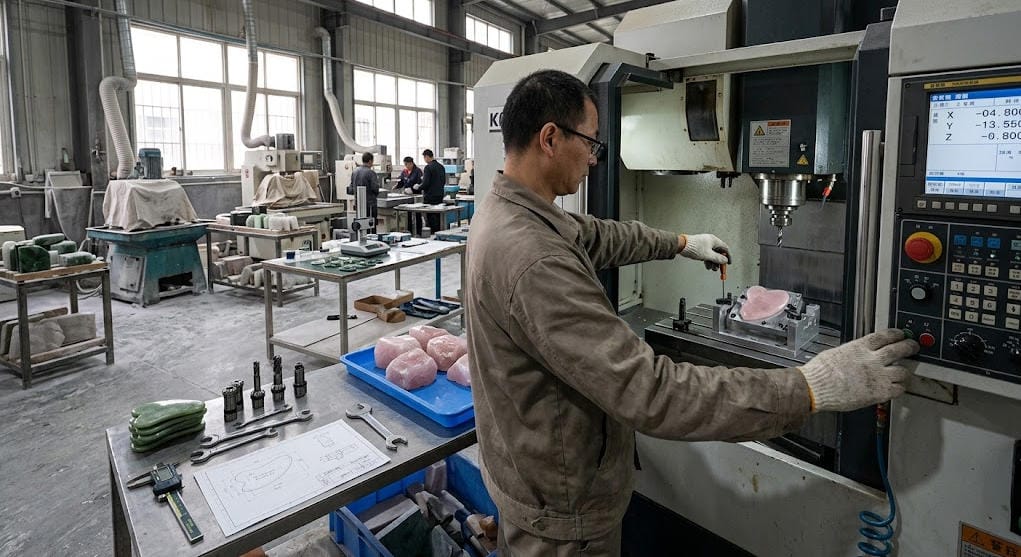
Most factories have a clear preference, and it isn’t a secret: standard products at high volume, or custom products at high volume. Both let a gua sha factory set up once and run for days without stopping to rethink the process. What actually strains production isn’t customization by itself, and it isn’t low volume by itself — it’s the two arriving together on the same purchase order.
A standard product at 5,000 pieces means the operator sets the machine once, and the line runs continuously. A custom shape at 5,000 pieces still means one setup, just with more upfront engineering to get there — but that engineering cost, as covered above, gets buried under volume. This means a gua sha manufacturer can commit real time to solving your design properly, because the payoff justifies the effort. Neither of those two scenarios strains a plant the way a small custom order does.
Why a 300-Piece Gua Sha Custom Order Behaves Like a 30,000-Piece Project
Here’s where it gets counterintuitive: the engineering workload for a 300-piece gua sha custom order can look almost identical to the workload for a 30,000-piece order of the same design. Say you send over a 3D file for an asymmetrical shape nobody has produced before, at a quantity of 300 pieces. The factory still has to work out how to hold the raw stone during cutting, where the CNC bit should enter, which zones are prone to chipping, which curves need hand-finishing over machine polishing, and how to keep edges consistent across all 300 units.
None of that thinking gets easier just because the run is smaller. Would you expect an architect to spend less time on blueprints for a small building than a large one, if both buildings share the same complexity? Usually not — and the same logic applies here. This means your 300-piece order can occupy a production engineer’s attention for nearly as long as a run ten or a hundred times its size, without generating the revenue that would normally justify that time.
That mismatch is exactly why some suppliers hesitate on complex custom shapes below a few hundred units, and why others quietly build the development cost into the unit price rather than billing it separately. If your project involves a genuinely new geometry — not a small variation on an existing tool — expect the quote to reflect engineering hours, not just material and polishing time. From a gua sha factory‘s side, those hours are real regardless of your order size.
Natural Stone Turns Your Low MOQ Gua Sha Custom Order Into a Yield Problem
Why Crystal and Jade Never Behave Like Plastic or Metal
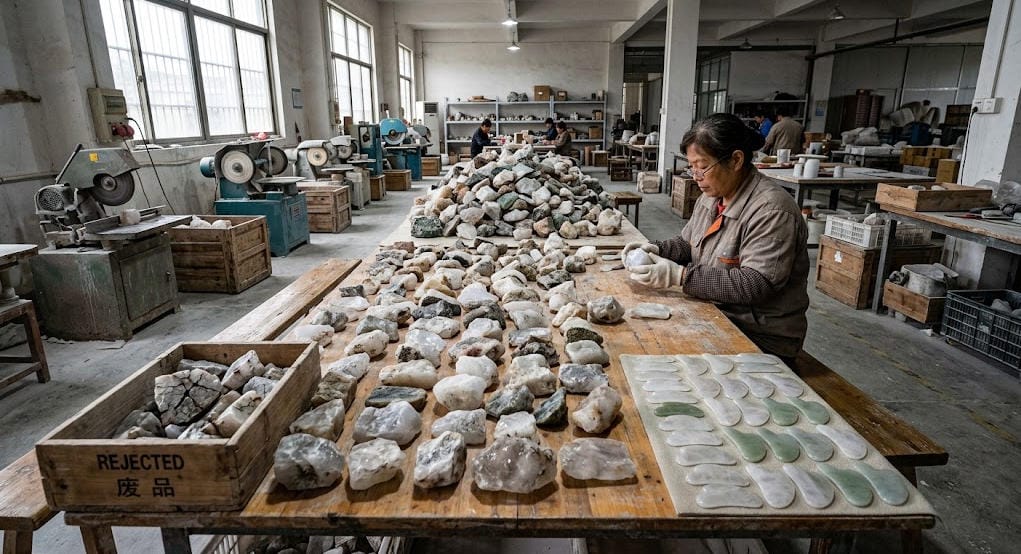
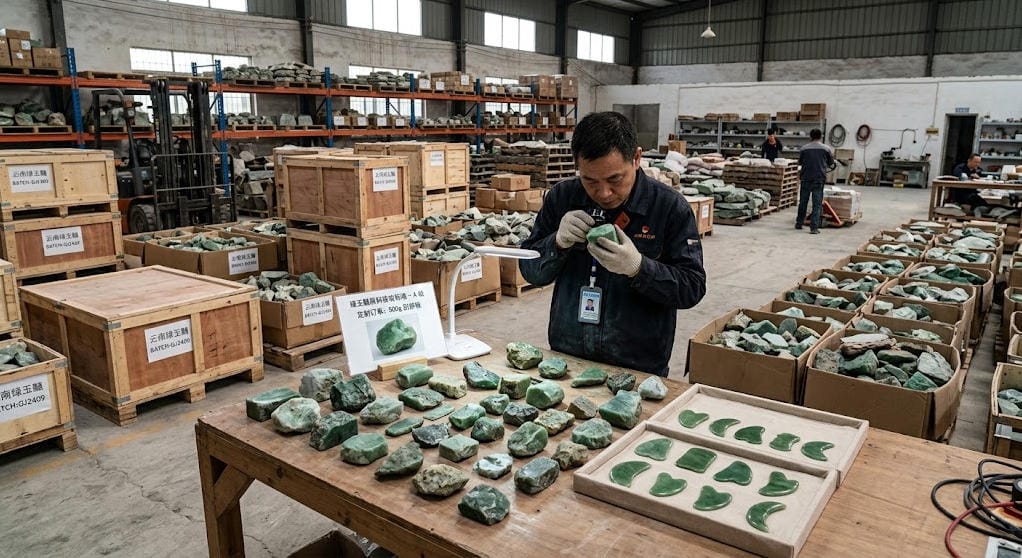
If your material is quartz, jade, agate, or another natural stone, low-volume custom work gets harder still. Natural material carries color variation, crystal-structure differences, internal cracks, cloudy inclusions (“cotton”), density variation, and inconsistent transparency, even within stone pulled from the same mine. Rock crystal quartz commonly forms with inclusions of other minerals during crystallization — a trait the International Gem Society describes as typical of common rock crystal, which only becomes rare and valuable in large, flawless pieces. Jade behaves similarly: GIA’s jade quality factors page notes that matching color, transparency, size, and symmetry across a set of pieces is genuinely difficult for manufacturers — a challenge that only intensifies as batch size shrinks.
How Much Raw Material a 300-Piece Gua Sha Custom Order Really Consumes
Suppose you want all 300 pieces made from high-transparency clear quartz, with color and texture matched as closely as possible across the batch. In practice, a supplier may need to source 400 to 500 pieces’ worth of raw material — sometimes more — just to sort, process, and eliminate stones that don’t meet your matching standard before 300 finished pieces come out the other end. This means your requested 300-piece gua sha custom order can translate into far more raw material purchasing than the order quantity alone suggests.
That gap is why low MOQ never automatically means low material consumption. For high-loss, high-risk natural stone customization, yield — the percentage of raw material that survives processing and grading to become a finished, sellable piece — matters more than the number printed on your purchase order. A 300-piece order with a 60% yield rate consumes roughly the same raw material as a 500-piece order with an 85% yield rate, even though the finished quantities look nothing alike.
Should you ask your supplier for their expected yield rate before finalizing a low moq gua sha custom quote? It’s one of the more useful questions you can ask, because a quote that ignores yield risk is a quote likely to change once cutting actually starts. If you’re sourcing through gua sha wholesale channels for a private label brand, building yield assumptions into your cost model early — rather than after the first batch comes back short — saves you from renegotiating mid-production.
Why a 300-Piece Gua Sha Custom Run Costs a Factory More Time Than the Order Justifies
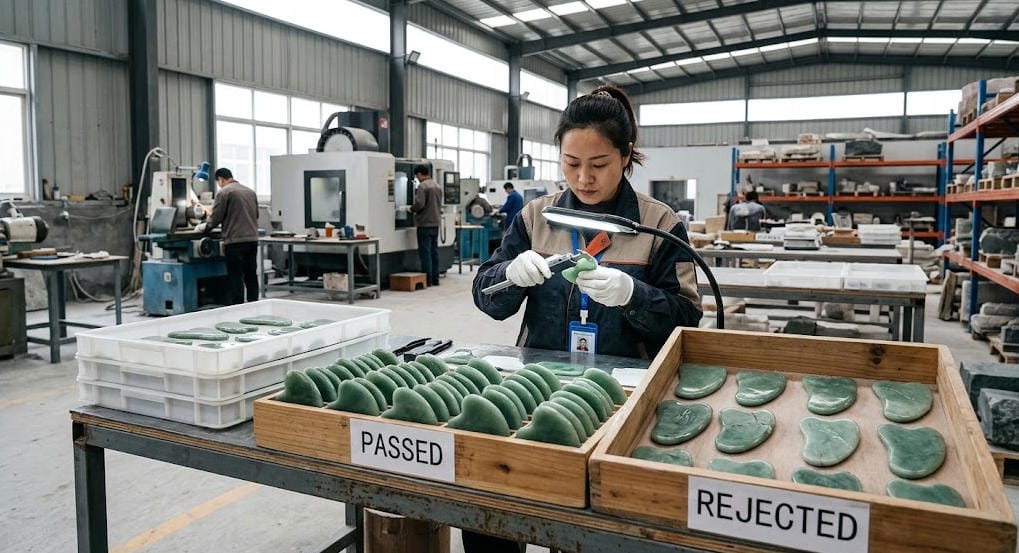
Changeover Math: What Machine Setup Time Actually Costs
Picture a single production line moving stone through six stages: loading, CNC shaping, coarse grinding, fine grinding, polishing, and quality control. A large order lets that line run for days without stopping. A small order breaks that rhythm before it ever really starts.
On a 5,000-piece run, a factory might spend roughly 4 hours on machine setup and then 40 hours on continuous production — setup accounts for about 9% of total floor time. This means the fixed changeover cost gets absorbed so thoroughly that it barely shows up in your per-piece price. Run the same math on 300 pieces, and the picture flips: 4 hours of setup against only 4 hours of production, pushing changeover time to roughly 50% of the entire job.
That’s not a small difference — it’s the line item that decides whether an order feels routine or disruptive to a gua sha factory‘s schedule. Would you accept a 50% overhead charge on any other line item in your supply chain without asking why it’s there? Most buyers wouldn’t, yet setup time rarely appears as its own number on a quote; it usually gets folded quietly into the unit price instead.
From the supplier’s side, a small gua sha custom batch isn’t simply “less production” — it’s often “adjust the machine, run a short batch, adjust again.” On a genuinely new shape, that sequence can repeat through a first article, parameter revisions, and only then real production. If your production planner quotes more lead time than you expected, this changeover math is very likely why — not a lack of urgency on the factory floor, but a gua sha factory line that genuinely spent half its time adjusting rather than producing.
The Hidden MOQ Mismatch Behind Every Low MOQ Gua Sha Custom Order
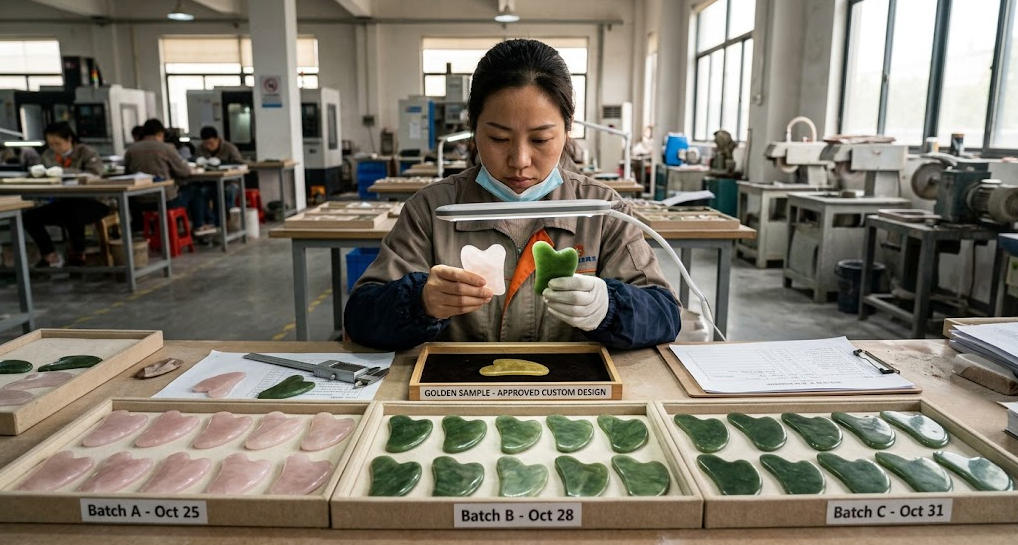
Why a Gua Sha Manufacturer Buys in Bulk Even for Your Small Order
Here’s a detail that surprises a lot of first-time buyers: your order quantity and your supplier’s purchasing quantity are two completely different numbers. Raw material suppliers carry their own MOQs, and a gua sha manufacturer has to meet those minimums regardless of how small your finished order is.
Say you need 300 pieces of green jade gua sha tools. To source stone at the grade and color range your design calls for, a supplier may need to purchase 500 kilograms — sometimes a full metric ton — simply because that’s the minimum lot a quarry or trader will sell, then sort and grade that lot down to the 300 pieces that meet your spec. At Donghua, this mismatch gets walked through with customers before a quote is finalized, because raw-material MOQ often decides whether a small jade order is even feasible without adjustment. This means your low quantity order doesn’t translate into a low quantity purchase upstream.
Who Actually Carries the Leftover Inventory Risk
That gap between your order size and the supplier’s purchase size doesn’t disappear — it lands somewhere, usually as unsold raw material sitting in the supplier’s storage after your 300 pieces ship. This means a gua sha manufacturer is effectively carrying two risks on your order at once: small-order revenue paired with large-batch inventory exposure. Should that risk factor into your price? It generally does, whether or not it’s itemized on your invoice.
If you’re comparing quotes across different gua sha wholesale partners, ask directly how each sources material for your specific stone type and color range. A supplier working from existing inventory prices differently than one sourcing a fresh lot purely for your low moq gua sha custom order, and knowing which situation you’re in helps you negotiate from an informed position instead of guessing at where the number came from.
Why Low-Volume Gua Sha Custom Orders Are More Sensitive to Defect Rates
The Math Behind Scrap on a New Product
Every production run loses some pieces to scrap — chips, cracks, dimensional errors, or polish that misses standard. What changes at low volume is how much that scrap actually costs you per surviving piece. Take a complex gua sha design with $8 per piece in material and processing cost as a working example.
On a 5,000-piece run with a 5% defect rate, roughly 250 pieces get scrapped, spread across 4,750 good pieces — a manageable dent in total cost. On a 300-piece run of a brand-new shape, defect rates commonly run higher during the debugging phase, sometimes reaching 10% while operators fine-tune technique on unfamiliar geometry — roughly 30 pieces lost out of 300, spread across a far smaller base of survivors. This means the lower your order quantity, the more painfully each scrapped piece shows up in your final unit cost, not because quality control gets sloppier, but because there’s less volume to absorb the learning curve of a new shape.
What a Higher Defect Rate at Low Volume Really Costs You
At 5,000 pieces and 5% scrap, the loss adds a small, predictable percentage to total cost. At 300 pieces and 10% scrap, that same $8-per-piece loss on 30 units represents a meaningfully larger share of order value — often enough to change whether a quoted price actually holds once production wraps.
Is a higher defect estimate on your gua sha custom quote a sign of inexperience? Usually not — it’s frequently the opposite. A gua sha manufacturer such as Donghua that quotes a realistic scrap allowance on a new low-volume shape is telling you it has actually run the debugging math, rather than promising a number that won’t survive first production. This means your best move isn’t chasing the lowest defect estimate on paper, but asking how it was calculated.
Why Low MOQ Gua Sha Custom Orders Are Harder to Keep Consistent, Not Easier
What Changes in a Small Gua Sha Custom Batch Between Day 1 and Day 3
It’s a reasonable assumption on paper: a 300-piece order should be easy to keep uniform, since there’s so little of it. In practice, natural stone production doesn’t reward small batches with easy consistency — often the opposite happens. Low-volume runs rarely get a single, stable production window; instead, they get spread across shorter, interrupted sessions.
Picture 100 pieces produced on day one, another 100 on day two, and the final 100 on day three. Between sessions, small variables can shift: edge rounding, thickness, curve transitions, polish sheen, color, and the degree of hand-finishing applied can all drift depending on which technician is working that day. Texture plays into this too — GIA’s buyer’s guide to jade notes that jadeite’s texture ranges from fine to coarse depending on natural crystal-size variation, part of why two pieces cut from adjacent stone don’t always polish identically. This means uniformity on a natural-stone gua sha custom order takes deliberate process control — it doesn’t happen automatically just because the order is small.
The Extra Inspection Steps Real Consistency Requires
If you’ve specified that all 300 pieces need to look and feel closely matched, your supplier can’t simply rely on a fast production run to get there. Real consistency at low volume requires more first-article confirmations, more mid-production checkpoints, and a final side-by-side comparison pass before packing — steps that add labor hours a large, continuous run wouldn’t need in the same proportion.
This means the tighter your consistency requirement on a small gua sha custom batch, the more inspection labor gets built into your unit price — not because the quote is padded, but because verified consistency at low volume is genuinely labor-intensive to deliver. If matched appearance matters for your private label gua sha line, ask your supplier exactly which inspection steps they include by default and which cost extra. That answer, more than any gua sha wholesale price list, tells you what you’re actually paying for.
Why Packaging Becomes the Real “Small Order Trap” in Private Label Gua Sha Projects
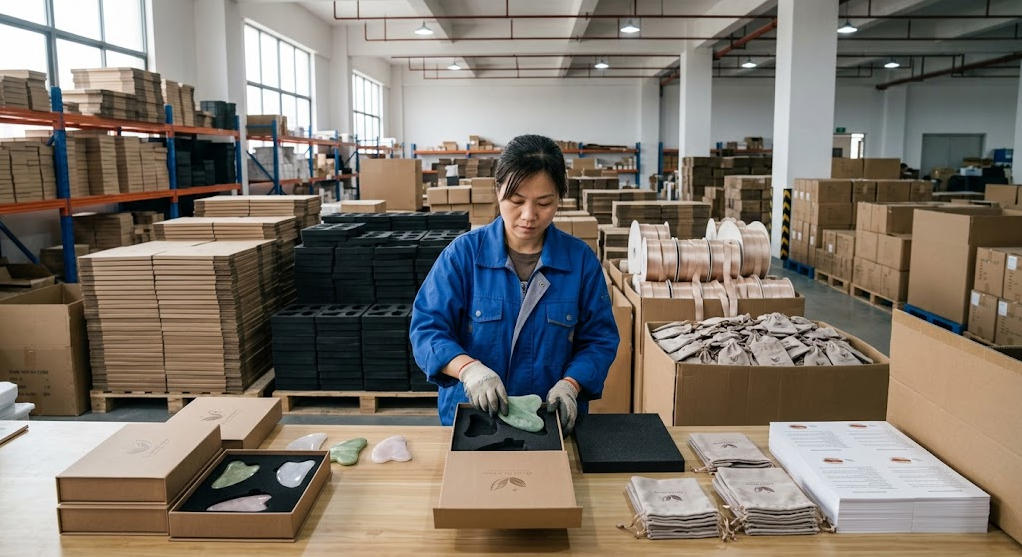
When Custom Boxes Need Their Own MOQ
If your order includes a custom rigid box, EVA inner tray, embossed logo, printed instruction card, satin ribbon, or a branded pouch, 300 pieces rarely gets you a favorable packaging unit price — even when the stone itself is priced fairly. Packaging suppliers run their own minimums, and many won’t quote custom rigid boxes or EVA inserts below 1,000 units at a reasonable cost.
This means your supplier can face the same mismatch on packaging that shows up on raw material: your finished order is 300 pieces, but the packaging purchase has to be 1,000. That leaves roughly 700 boxes with nowhere to go — sitting in storage, billed to you as a lump sum, or absorbed as risk by the factory hoping you reorder. When someone in this industry says “under 500 pieces isn’t easy,” they’re often describing a packaging supply chain never designed for orders this small — a very different problem than the one most buyers assume they’re solving.
Who Absorbs the Leftover Packaging
Here’s the practical question worth asking before you finalize a private label gua sha launch: who is actually responsible for those extra 700 boxes if you only reorder once, or not at all? In many cases, the answer defaults to the factory, and that risk gets priced into your quote whether or not it’s itemized as a separate line.
You have a few ways to reduce this exposure. Standard-size boxes with a printed sleeve or sticker carry far lower MOQs than fully custom rigid packaging, and neutral packaging with your logo as a separate label lets you commit to smaller print runs while still building brand recognition on shelf. This means you don’t need to abandon a branded look just because your first order is small — choose which packaging elements to customize now, and which to standardize until volume grows. If your goal is a recognizable private label gua sha line from day one, ask which packaging components carry the lowest MOQ threshold, and build your first order around those constraints.
The Opportunity Cost Behind Every Gua Sha Custom Quote
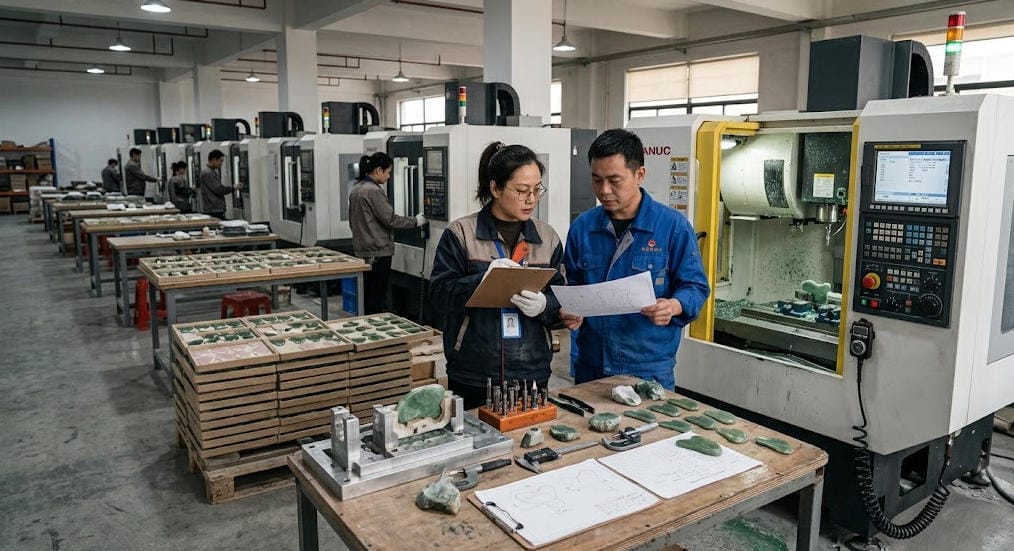
What One CNC Machine Could Be Doing Instead
A factory doesn’t evaluate your order in isolation — it weighs what else that same machine and engineering time could be doing during the hours your order occupies them. A single CNC machine running a 5,000-piece standard order can run for many continuous hours with minimal supervision. That same machine running a 300-piece gua sha custom order needs programming, setup, a first-article sample, a pause for your approval, quality control, cleanup, and a changeover back to whatever runs next.
This means the real question a gua sha factory weighs isn’t only “how much profit does this 300-piece order generate” — it’s “how many production hours across how many machines does this order consume, compared to what else could fill that same time.” That second question is opportunity cost, and Donghua factors it into every low moq gua sha custom quote even though it rarely appears as a line item on the page.
Why “How Much Will This 300-Piece Order Earn” Is the Wrong Question
If you’re negotiating price on a small gua sha custom run, framing the conversation purely around margin misses half of what your supplier is pricing. Is a lower unit price achievable if your order occupies less exclusive machine time — say, by fitting into a scheduling window between two larger runs rather than demanding priority handling? Often, yes.
This means flexibility on your delivery timeline can be worth more in negotiation than volume alone, whether you’re buying through gua sha wholesale channels or placing a fully custom order. A gua sha manufacturer willing to slot your order into open capacity, rather than clearing a line specifically for it, can frequently offer a better price because the opportunity cost drops. Asking “is there a production window where this order fits more efficiently” is more productive than asking for a flat discount, because it addresses the actual constraint driving the price.
The 500-Piece Threshold: A Practical Reference, Not a Rule
Reading the Volume Bands Correctly
Many suppliers treat 500 pieces as an informal dividing line, but it’s a practical economic threshold rather than an industry-wide standard carved in stone. If you’re phasing a private label gua sha catalog in gradually, this table doubles as a rough roadmap for where each SKU sits:
| Order Volume | What Typically Happens |
|---|---|
| Under 100pcs | Closer to a sample or trial run than production |
| 100–300pcs | Small-batch custom; fixed costs dominate the price |
| 300–500pcs | Early signs of production economics kicking in |
| 500–1,000pcs | Most custom projects become noticeably easier to run |
| 1,000–5,000pcs | Process, material, and defect costs dilute meaningfully |
| Above 5,000pcs | Closer to full-scale production logic |
This means your quote won’t jump smoothly with volume — it tends to move in steps, with the steepest drops clustered around the lower bands where fixed costs still dominate.
What Actually Decides Gua Sha Custom Difficulty
Volume alone doesn’t determine how hard your order is to produce. A more accurate way to estimate difficulty multiplies several variables together: design complexity, material risk, processing method, expected yield, packaging requirements, and order quantity. Two 300-piece orders can sit at completely different difficulty levels — a simple symmetrical shape in stable material behaves nothing like an asymmetrical design in high-variance natural stone, even at identical quantities.
This means the most useful question to bring into a quote conversation isn’t “what’s your MOQ,” but “given this specific design and this specific material, where does my quantity land on your difficulty curve.” That question gets you a far more accurate answer than a generic minimum-order number ever could, and it signals to your supplier that you understand what’s actually driving the price.
How Donghua Helps You Plan a Gua Sha Custom Order That Works at Low Volume
You don’t have to solve every variable in this article on your own before requesting a quote. Sharing your target quantity, material preference, and design complexity upfront lets a gua sha manufacturer flag yield risk, packaging MOQ mismatches, and realistic defect allowances before you commit — not after production starts. Donghua has spent over twelve years processing, designing, and manufacturing crystal and jade gua sha tools at the source, and that background gets used less to sell a minimum order and more to help you land on a quantity and design combination that actually makes sense for your budget and timeline.
If your gua sha custom project is still in the planning stage, the more useful conversation happens before quoting, not after: which parts of your design carry real engineering complexity, whether your chosen stone has a yield profile suited to your target quantity, and which packaging elements can stay standardized until your order size grows. Independent gemological standards from organizations like GIA and SSEF — SSEF has spent over five decades building scientific methods to verify gemstone material and support consistent quality standards across the trade — also give you a framework for asking sharper questions about material grading, even when you’re sourcing decorative tools rather than fine jewelry stones.
Gua Sha Custom FAQ: Quick Answers Before You Request a Quote
1. Is 300 pieces too small for a gua sha custom order?
Not necessarily — but expect a higher per-piece price than 500 or 1,000 pieces, driven by fixed development costs and lower material yield rather than markup.
2. Does low MOQ gua sha custom always mean lower total spend?
No. Between raw material minimums and packaging MOQs, a small finished order can still require large upstream purchases, which is why total project cost sometimes surprises first-time buyers.
3. What’s the fastest way to lower my unit price on a small custom order?
Simplify geometry where possible, choose stable material with predictable yield, standardize packaging you don’t need custom on day one, and ask where your order fits into open production capacity.
4. Should I buy through gua sha wholesale channels instead of going low MOQ custom?
It depends on your goal. Standard-design gua sha wholesale purchasing benefits from pooled volume and lower per-piece cost, while a low moq gua sha custom order carries the fixed-cost and yield trade-offs covered throughout this article — but it’s the only path to a genuinely differentiated private label gua sha product.