
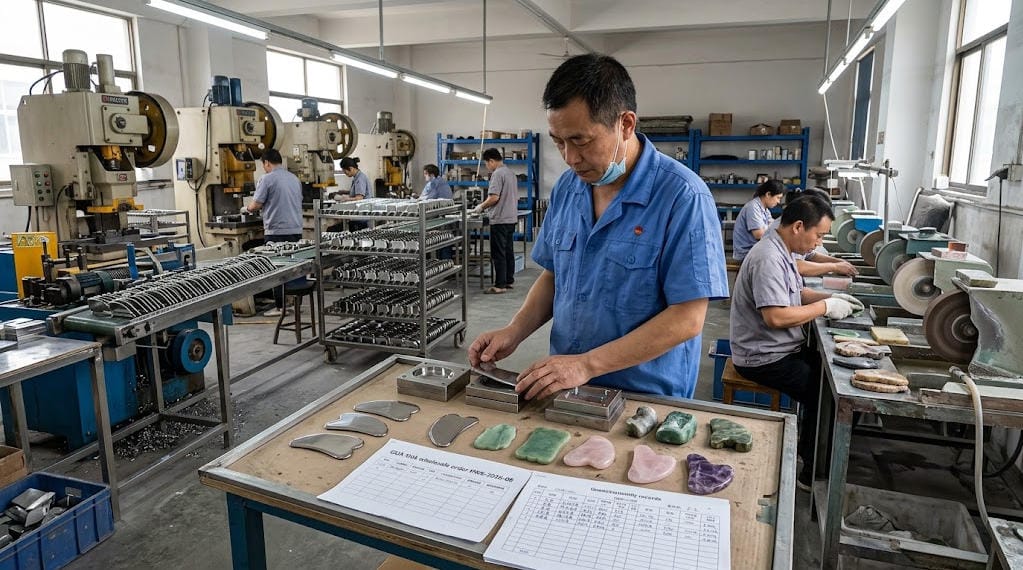
If you’ve compared quotes from more than one gua sha manufacturer, you’ve probably noticed something that doesn’t add up. Stainless steel tooling for a standard gua sha board usually runs under $400. Jade and crystal tooling usually stays under $100. On paper, the material with the cheaper tooling should win on price at any order size. In practice, once your order crosses roughly 1,000pcs — already considered a large order in today’s gua sha wholesale market — the opposite tends to happen: your stainless steel unit price falls faster, and by 3,000 to 5,000pcs it can land below the jade or crystal quote you expected to win. This isn’t a pricing trick. It comes from how each process is actually built, and that structure, not the headline mold fee, is what protects your margin.
How a Gua Sha Manufacturer Actually Prices Mold and Tooling Fees
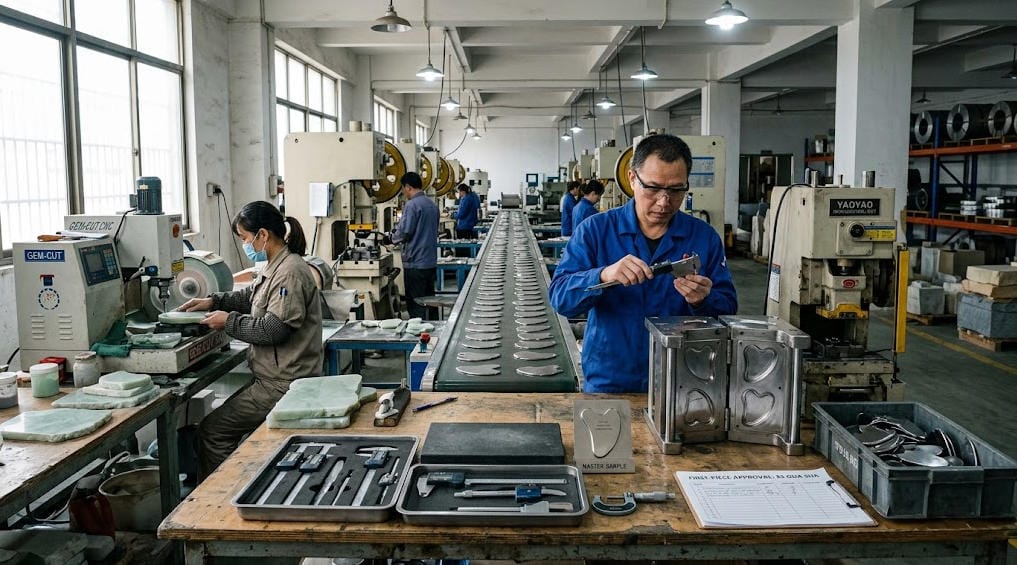
Every quote you receive from a gua sha manufacturer starts with a simple question on the factory floor: how many operations does this shape require before it’s ready to ship? For a stainless steel gua sha board made by stamping or press-forming, that answer usually points to a metal mold, and mold fees for a standard board typically land under $400. For jade or crystal, there’s no metal mold to speak of — the tooling line item mostly covers first-piece cutting, shaping, and polishing setup, and it typically stays under $100. Neither number is arbitrary. Both come from the actual labor and machine time needed to get the very first usable piece off the line. This means you can stop assuming the cheaper tooling quote automatically points to the cheaper finished product — the tooling fee only tells you about piece #1, not piece #1,000.
Stainless Steel Tooling: Typically Under $400
A stainless steel mold for a gua sha board involves tool steel, CNC machining, heat treatment, and trial runs before it’s approved for production. Depending on the complexity of the shape — a simple oval board versus one with fluted edges or an integrated handle — this fee can vary, but for most standard designs it stays under $400. You’re paying for a tool that will physically stamp or press every single unit that comes after it. This is the same reason Donghua quotes repeat customers a lower blended price on reorders without renegotiating the whole deal — the mold cost simply isn’t there to renegotiate a second time.
Jade and Crystal Tooling: Typically Under $100
Jade and crystal don’t pass through a stamping mold in the same sense. Instead, a jade gua sha manufacturer cuts rough material into a blank, shapes it on a CNC or lapidary wheel, and polishes the first sample by hand before confirming your approval. That entire first-piece process usually costs under $100. It looks cheaper on your quote sheet, and technically it is cheaper — but it’s a different kind of cost. It’s development labor, not a reusable tool. This means every piece afterward still requires a version of that same cutting-and-polishing work, just repeated, not skipped.
Why 1,000pcs Already Counts as Volume in the Gua Sha Wholesale Market
In many manufacturing categories, “large order” means tens of thousands of units. That’s not the reality in gua sha production. Ask any established gua sha factory and you’ll hear the same threshold: 1,000pcs is where an order starts being treated as a large batch, with production scheduling, material bulk-purchasing, and tiered pricing all kicking in. This matters because it changes how you should read a mold-fee comparison. At 1,000pcs, a $400 stainless steel mold adds about $0.40 to your unit cost. A $100 jade or crystal tooling fee adds about $0.10. That’s a $0.30 gap — real, but small enough that it rarely decides your final unit price by itself. This means you shouldn’t be shopping tooling fees at all once you’re above 1,000pcs; you should be shopping something else entirely, which is what the next section covers.
The Real Driver Behind Your Final Price: Variable Cost, Not Mold Fees
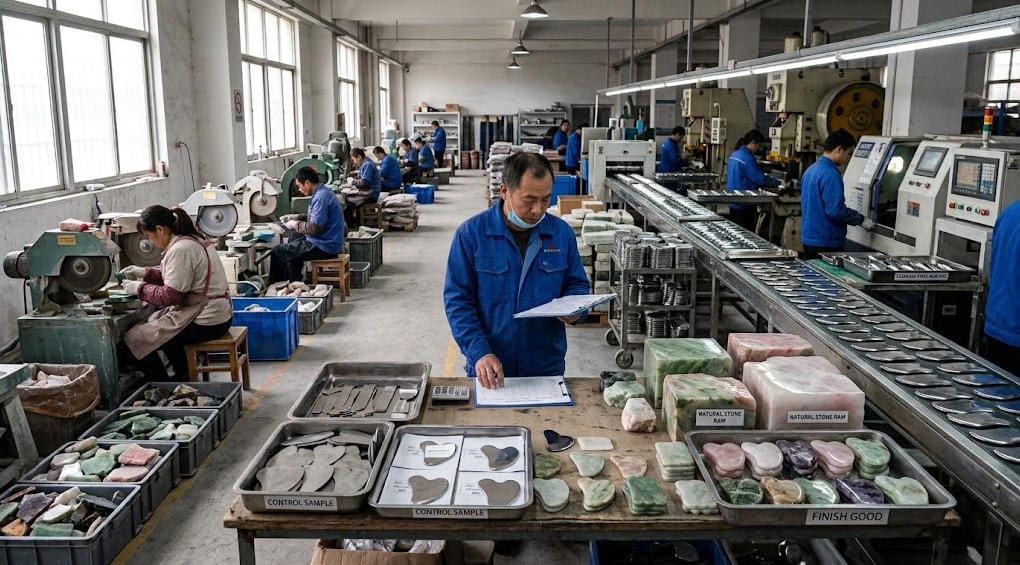
Here’s the part most buyers miss when comparing a stainless steel guasha manufacturer against a jade or crystal supplier: total cost isn’t just tooling plus a flat per-piece rate. It’s tooling divided across your order, plus a variable cost that behaves completely differently depending on the material. Once you separate these two numbers, the real pricing pattern becomes obvious — and it has almost nothing to do with the $300 gap in mold fees.
The Formula Every Gua Sha Factory Uses to Quote You
Behind every quote sheet sits the same basic formula: total cost equals fixed cost plus variable cost multiplied by quantity. A gua sha factory working in stainless steel has a fixed cost around $400 and a variable cost per piece that keeps dropping as batch size grows, because stamping, CNC finishing, and polishing all get faster and more consistent with repetition. A factory working in jade or crystal has a lower fixed cost, around $100, but its variable cost stays comparatively flat, because natural material can’t be stamped, and every piece still needs individual cutting, grading, and polishing attention. Run the math at 5,000pcs and you’ll usually find stainless steel pulling ahead — not because its tooling was cheaper, but because its per-piece cost dropped further. This means that if you’re negotiating on mold fees alone, you’re negotiating over the smaller half of the equation.
Where Stainless Steel Pulls Ahead
Stainless steel’s variable cost drops because the same mold, the same sheet thickness, and the same polishing sequence repeat identically on unit 1 and unit 10,000. Machine setup time gets amortized, labor per piece falls as operators move faster on a repetitive task, and defect rates tend to stabilize once a run is underway. Is that dramatic on any single unit? Not really. But multiplied across a 5,000-piece order, it adds up to a measurable price advantage. This means your quote should get noticeably better, not just proportionally better, as your order size increases with a stainless steel guasha manufacturer.
Where Jade and Crystal Stay Flat
Jade and crystal variable costs resist that same downward slope, and the reason isn’t a lack of effort on the production floor — it’s the raw material itself. Two blocks of rough jade, cut with identical parameters, can still produce two visually different pieces because of natural veining, color zoning, or internal structure. That variability means cutting, grading, and polishing labor stays roughly constant per piece no matter how large your order gets. So why doesn’t scale rescue jade and crystal pricing the way it rescues stainless steel? Because scale only reduces costs that come from repetition — and cutting a living, unrepeatable material isn’t one of those costs.
What a Stainless Steel Guasha Manufacturer’s Mold Fee Actually Pays For
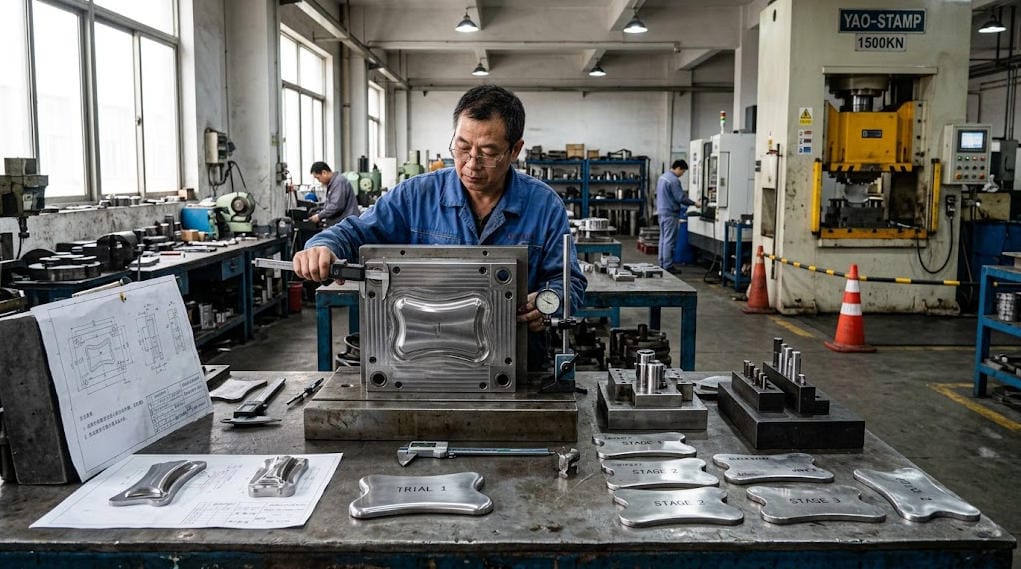
A $400 quote line labeled “mold fee” can feel abstract until you know what it’s buying. It’s worth breaking down, because understanding this is what lets you negotiate with a gua sha manufacturer instead of just accepting or rejecting a number. At Donghua, this breakdown is exactly what buyers tend to ask for once they’ve already compared a few quotes.
Tool Steel, Heat Treatment, and Trial Runs
The mold itself starts as a block of tool steel, machined to the exact geometry of your board, then heat-treated to survive thousands of stamping cycles without deforming. After machining, the tool goes through trial runs — test stampings that get measured, adjusted, and re-tested until the output matches your approved sample. For a straightforward oval or fan-shaped board, this whole sequence typically fits inside that $400 figure. For a design with fluted edges, an integrated handle, or asymmetric curves, the machining time goes up and so does the fee. This means the complexity of your design — not the material itself — is often the bigger lever on your actual tooling cost.
Fixtures That Ride Along With the Mold
Depending on your product, a stainless steel guasha manufacturer may also need positioning jigs, CNC fixtures, or polishing fixtures that work alongside the main mold. These are usually smaller costs than the mold itself, but they belong to the same fixed-cost category — built once, used repeatedly, never billed again once amortized. Worth asking your supplier directly: does this fixture cost carry over to future SKUs, or is it locked to this one design? The answer changes how you should plan variations on your next order.
Why This Cost Never Repeats
Once your mold and fixtures pass approval, they sit on a shelf between production runs, ready to be reused on your next order without a second tooling invoice. This is the entire reason the $0.40-per-piece figure at 1,000pcs shrinks to roughly $0.04 at 10,000pcs — the numerator stays fixed at $400 while the denominator grows. This means your second order, and every order after it, only carries the tiny remaining fraction of that fee, not the full charge again.
What a Jade Gua Sha Manufacturer Calls “Tooling” Is Really First-Piece Development
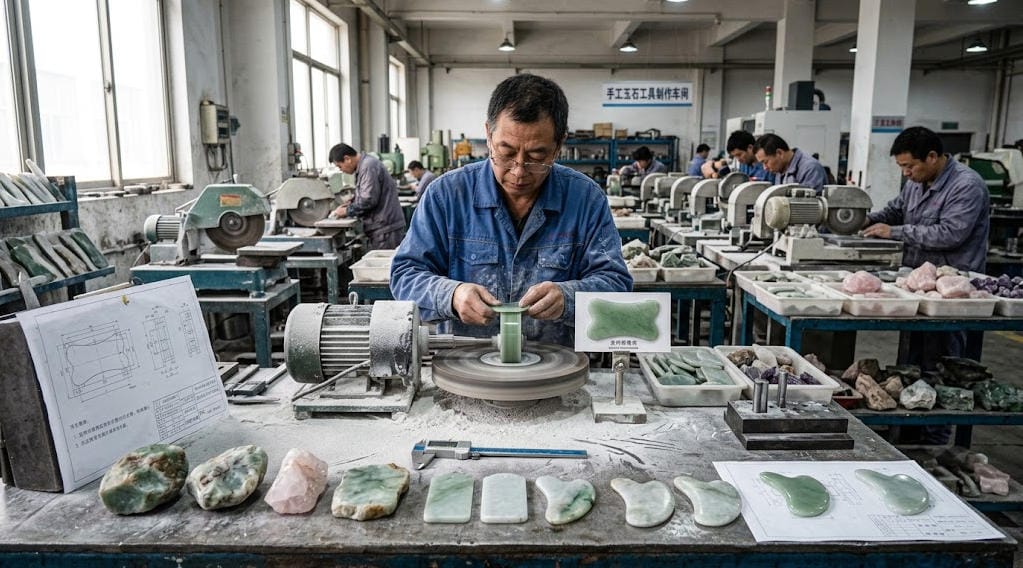
When a jade gua sha manufacturer quotes you a tooling fee under $100, it’s tempting to read that as a bargain. It isn’t wrong, exactly — it’s just a different category of cost hiding under a familiar label. Nothing about that quote is a stamping tool sitting on a shelf, ready to punch out identical parts. It’s development labor spent once, and then, in a different form, spent again on every unit that follows.
Cutting, Shaping, and Polishing Aren’t Mold Costs
Getting your first approved jade or crystal sample typically involves rough-material selection, cutting to a blank, CNC or lapidary shaping, hand polishing, and a final fit check against your reference design. Each step costs money and time, and together they land under $100 for most standard gua sha shapes. But here’s the catch: none of that work gets stored in a reusable tool. Your second piece needs its own cutting pass, its own shaping pass, its own polishing pass. This means the $100 you paid didn’t buy a machine that repeats your design — it bought a proven recipe that a gua sha factory still has to re-run by hand on every single unit.
Why a Lower Tooling Quote Doesn’t Mean Lower Total Cost
A buyer comparing tooling line items side by side might conclude jade and crystal are the cheaper option outright. That conclusion only holds if you stop reading the quote after the first line. Once you add up per-piece cutting, grading, polishing, and finishing labor across your full order, the picture changes — often significantly, once volume passes a few thousand pieces. So which number should actually guide your sourcing decision: the $100 tooling fee, or the per-piece cost that repeats itself thousands of times? For any order past 1,000pcs, it’s the second one, every time.
Why Natural Material Yield Keeps Pushing Jade and Crystal Costs Up
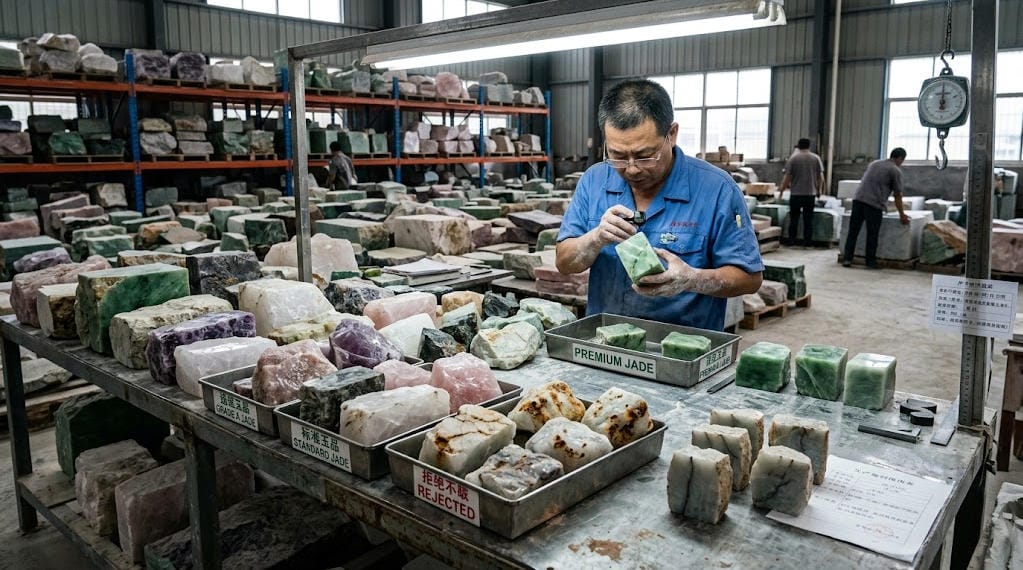
This is the section that matters most if you’re placing a large order in jade or crystal, because it explains why your unit price won’t keep falling the way a metal-tooled product’s would. It comes down to one fact no polishing technique can fully engineer around: natural stone is not uniform.
Every Block of Rough Is Different — and Gemology Confirms It
This isn’t a claim unique to any one gua sha manufacturer — it’s documented gemological fact. According to GIA’s jade quality guidance, jadeite’s texture ranges from fine to coarse depending on variations in crystal size and hardness within the stone, which is why two pieces cut from different rough blocks can look and feel different even under identical processing. The International Gem Society describes clarity grading as the practice of assessing small mineral inclusions, hollow areas, and fractures that occur naturally inside a gemstone — the same categories of variation a jade gua sha manufacturer has to sort through, piece by piece, before a single unit ships. This means the color and texture differences you sometimes see across a jade product batch aren’t a quality-control failure. They’re the documented behavior of the material. GIAInternational Gem Society
What Happens When Pieces Fail Grading
Picture 100 blocks of rough jade entering production. Some carry visible cracks. Some show color zoning that won’t match your reference sample. Some have internal cloudiness that only surfaces once cutting begins. In a typical run, a meaningful share of that rough — not a rare exception — won’t reach A-grade output, and you’re not just paying for the pieces that pass; you’re paying for the material and labor spent on the pieces that didn’t. Does that make natural stone a worse material to work with? Not necessarily — it makes it a different one, with a cost structure a metal-stamped product simply doesn’t carry. This means your quoted unit price for jade or crystal already has to account for this loss, which is exactly why it can’t drop as sharply as stainless steel’s does at volume.
Color and Clarity Matching Multiplies the Problem
If your order requires tight color and clarity consistency across thousands of units — a common ask for private-label buyers — the raw-material sourcing burden goes up again. SSEF, the Swiss Gemmological Institute, notes that its work centers on detecting gemstone authenticity, origin, and treatment on a scientific and reproducible basis — a reminder of how much natural variation exists even within a single gem category, enough to require dedicated laboratory science to sort through it. A gua sha factory matching thousands of units to one target shade has to source more rough material than the order technically requires, simply to have enough acceptable pieces left after grading. This means tight color-matching requests should come with an expectation of higher per-unit cost, not just a longer lead time. SSEF
Why a Stainless Steel Guasha Manufacturer Scales and a Gua Sha Factory Working in Stone Cannot
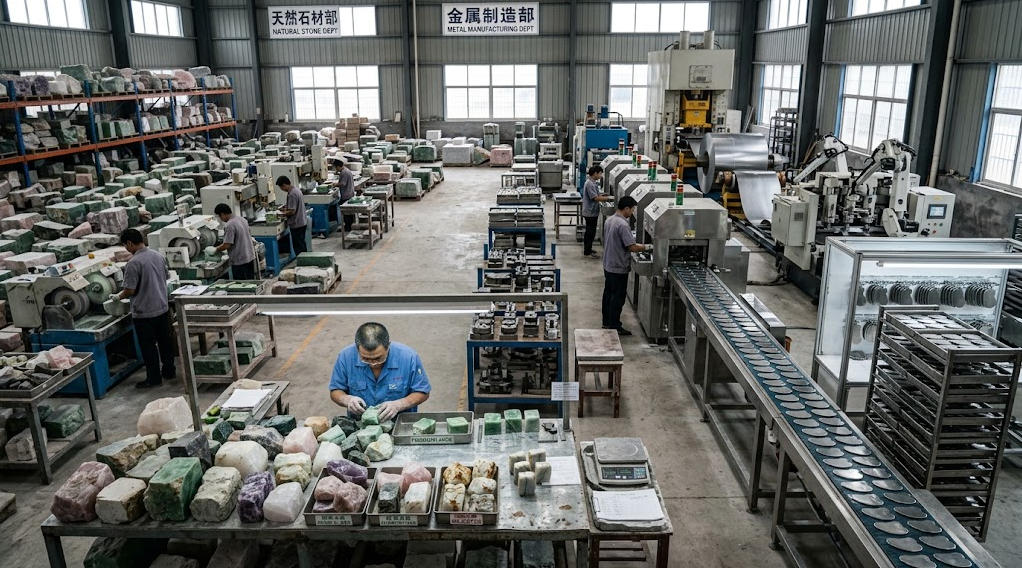
Put the two production models side by side and the divergence at scale becomes easy to see. One is built around repeating an identical action. The other is built around making thousands of non-identical inputs land in the same place.
The Repeatable Production Line
A mature stainless steel guasha manufacturer runs a linear sequence: coil or sheet stock, stamping, CNC or shape-finishing, deburring, polishing, cleaning, inspection, packing. Buyers running both stainless steel and jade lines through a single supplier, such as Donghua, often use this predictability to plan reorder timing months in advance. At tens of thousands of units, the same mold, the same sheet thickness, the same polishing parameters, and the same inspection checklist repeat without modification. This means the economics only get better as your order grows — there’s no natural ceiling on how far the curve bends downward within a normal production run.
Why Natural Stone Resists Standardization
Stainless steel production aims for uniformity: every unit should be functionally and visually identical. Natural jade and crystal production aims for something harder — consistency despite variation, not the elimination of it. Even with identical CNC parameters, two pieces of rough can produce different results because their internal structure was never identical to begin with. That’s why human inspection and grading remain load-bearing parts of the process for any jade gua sha manufacturer, in a way that’s difficult to compress no matter how large the order gets. So does that mean natural stone can never scale efficiently? It scales — just along a shallower curve, and it’s worth pricing your order with that curve in mind rather than expecting it to mirror stainless steel’s.
How to Match Your Order Volume to the Right Gua Sha Manufacturer
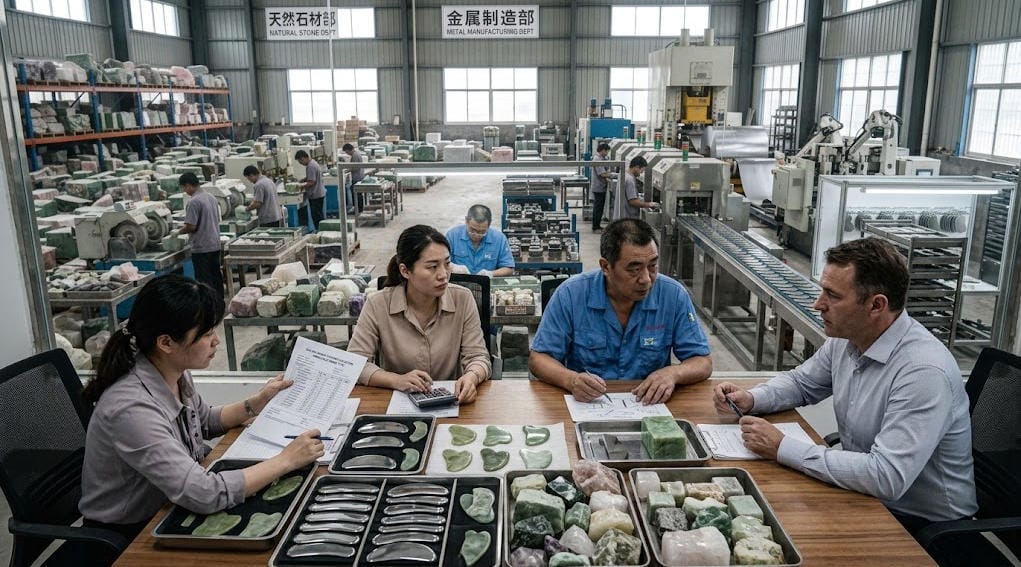
Everything above points to one practical question: at what volume should you actually switch your default assumption from “jade or crystal will be cheaper” to “stainless steel will be cheaper”? There’s no single number that applies to every design, but the pattern is consistent enough to give you a working rule of thumb when you’re comparing quotes from more than one gua sha manufacturer.
Under 1,000pcs: Prioritize Flexibility Over Fixed-Cost Efficiency
Below roughly 1,000pcs, fixed-cost amortization hasn’t done much work yet for either material, so tooling cost still matters more than usual. This is where a jade gua sha manufacturer‘s lower $100 tooling fee genuinely helps you, since you’re not ordering enough volume to dilute a $400 stainless steel mold fee meaningfully. This is also the range where jade and crystal’s natural-material story — the part your end customer actually sees and pays a premium for — carries more weight than a marginal per-unit cost difference. This means for sampling, small private-label runs, or testing a new SKU, jade or crystal is usually the lower-risk starting point.
1,000–5,000pcs: Request Both Quotes and Run the Math
This is the zone where the two materials cross paths, and it’s exactly why guessing is a bad strategy here. A gua sha factory quoting both lines should be able to give you side-by-side numbers at your specific quantity, not a generic price list. As a rough guide based on the figures throughout this article:
| Order Volume | Stainless Steel (approx. unit cost) | Jade/Crystal (approx. unit cost) |
|---|---|---|
| 1,000pcs | ~$1.70 | ~$1.60 |
| 3,000pcs | ~$1.43 | ~$1.53 |
| 5,000pcs | ~$1.38 | ~$1.52 |
These figures assume a $400 stainless steel mold against roughly $1.30 variable cost, and a $100 jade tooling fee against a comparatively flat $1.50 variable cost — illustrative, not a quote. Still, the crossover pattern holds across most standard board designs: somewhere between 1,000 and 3,000pcs, stainless steel typically starts pulling ahead. This means if your order sits in this range, it’s worth asking your gua sha manufacturer for real numbers at your exact quantity rather than assuming either material wins by default.
Above 5,000pcs: Let Fixed-Cost Amortization Do the Work
Once you’re ordering for genuine gua sha wholesale distribution — 5,000pcs and up — the math tends to favor a stainless steel guasha manufacturer more clearly, because the fixed-cost gap has shrunk to fractions of a cent while the variable-cost gap keeps compounding across every additional unit. If your buyers or end customers specifically want the tactile, natural-material appeal of jade or crystal, that’s a legitimate reason to stay with stone regardless of the math — but you should walk into that decision knowing you’re paying for material character, not for a manufacturing efficiency you’d get for free with metal. This means large gua sha wholesale orders are the clearest case for at least requesting a stainless steel comparison quote, even if you end up staying with stone.
A Disclosure on These Numbers
Every figure in this article — the $400 and $100 tooling costs, the per-piece cost estimates, the crossover range — is representative of typical production for standard gua sha board designs, not a binding quote from any single gua sha factory. Actual costs shift with design complexity, surface finish, packaging requirements, and current material pricing. Treat this article as a framework for asking better questions, not as a substitute for a formal quote from your gua sha manufacturer of choice.
Where This Analysis Comes From
This breakdown reflects how cost actually behaves on a production floor that runs both material types side by side, rather than theory borrowed from unrelated industries.
Running Both a Stainless Steel and a Jade Gua Sha Manufacturer Line for 12+ Years
Donghua has operated as a source-factory across water crystal, jade, and stainless steel gua sha production for more than 12 years, covering processing, design, manufacturing, and sales under one roof. That dual-line history is exactly why this article can compare stainless steel and jade cost structures honestly instead of favoring one material to sell it harder. This means when you ask Donghua for a quote, you’re not getting an answer filtered through a supplier who only understands half of this cost equation — you’re getting numbers pulled from both production lines directly.
Getting a Real Quote for Your Volume
If you’re planning an order anywhere near the 1,000–5,000pcs crossover zone discussed above, the fastest way to make a confident sourcing decision is to request side-by-side quotes at your exact quantity rather than relying on general figures like the ones in this article. Donghua can walk you through both a stainless steel and a jade or crystal quote for the same design, so you can see your own crossover point instead of estimating it. Whether you’re sourcing a single SKU or building out a full gua sha wholesale catalog, that direct comparison is what actually protects your margin — not the mold fee line item you started this article looking at.
FAQs About Mold-Making Costs for Stainless Steel and Jade Stone Gua Sha
1. Why does stainless steel cost more to tool but end up cheaper per piece?
Stainless steel’s $400 mold is a one-time fixed cost that gets amortized across every unit. Jade and crystal’s $100 tooling is first-piece labor that repeats on each unit, so variable cost stays high regardless of order size.
2. What order size counts as “large” for a gua sha manufacturer?
In today’s gua sha wholesale market, 1,000pcs already qualifies as a large order. Below that, tooling fees matter more; above it, variable cost differences between materials start deciding your final unit price.
3. Why can’t jade or crystal prices drop as fast as stainless steel at scale?
Natural rough material varies piece to piece in color, clarity, and structure. Every unit still needs individual cutting, grading, and polishing, so labor cost per piece stays comparatively flat even at high volumes.
4. Does a lower jade tooling fee mean a lower total cost?
Not necessarily. The $100 fee only covers first-piece development, not a reusable tool. Total cost depends on variable cost per piece across your full order, which a jade gua sha manufacturer can’t reduce the same way.
5. When should I request quotes from both material types?
Between 1,000 and 5,000pcs, costs typically cross over. Request side-by-side quotes from your gua sha manufacturer at your exact volume instead of assuming either stainless steel or stone wins by default.