
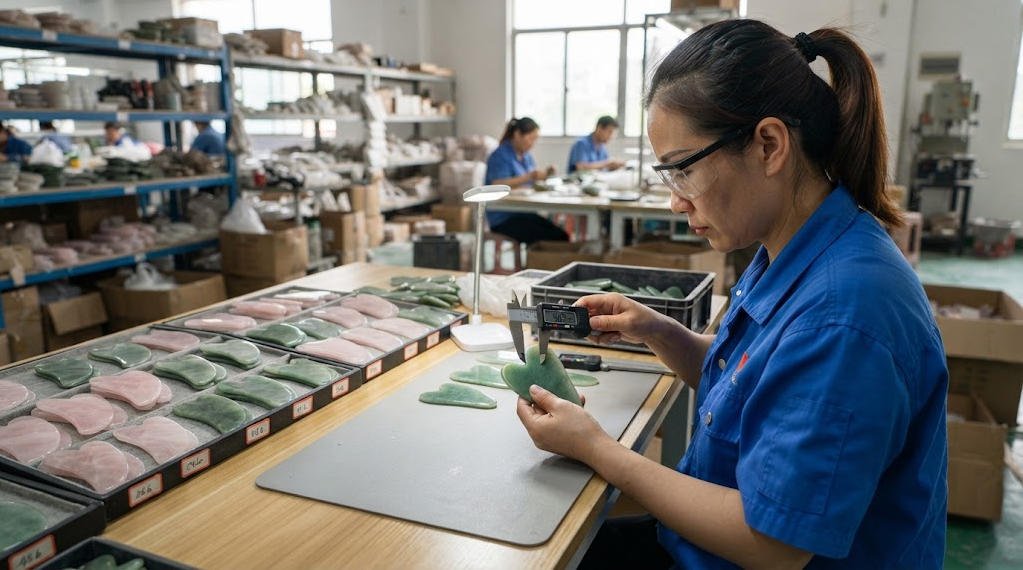
A gua sha manufacturer that inspects 100% of finished pieces, holds length and width to ±1 mm, holds thickness to ±0.5 mm, and rejects any pit wider than 0.5 mm hands you a measurable basis for accepting or refusing a shipment. That standard applies to every order leaving the Donghua workshop, and it is the first item you should ask any guasha tools factory to confirm in writing.
For third-party checks, the same limits sit under AQL 2.5, the acceptance quality limit scheme defined in ISO 2859-1, or under the sampling ratio your contract names, such as 10% of a 100,000 pcs lot. Internal full inspection still comes first, because a sample report cannot replace a piece-by-piece check.
This guide shows you what gets checked, how pass and fail is decided, where treated or mislabeled stones create risk, which rules touch your gua sha wholesale orders, and what a defect costs compared with an inspection. Start with the numbers, then decide how much proof you need.
Table of Contents
How Does a Gua Sha Manufacturer Inspect Every Piece Before It Ships?
Why a Gua Sha Manufacturer Should Inspect 100% of Finished Pieces
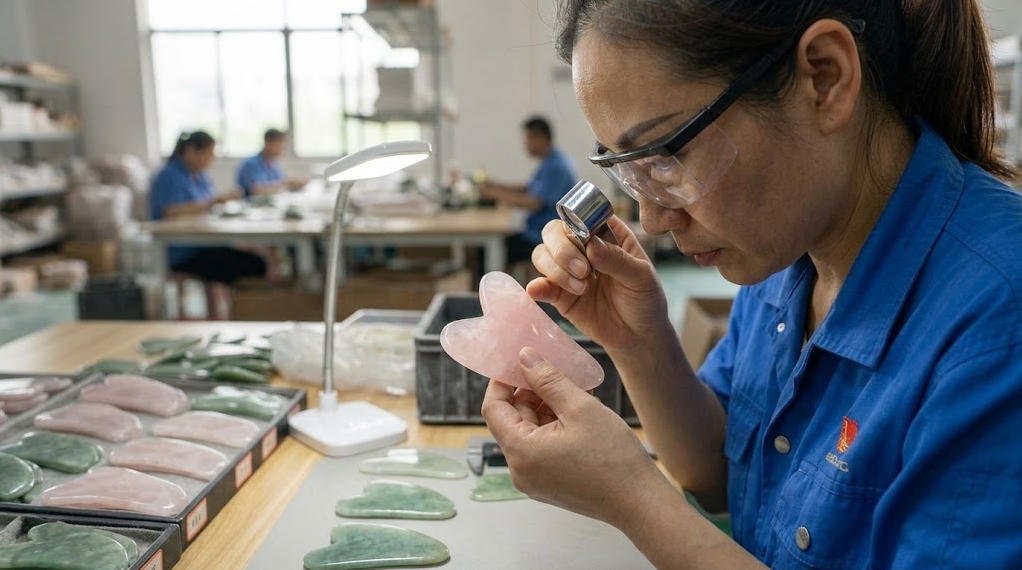
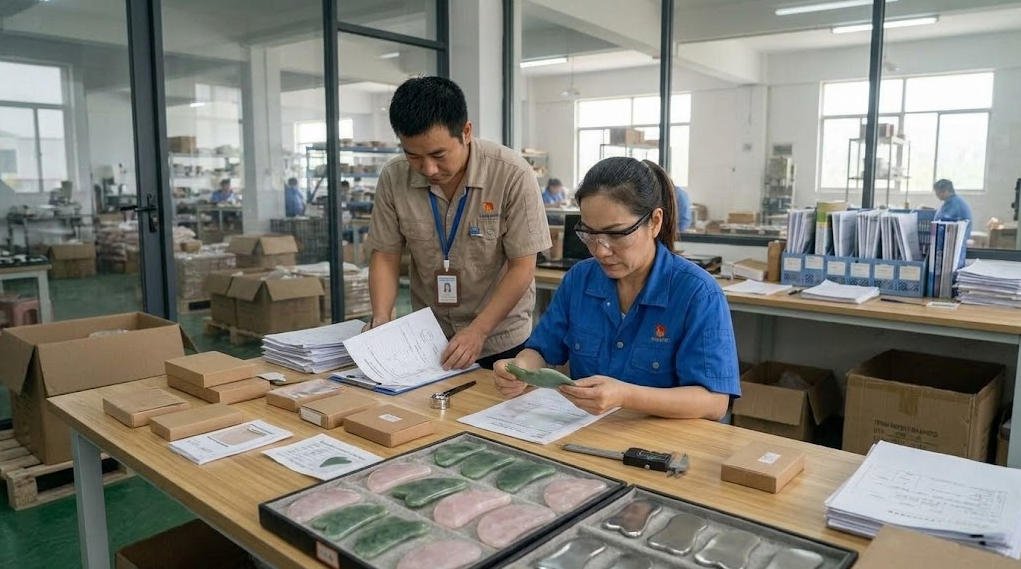
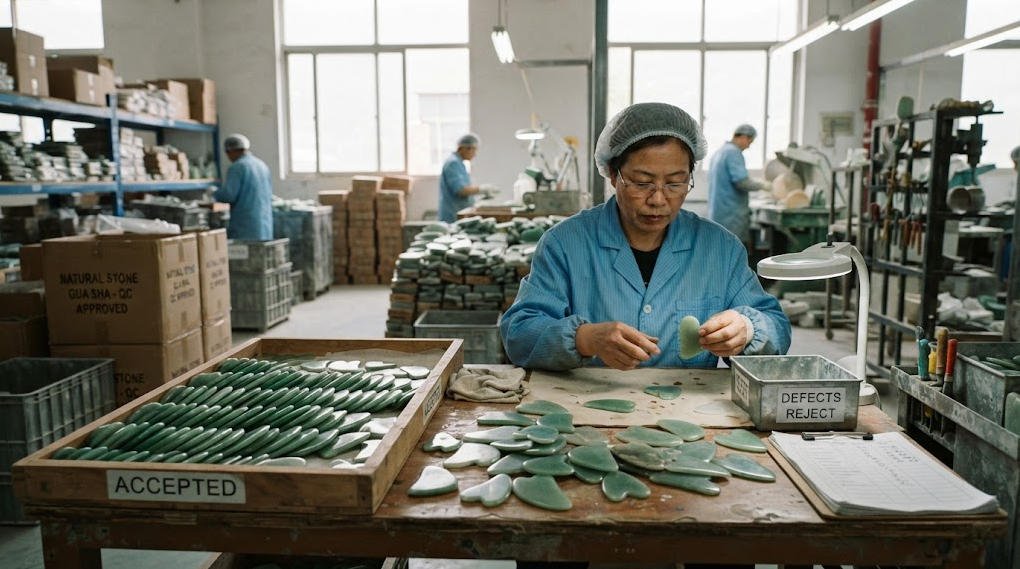
Each finished tool at Donghua passes a full inspection before it enters stock or goes onto a shipping list. A piece that fails is pulled out, and only passed pieces reach your carton. Sampling at this stage would leave the rest of the lot unchecked, and that is the gap you want closed. No industry rule sets an inspection ratio, so each gua sha manufacturer picks its own. This means you can request the ratio in writing instead of relying on a verbal promise.
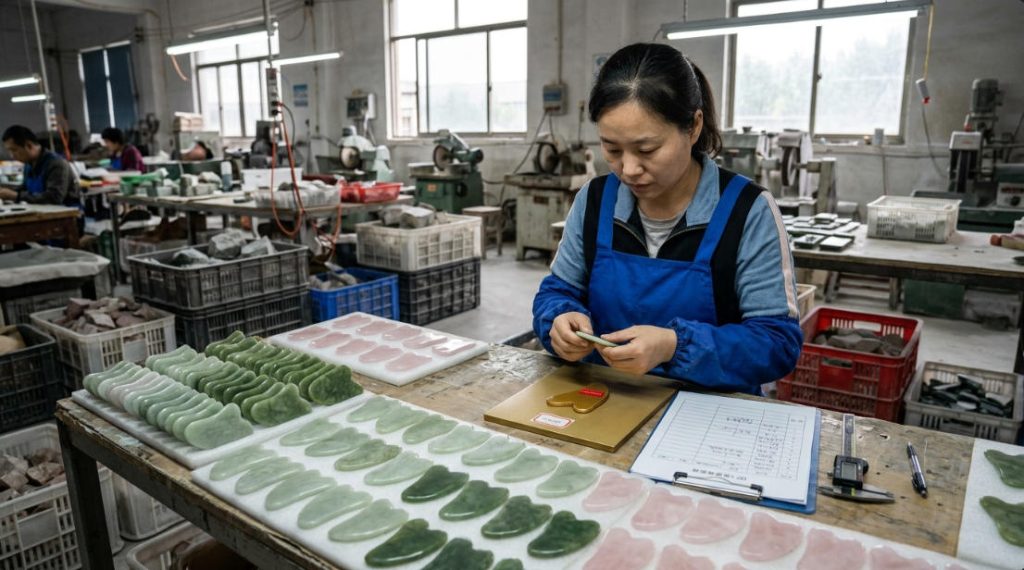
The inspection covers three areas. Appearance means color difference and impurities, which decide the first impression when your customer opens the box. Function means pits and cracks, which decide whether the tool is safe on skin. Consistency means size against the master model, which decides whether the 5,000th piece matches the first. This means you can judge any shipment with three plain questions: does it look right, is it safe, and does it match your sample?
Pass and Fail Limits a Guasha Tools Factory Should Give You in Writing
Vague phrases such as “minor flaws accepted” cannot settle a dispute, while a number can. The table below shows the default limits. If your order carries its own tolerance or color standard, your numbers replace these defaults.
| Check | Pass limit | Fail trigger |
|---|---|---|
| Length and width | ±1 mm of the master model | Outside ±1 mm |
| Thickness | ±0.5 mm of the master model | Outside ±0.5 mm |
| Pits and cracks | None above 0.5 mm in diameter | Diameter over 0.5 mm; or width under 0.5 mm with length over 2 mm; or any crack on the edge that catches skin |
| Impurities | Up to 2 mm (set per material) | Over 2 mm under the general rule |
| Color | Matches the golden standard sample | Visible mismatch with the sample for that material |
Why two limits for cracks? Width alone misses long hairlines. A line narrower than 0.5 mm still fails once it passes 2 mm in length, since a longer line has more room to open under pressure. Any crack on the working edge that catches a fingertip fails at once, because that edge travels across your customer’s face. This means you can refuse a lot for a defect that a width-only rule would have let through.
How Color and Impurity Rules Protect Your Brand
Color is judged against a golden standard sample, and each material gets its own sample. Stone color can shift for reasons far from the workshop floor. GIA reports that heat can lighten very dark amethyst, and that pale amethyst or even colorless quartz has been dyed purple. A physical sample on the bench is therefore the only reliable reference, and a photo on a screen is not. This means you can approve one master sample and have every later lot measured against it.
Impurity rules follow the same logic. The general limit is 2 mm, but some materials carry natural marks, and blue spot stone is the clearest case. Judging it by the general limit would reject nearly every piece, so it gets its own evaluation rule. This means you can expect a fair pass rate on spotted stones without letting real flaws slip through.
What Gua Sha QC Records Tell You About Your Next Lot
Inspection results do more than sort pass from fail. When pits cluster on one material or one polishing step, the workshop can trace the cause and correct it. Over time, that gua sha qc history shows which materials need tighter control and which steps drift. This means you get a defect record to review at every reorder instead of starting from zero each time. Does your current supplier share that record with you? If not, ask for it before your next purchase order.
How Does a Gua Sha Manufacturer Work With Third-Party Gua Sha QC and AQL 2.5?
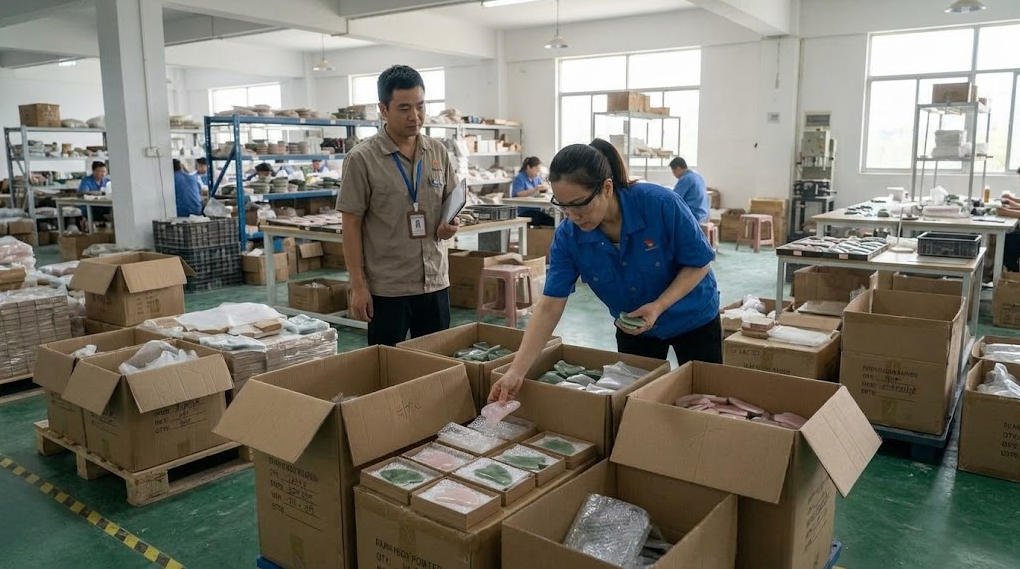
Third-party inspection works best when a gua sha manufacturer and a buyer agree on the rules before production starts, not after a dispute. The rules fit in four lines: the sample size, the defect limits, the timing, and who pays. The sections below walk through each one.
What AQL 2.5 Means for a Gua Sha Wholesale Lot
AQL stands for acceptance quality limit, and the 2.5 sets how many defects a lot may carry and still be accepted. The inspector pulls a random sample, counts defects against the pass and fail limits from the previous chapter, and compares the count with an accept number and a reject number. ISO 2859-1 defines these AQL-indexed single, double and multiple sampling schemes, so any inspector can apply the same table. This means you can predict, before the lot ships, how many defective pieces a pass would still permit.
Under General Inspection Level II with single sampling, which is the usual setup, AQL 2.5 gives the numbers below. Any gua sha manufacturer can quote this table, and you can check it against your contract.
| Lot size (pcs) | Sample size | Accept (Ac) | Reject (Re) |
|---|---|---|---|
| 1,201–3,200 | 125 | 7 | 8 |
| 3,201–10,000 | 200 | 10 | 11 |
| 10,001–35,000 | 315 | 14 | 15 |
| 35,001–150,000 | 500 | 21 | 22 |
Take a 5,000 pcs order. The inspector checks 200 pieces, and the lot passes with up to 10 defective pieces in that sample, which is 5% of the sample. The other 4,800 pieces stay unopened. A passing report therefore describes the sample, and it does not promise that every remaining piece is clean. This means you should write the allowed defect count into your acceptance terms, and name the standard edition and inspection level in the contract, since sample sizes shift with both.
Fixed Ratios Versus AQL: Which One Fits Your Order?
Some gua sha wholesale buyers skip the table and write a fixed ratio into the contract. A 2,000 pcs order can go to the inspector as a full check, because the extra time is small. A 100,000 pcs order is different: a full check costs too much time and money, so a 10% sample of 10,000 pieces is used, with one inspection mid-production and one before shipment. The AQL table covers the same lot with 500 pieces, so the fixed 10% asks for 20 times the inspector workload. A gua sha manufacturer can support either method. This means you can match the method to the order: full inspection on small lots, AQL on large ones, and a fixed ratio when one failed shipment would hurt your brand badly.
How to Book Third-Party Inspection With Your Guasha Tools Factory in Five Steps
You can set this up in one email thread if you follow the order below.
- Send a one-page spec with your tolerance, crack, impurity and color limits, and attach the golden standard sample for each material.
- Name the AQL (2.5), the inspection level, the standard edition, and the defect classes the AQL covers, so your gua sha qc terms leave no gaps.
- Pick the timing: pre-shipment only for small lots, or mid-production plus pre-shipment for large ones.
- Agree who pays for inspection, re-inspection and rework. Third-party fees normally sit with the buyer.
- Request the report with photos before you release the balance payment.
This means a disputed lot gets settled against a document both sides signed, instead of against memory.
Why a Gua Sha Manufacturer Still Runs Its Own Full Check
An inspector decides whether a lot is accepted. The inspector does not fix what went wrong on the production line. At Donghua, the internal full check runs first, and it shows where defects start, whether in a material, a cutting step or a polishing step. Clean lots also shorten the inspector’s time on site, which lowers the fee you pay. A gua sha manufacturer that skips internal inspection hands every problem to you.
Responsibility follows the same line. When a bulk order shows a quality problem, the gua sha manufacturer answers for it, and the inspection company does not. This means you keep one accountable party, even after a third-party report lands in your inbox.
What Material Risks Should a Gua Sha Manufacturer Disclose Before You Order?
Where a Gua Sha Manufacturer’s Inspection Stops and Lab Testing Starts
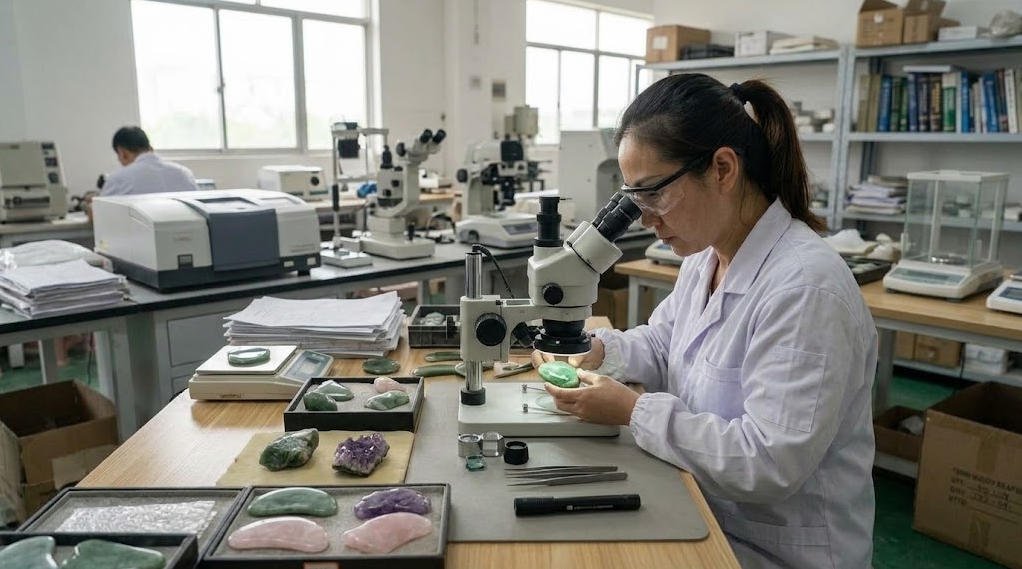
A full workshop inspection catches what eyes, calipers and a master sample can measure: color, impurities, pits, cracks and size. It does not identify dye, heat treatment or polymer filling, because those need laboratory instruments. GIA’s lab notes describe a carved jadeite piece that standard testing and Raman spectroscopy confirmed as jadeite, while infrared spectroscopy showed polymer impregnation. A gua sha manufacturer that says its workshop checks prove a stone is untreated is overstating what those checks do. This means you should keep three documents apart: the QC report, the material declaration, and the lab report.
Partial testing creates a second trap. The same GIA note warns that testing only a portion of a stone might convince an observer that no dye had been applied. In that specimen, long-wave UV showed strong fluorescence from the dyed areas and little to none from the natural green area. A UV lamp can therefore screen a lot, yet a screen only gives a hint. Why settle for a hint when a lab can give a verdict? This means you can use UV as a first filter and reserve lab fees for the lots that matter most.
How Dyed and Treated Stones Reach Gua Sha Wholesale Shipments
Color is where most treatments show up. GIA reports that heat can lighten very dark amethyst, and that pale amethyst and even colorless quartz have been dyed purple. Rose quartz carries its own warning: GIA describes crystalline pink quartz as exceptionally rare compared with massive rose quartz, so a clear, vivid pink piece sold at an ordinary price deserves a question. Read the table below as a starting point for your gua sha wholesale purchase order.
| Material | Where the risk shows up | What to put in your order |
|---|---|---|
| Jadeite | Lower-quality pieces are often treated with acid bleaching, polymer impregnation and dyes | Written treatment statement; lab report on high-value lots |
| Amethyst | Heat on dark stones; dye on pale stones | Declaration of color origin, natural or treated |
| Rose quartz | Dye on faint stones; unusual clarity at ordinary prices | Declaration of color origin, natural or treated gia |
This means you can turn a vague “natural stone” promise into a line your supplier has to confirm in writing.
What the Trade Name “Jade” Covers and What It Does Not
The word “jade” is often stretched across any green stone. The Laboratory Manual Harmonisation Committee, whose members include the GIA and SSEF labs, tightened it in 2025. Information Sheet No. 11 now defines “jade” as aggregates primarily composed of jadeite, omphacite, kosmochlor or nephrite, and it adds that reports on jadeite jade may note the Asian trade name Fei Cui. A green stone outside those four minerals fails that definition, whatever the label says. This means you can print the mineral name next to the trade name on your product page and purchase order, and defend both.
How You and a Gua Sha Manufacturer Can Verify Material Before Production
Start with the order confirmation. Ask your guasha tools factory to list the mineral name, the treatment status and the color origin for each material, so the paper trail exists before cutting begins. If the lot is high in value, or you plan to print “untreated” on the packaging, send one or two pieces from the first production lot to a recognized lab such as SSEF or GIA, and keep retention samples from every lot for later comparison. Donghua’s inspection will then judge each lot against the same samples your lab report describes. This means a customer complaint about color or authenticity meets a documented answer, and you do not have to rebuild the story from memory.
Which Rules Apply When a Gua Sha Manufacturer Ships to the US and EU?
Rules shift by market and by the claims printed on your box, so the lines below matter before the first carton leaves the dock. Treat this chapter as a planning summary, since it is not legal advice, and confirm the final details with a licensed customs broker or compliance counsel.
How Claims Change the Rules a Gua Sha Manufacturer Must Meet
A plain stone tool and a powered device sit in different regulatory categories, and your wording can move a product from one to the other. In October 2025, the FDA cleared an LED gua sha as a Class II device for wrinkle treatment, under 21 CFR 878.4810 with product code OHS, as the FDA 510(k) record K252272 shows. That device emits red and infrared light, which a stone tool does not. Retailers add their own lines: Walmart’s supplier requirements state that cosmetic tools and accessories are not cosmetics and fall under the Consumer Product Safety Commission. This means you can keep a stone product in the simpler category by describing it as a massage tool and leaving out treatment claims.
Customs Codes and Paperwork for Gua Sha Wholesale Shipments
Customs brokers like to start from a precedent. U.S. Customs and Border Protection ruling N318295 classified a stone gua sha tool, together with a facial roller, under HTSUS 9019.10.2050 for massage apparatus. A ruling binds only the company that requested it, so your broker still has to confirm the code against your own product. This means you can hand your broker the ruling number on day one and keep the commercial invoice, the packing list and your gua sha wholesale product description consistent with one another.
What California Prop 65 Means for Your Listings
Prop 65 is about warnings, and it does not ban products. It requires a clear and reasonable warning before a business knowingly and intentionally exposes someone to a chemical listed as causing cancer or reproductive toxicity, and OEHHA has published more than 300 safe harbor levels to help businesses decide whether a warning is needed. The rule reaches sellers outside California, too, because it covers businesses that merely ship products into the state. Your guasha tools factory can support you with test reports on each material and on any metal fitting, glue or coating that touches skin. This means you can compare a measured result with a safe harbor level before deciding whether your listing needs a warning.
EU General Product Safety Rules: Who Signs the Label?
The EU’s General Product Safety Regulation (EU) 2023/988 has applied since 13 December 2024. Every covered product needs a responsible economic operator in the EU, such as an EU manufacturer, an importer, an authorised representative or a fulfilment service provider, as the EUR-Lex summary explains. The manufacturer must also state its name, postal address and electronic address on the product itself where possible, according to Fieldfisher’s overview. A stone tool holds no cosmetic substance, so this general regime is the likelier fit, although you should confirm that for your exact product. This means you should name your EU importer or representative before production, so the label proof can carry the right contact details.
How You and a Gua Sha Manufacturer Build the Compliance File
Compliance goes faster when documents exist before the questions arrive. Gather the material declaration from chapter 3, the gua sha qc report and AQL record from chapters 1 and 2, the test reports, the customs code, and the label proof with your EU contact details. Why chase these during a customs hold when you can file them in one folder? Keep one folder per lot, so that every shipment can show its own gua sha qc history. This means you can answer a buyer, a marketplace or an inspector in minutes, and your shipment stays on schedule.
What Does Gua Sha QC Cost, and What Return Does a Gua Sha Manufacturer Give You?
What Third-Party Gua Sha QC Costs Per Order
Inspection companies bill by the man-day, which is one inspector working one day on site. V-Trust quotes an all-inclusive US$268 per man-day for pre-shipment inspection in major Asian manufacturing clusters, while QIMA’s product inspections start from US$309 per man-day in China, as this provider list reports. For pieces per day, Guided Imports cites 125 to 200 pieces per man-day for basic consumer electronics. The table below borrows the top of that range, 200 pieces per day, and the $268 rate. Both inputs are illustrative, so replace them with your own quote.
| Plan | Pieces checked | Man-days | Fee per visit |
|---|---|---|---|
| 2,000 pcs, full check | 2,000 | 10 | about $2,680 |
| 100,000 pcs, fixed 10% | 10,000 | 50 | about $13,400 |
| 100,000 pcs, AQL 2.5 | 500 | 2.5 | about $670 |
A fixed 10% on the large order, run twice, costs roughly $26,800, while one AQL 2.5 visit costs about $670. This means you can see the price of each method before you sign, and you can pick the one your order value justifies.
What a Defective Lot Costs a Gua Sha Wholesale Buyer
Start with a simple formula: defective pieces × (unit landed cost + handling per returned piece). Assume a landed cost of $5 per piece, and a 100,000 pcs lot with 3% defective pieces. That is 3,000 pieces, or $15,000 before you count refunds, replacements or ranking damage. Here is the uncomfortable part. With 500 pieces sampled and an accept number of 21, my binomial estimate says a lot with 3% defects passes about 95 times in 100. A lot with 5% defects passes only about 24 times in 100, so it is rejected roughly three times in four. This means an AQL 2.5 pass proves the lot is acceptable at the agreed limit, and it does not prove the lot is clean.
How to Calculate ROI on a Gua Sha Manufacturer’s Inspection Plan
Use one line: ROI = (defect cost avoided − inspection cost) ÷ inspection cost. Take the same large order with two AQL 2.5 visits, one mid-production and one before shipment, at $670 each, so $1,340 in total. Suppose the mid-production visit meets a polishing problem that affects 5% of the lot. That is 5,000 pieces, or $25,000 at $5 each. Because that lot is rejected about 76% of the time, the expected saving is about $19,000. The ROI then comes to (19,000 − 1,340) ÷ 1,340, which is roughly 13 to 1. The inputs are assumptions, yet the method works with your own prices. This means you can justify a mid-production visit with a calculation instead of a hunch.
Where a Gua Sha Manufacturer’s Full Inspection Lowers Your Cost
Third-party fees grow with inspector time and with repeat visits. A lot that has already passed a piece-by-piece check at the workshop gives the inspector fewer defects to count, so a failed visit and a second $670 fee become less likely. A guasha tools factory that logs where defects start can also fix the cause before your next lot reaches the line. Donghua runs that internal check before any inspector arrives. This means you pay for fewer re-inspections, and your cost per accepted piece falls with every clean lot.
How Do You Audit a Gua Sha Manufacturer Before the First Order?
An audit does not need a plane ticket. Most of it happens in writing, and the rest happens on a small trial lot. The steps below show you how to turn the earlier chapters into a repeatable check you can run on any supplier.
Five Questions to Ask a Gua Sha Manufacturer in Writing
Send the questions in one email, so every answer sits in a single thread. First, ask for the inspection ratio before shipment, and expect a clear figure such as 100% of finished pieces. Second, ask for the pass and fail limits for size, pits, cracks, impurities and color, together with the golden standard sample for each material. Third, ask which AQL, inspection level and standard edition apply when a third-party inspector visits. Fourth, ask for the mineral name, treatment status and color origin of each material. Fifth, ask who pays for rework and re-inspection if a lot fails. A gua sha manufacturer that answers all five with numbers is easy to hold to account. This means you can compare two suppliers line by line instead of comparing price alone.
How to Run a Trial Lot With a Guasha Tools Factory
Start small, because a small lot lets you test every promise at low risk. A 2,000 pcs order is a workable size, since a full third-party check takes little time at that volume. Approve the golden standard samples first, then compare the factory’s internal gua sha qc report with the inspector’s report on the same lot. If you use AQL 2.5 instead, the sample for 2,000 pcs is 125 pieces, and the lot passes with up to 7 defects, as the ISO 2859-1 sampling system sets out for General Inspection Level II. The two reports should tell the same story. This means you can decide on a larger order with evidence from your own lot, and you can stop wondering how it will go.
Red Flags That Cost Gua Sha Wholesale Buyers Money
Some warning signs show up in the first conversation. A supplier that will not state an inspection ratio is hiding the number that matters most. A “natural stone” claim with no treatment statement leaves you exposed to the dye and polymer risks from chapter 3. A workshop that says its own checks prove a stone untreated is claiming more than a calipers-and-eyes inspection can deliver, because that proof needs laboratory instruments such as those at SSEF or GIA. A supplier that has no defect history to share cannot show you where problems start. This means you can walk away early, before a deposit leaves your account.
What a Gua Sha Manufacturer Owes You: The Short Version
Here is the whole article in four numbers and one rule. Every finished piece is inspected, which makes the ratio 100%. Size stays within ±1 mm on length and width and ±0.5 mm on thickness, pits and cracks stay under 0.5 mm in diameter, and impurities stay within 2 mm. Third-party sampling follows AQL 2.5 or the ratio in your contract, and the gua sha manufacturer answers for bulk quality problems whichever method you choose. A passing report describes a sample, and it never replaces the supplier’s own responsibility.
Donghua has spent more than 12 years processing, designing and making jade and crystal gua sha tools, and the workshop shares its QC spec sheet on request. Ask any guasha tools factory for the same sheet, compare the numbers, and place the first order only when the answers match.