
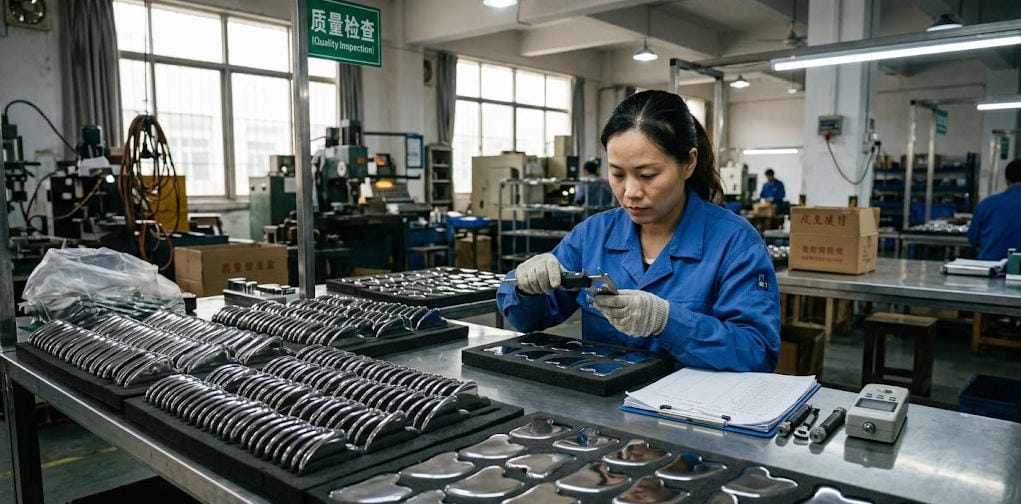
If you’re weighing a bulk order right now, here’s the number that usually settles the debate fastest: on a run of 10,000 pieces, natural stone tolerances allow visible batch-to-batch variation in color, texture, and clarity, while a stainless steel gua sha wholesale order can hold near-identical dimensions and finish across the entire lot. That single fact — consistency at scale — is the main reason more beauty brands, spas, e-commerce sellers, and OEM buyers are shifting bulk purchase orders away from jade, crystal, and agate toward stainless steel.
But there’s a catch that catches almost every first-time buyer off guard: “stainless steel” printed on a product listing does not automatically mean 304 or 316 stainless steel. This article walks through why the gua sha wholesale market is moving toward metal, what actually makes stainless steel competitive rather than just different, and — this is the part that protects your margin — how you can verify the grade before a container full of product reaches your warehouse.
Why the Gua Sha Wholesale Market Is Shifting Toward Stainless Steel
Natural Stone Was Never Built for Uniform Batches
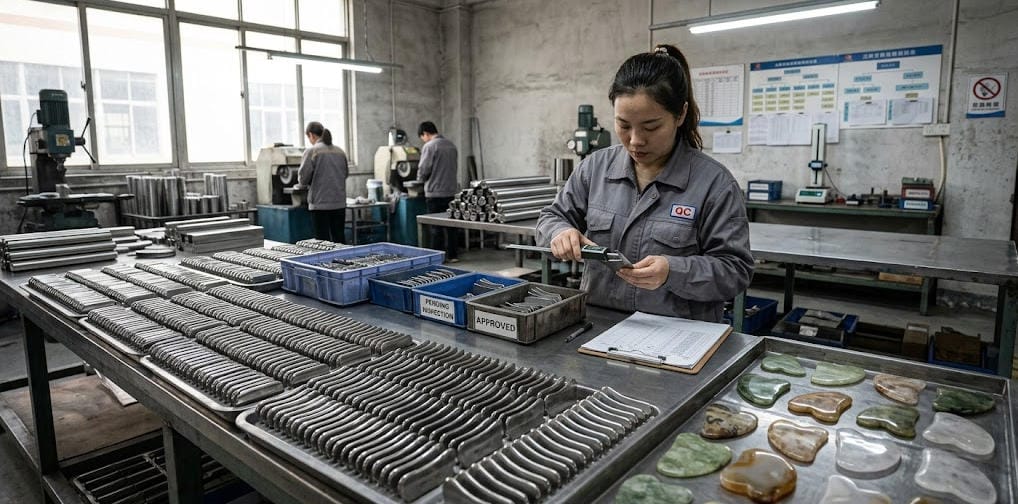
Jade, crystal, agate, and fluorite are mined materials, and mined materials carry the fingerprint of geology. Color shifts within the same vein. Translucency changes from one lot to the next. Inclusions appear in some pieces and not others, and the raw material cost itself fluctuates depending on which quarry batch a supplier is sourcing that month. None of this makes natural stone a bad material — it’s actually part of the appeal for consumers who want a one-of-a-kind, “no two pieces are identical” product story. The colored gemstone industry has never settled on a single international clarity standard the way diamond grading has, and organizations like the International Gem Society note that clarity expectations shift depending on the specific mineral variety being graded, unlike the more standardized diamond scale . That variability is normal for gemstones. It is a problem for a wholesale purchase order.
If you’re buying 500 pieces for a boutique launch, natural variation might even be a selling point. If you’re buying 20,000 pieces for a chain retailer or a private-label skincare line, that same variation becomes a liability — mismatched SKUs, inconsistent product photography, and customer complaints about “my piece looks different from the one online.” This means your production planning has to build in extra sorting and grading time whenever natural stone is involved, and that sorting cost rarely shows up on the initial quote.
Standardized Grades Change the Purchasing Conversation
Stainless steel is an industrially standardized material. You can specify 304, 316, or 430 by name, request the exact same chemical composition on every purchase order, and expect a stainless steel gua sha manufacturer to reproduce it lot after lot. Where natural stone purchasing conversations tend to center on “how much variation is acceptable,” stainless steel purchasing conversations center on “how tight can the tolerance be.” That’s a fundamentally different negotiation, and it’s one that favors buyers who need repeatability more than they need uniqueness.
Think about what that means for a monthly production run of 10,000 units. With natural stone, an experienced gua sha supplier will tell you upfront that some visual difference between pieces is expected and unavoidable. With stainless steel, the expectation flips — you’re now asking your supplier to explain any variation, because consistency is the default, not the exception. This means you can plan your retail packaging, your product photography, and your customer-facing claims around a single, reproducible appearance instead of hedging every listing with “natural variation may occur.”
Who Is Actually Driving This Shift
The buyers pushing this trend aren’t hobbyists. They’re chain beauty brands standardizing their retail assortment, e-commerce brands that need every unit to match the hero image, OEM/ODM clients building private-label skincare tool lines, and large-volume wholesalers who simply can’t absorb the sorting labor that natural stone requires at scale. If your business fits any of those profiles, the appeal of stainless steel probably isn’t about it being “better” in some abstract sense — it’s about the operational math working in your favor once order volume crosses a certain threshold.
This is also why more buyers are searching specifically for a guasha tools manufacturer rather than a general trading company. A trading company can resell whatever grade is available that week; a factory-side guasha tools manufacturer can hold a fixed specification across every stainless steel gua sha wholesale order you place over the course of a year, because the tooling, the raw material contracts, and the finishing line stay constant on their end.
What Actually Makes Stainless Steel Competitive — Not Just Different
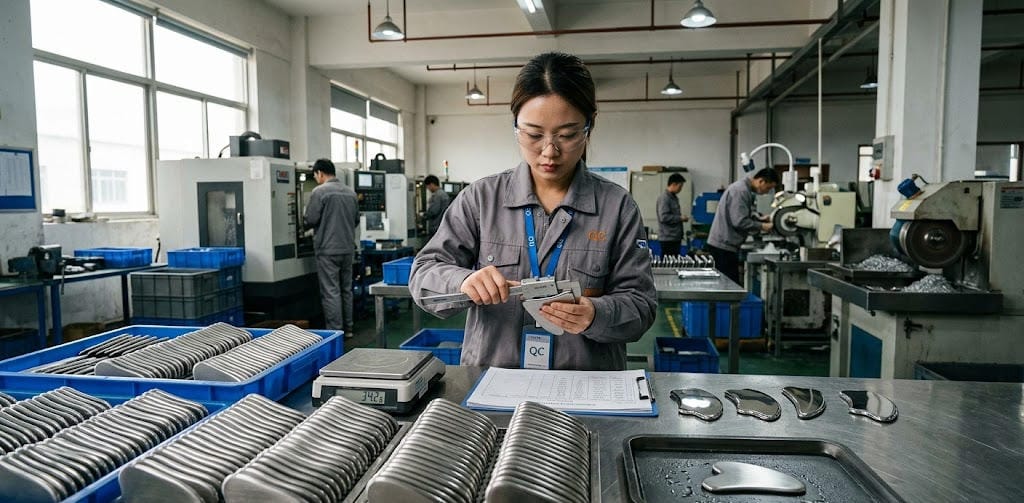
Being standardized is one advantage. But standardization alone doesn’t explain why stainless steel gua sha wholesale demand keeps climbing. There are several concrete, operational reasons metal tools are winning shelf space, and each one maps to a specific cost or risk line in a wholesale buyer’s business.
Durability Changes Your Loss Column, Not Just the Product Feel
Under normal handling, stainless steel does not chip, crack, or shatter the way crystal, jade, fluorite, or agate can when dropped. For a buyer moving product through freight, customs, warehouse handling, and last-mile shipping, that single property touches four separate cost centers: transit loss, warehouse breakage, customer complaint rate, and after-sales replacement cost. Cross-border e-commerce shipments in particular tend to tolerate rougher handling for metal tools than for stone, simply because there’s no fracture point to worry about.
Run the math on a mid-sized order. If breakage and chip-related returns on a natural stone shipment run even 2–3%, a 50,000-unit order could mean over a thousand units lost or returned before they ever reach a shelf — not counting the customer service time spent resolving each case. That’s an illustrative estimate, not a certified figure, but it’s the order of magnitude that wholesale buyers report when comparing claims between stone and metal SKUs. This means a stainless steel line can lower your effective landed cost per sellable unit, even when the unit price on the invoice looks similar to stone.
Surface Finish Can Be Repeated, Not Just Achieved Once
CNC machining, stamping, precision grinding, brushed finishing, mirror polishing, electropolishing, and PVD coating all give a stainless steel gua sha manufacturer repeatable control over surface appearance. A mirror-polished stainless steel gua sha catches light in a way that reads as intentional and controlled rather than naturally occurring, which is part of why so many brands have repositioned metal tools from “household beauty gadget” toward “Professional Beauty Tool” or “Premium Skincare Tool” language on their packaging. So what does a repeatable finish actually buy you? It means every unit in a 10,000-piece order can carry the same finish under the same studio lighting, which removes one more variable from your product photography and your quality-control checklist. Not every guasha tools manufacturer can hold a mirror finish across a full production run without visible batch drift, so it’s worth asking to see finish-consistency samples from a previous stainless steel gua sha wholesale order before you commit to a new supplier.
Hygiene Requirements in Professional Settings
Natural stone with microscopic pores, hairline cracks, or structural flaws requires more careful cleaning and disinfection protocols, because bacteria and residue can settle into surface irregularities that aren’t visible to the naked eye. A well-finished stainless steel surface is comparatively easier to wash, wipe down, sanitize, and dry completely — a meaningful difference for salons, spas, and skin-management clinics where tools get reused across clients throughout the day. This is part of why the product category itself has been expanding from “home beauty tool” language toward “Professional / Salon / Spa Beauty Tool” positioning. If your buyer base includes licensed estheticians or spa operators, this hygiene profile is often the deciding factor over price. When hygiene claims matter to your end customer, it also helps to ask your gua sha supplier whether their finishing process is documented anywhere in a gua sha certificate or quality file, since a clean surface finish and a corrosion-resistant alloy usually go hand in hand.
Thermal Feel Becomes a Marketing Asset
Stainless steel conducts heat and cold noticeably faster than most natural stones. Chill a stainless steel gua sha and the cooling sensation on skin is immediate and pronounced, which is exactly why “cold + weight + shine” has become a recognizable sales pitch for metal tools — a deliberately different experience from the “natural, gentle, healing” positioning that crystal and jade brands lean on. Neither story is wrong; they’re aimed at different buyers. But if your target customer responds to spa-style cooling and de-puffing claims, metal has a physical property advantage that stone simply can’t replicate as strongly. A capable stainless steel gua sha manufacturer can even tune wall thickness slightly to adjust how quickly a piece cools or warms, which is a level of control that’s simply not available with a mined material.
Weight Perception and Perceived Value
At the same physical size, stainless steel typically feels heavier in the hand than most natural stones and far heavier than plastic alternatives. That weight is not incidental — consumers routinely associate heft with quality, whether or not that association is strictly rational. For a brand trying to justify a higher retail price point, the tactile weight of a metal tool does some of the persuasion work before a single word of marketing copy gets read. This means your packaging and pricing strategy can lean on a physical sensation instead of relying entirely on claims you have to explain. It’s a small detail, but ask any guasha tools manufacturer with export experience — customers notice the weight of a piece within the first two seconds of picking it up, before they read a single line of copy.
Dimensional Control for OEM/ODM Programs
Because stainless steel is suited to industrial machining, it’s comparatively straightforward to hold precise thickness, fixed dimensions, controlled weight, sharp edge geometry, double-sided contours, multi-tooth edges, unusual curve profiles, and engraved logos. Natural stone can also be CNC-shaped, but the raw material’s inherent flaws still cap how tight the final tolerance can get, no matter how good the machining is. If your program depends on exact repeat dimensions across production runs — which most OEM/ODM contracts do — this is often the single most practical reason to specify metal over stone in your spec sheet. Any stainless steel gua sha manufacturer running OEM programs at scale should be able to hand you a tolerance sheet before production starts, not after the first batch already shipped.
Why “Stainless Steel” on a Listing Doesn’t Guarantee 304 or 316
Here’s the part of stainless steel gua sha wholesale sourcing that causes the most expensive mistakes, and it’s the reason this article exists as a risk disclosure, not just a sales pitch.
What “Looks Like Stainless” Can Actually Be
The market includes genuine 304 stainless steel, genuine 316 stainless steel, 430 stainless steel (a lower-cost ferritic grade), 201 stainless steel (a manganese-substituted grade with different corrosion performance), and — less honestly — zinc alloy with a stainless-colored surface coating, or ordinary carbon steel with chrome or nickel plating made to resemble stainless. From a few feet away, most of these products look nearly identical: silver, shiny, and reasonably heavy. That resemblance is exactly the problem. A gua sha supplier quoting an aggressively low price is not necessarily lying about “stainless steel” — they may simply mean a grade you didn’t ask for. This is exactly the gap a proper gua sha certificate is meant to close, and it’s the single cheapest risk-reduction step available to any buyer planning a stainless steel gua sha wholesale order.
Why Visual and Weight Checks Fail
So what actually proves a piece is 304 or 316? Not appearance, and not weight. “Silver, shiny, heavy, and the magnet doesn’t stick” is a description that fits several different alloys, some of which cost half as much as genuine 304 to produce. If your entire verification process is a visual inspection during a factory visit, you are trusting the supplier’s word, not confirming the metal’s chemistry. That’s a reasonable starting point for a relationship — it is not a reasonable final answer for a five-figure purchase order.
How to Verify Stainless Steel Gua Sha Before You Commit to a Bulk Order
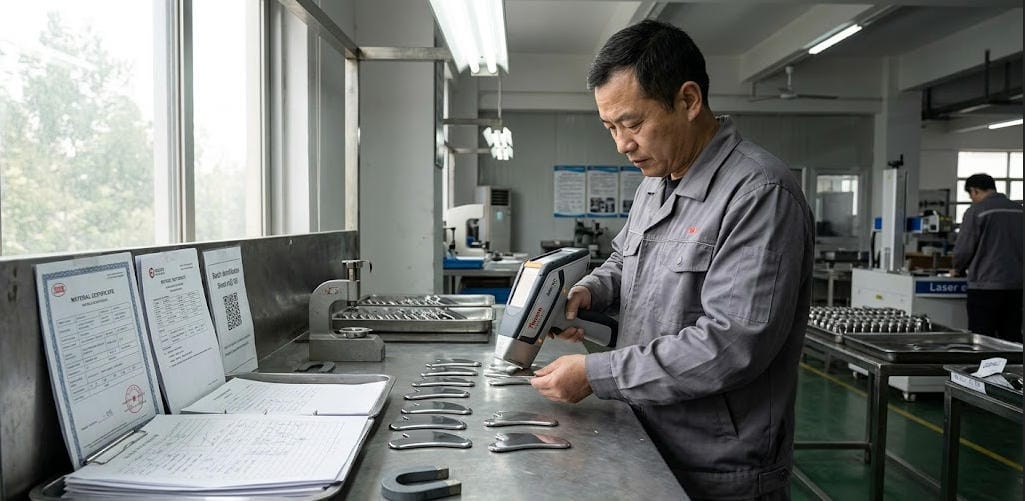
Verification should move from simple screening toward laboratory-grade confirmation, and the right stopping point depends on order size and how your own customers will use the product.
Step 1 — Request a Written Material Declaration
Before any physical testing, ask your stainless steel gua sha manufacturer to state the exact grade in writing — SUS304 / AISI 304, or SUS316 / AISI 316 — rather than the generic phrase “stainless steel.” That generic phrase is not a specification; it’s a category that includes grades you probably don’t want. For anything beyond a small trial order, ask for a gua sha certificate package that includes a Material Certificate, a Mill Test Certificate (MTC), a Material Test Report, or a PMI report. If a supplier hesitates to put a grade number on paper, treat that hesitation as information, not as an oversight.
Step 2 — Run Quick Screening, With Realistic Expectations
A magnet test is the most common screening method, and it’s genuinely useful for catching obvious mismatches — but it does not prove a grade. Genuine 304 and 316 are austenitic stainless steels that are typically low-magnetic or non-magnetic when fully annealed, yet cold-working, stamping, drawing, bending, or CNC machining can locally alter the crystal structure and induce measurable magnetism in specific spots. Independent materials-testing references describe this same limitation directly: a magnet test can support initial screening but cannot confirm whether a part is 304 or 316, and it should never replace a material certificate or grade-verification test when the buyer needs certainty (source). So does “the magnet doesn’t stick” prove you’re holding 304? It doesn’t — it only tells you the piece is probably austenitic, not which austenitic grade.
A spark test, done by lightly grinding the material against a wheel and reading the spark pattern, is useful for a factory’s internal raw-material sorting, but it’s a poor final proof for a finished, polished, surface-treated export product — the spark pattern is affected by the processing the metal has already been through, and it cannot distinguish 304 from 316 with any precision. Chemical reagent test kits are a step up: they’re inexpensive, fast, and reasonably good at flagging obvious substitutions like 201 in place of 304. Still, reagent kits function as a screening tool, not a laboratory-grade determination, so treat a passed reagent test as “cleared the first filter,” not as final proof.
Step 3 — PMI / XRF Testing for Real Verification
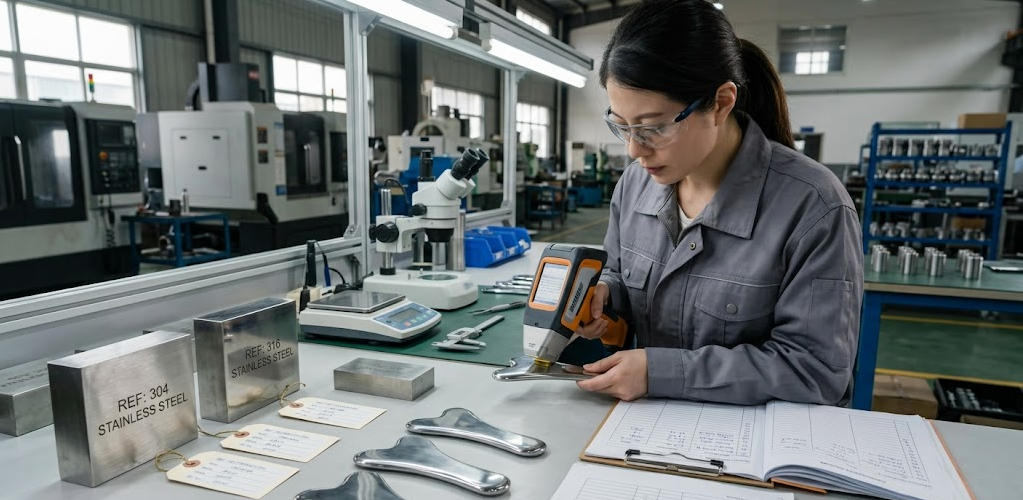
If your customer base genuinely requires confirmed 304 or 316 — think professional spa chains, medical-adjacent skincare devices, or contracts with material-compliance clauses — Positive Material Identification (PMI) using a handheld X-ray fluorescence (XRF) analyzer is the method most industrial buyers rely on. PMI reads the actual elemental composition of the metal — chromium, nickel, molybdenum, manganese, and iron — directly from the surface, without destroying the part. ASTM International maintains standard practices specifically for this kind of alloy verification in stainless steel products, which gives you a documented, industry-recognized method to cite in your own purchasing specification. The key differentiator PMI reveals is molybdenum: 304 is defined mainly by its chromium and nickel content, while 316 adds a meaningful molybdenum percentage on top of those two elements. That single element reading is usually enough to separate a genuine 316 claim from a mislabeled 304 or 201 substitute. Ask your stainless steel gua sha manufacturer whether PMI results can be attached directly to your gua sha certificate package — a factory that already runs this test internally will have no problem sharing the readout.
Step 4 — Laboratory Testing for Formal Compliance Files
For the highest-stakes orders — large private-label contracts, regulated retail partners, or buyers who need a defensible paper trail — a full laboratory chemical analysis is the most rigorous option available. It’s destructive to the sample tested and slower than PMI, but it produces documentation suitable for formal compliance and quality files. Rigorous, independently verifiable testing is exactly the standard that respected material-testing institutions build their reputations on; the Swiss Gemmological Institute (SSEF), for example, has spent decades building scientific, reproducible protocols specifically so that trade partners can trust a test result without needing to verify it themselves. The same logic applies to metals: a documented, repeatable test protocol is what turns “the supplier said so” into something you can actually stand behind if a customer or regulator asks. For a large stainless steel gua sha wholesale contract, it’s reasonable to ask a guasha tools manufacturer to budget laboratory testing into the unit cost upfront, rather than treating it as an optional add-on you negotiate for after a quality dispute has already happened.
| Verification Level | Method | What It Actually Confirms |
|---|---|---|
| Level 1 | Written material declaration + gua sha certificate | Confirms what the supplier claims, on paper |
| Level 2 | Magnet test / reagent screening | Rules out obvious mismatches, not exact grade |
| Level 3 | PMI / XRF testing | Confirms actual elemental composition (Cr, Ni, Mo) |
| Level 4 | Laboratory chemical analysis | Produces formal documentation for compliance files |
For a routine trial order, Level 1 plus Level 2 is usually enough to screen a new gua sha supplier before committing real volume. For a large production run, Level 1 plus sampled PMI testing on a percentage of the batch is a more defensible standard. For premium brand launches or clients with explicit material requirements written into their contract, PMI combined with a formal laboratory test report is the safer floor, not the ceiling.
304 vs 316 — Which Grade Should Your Order Actually Use
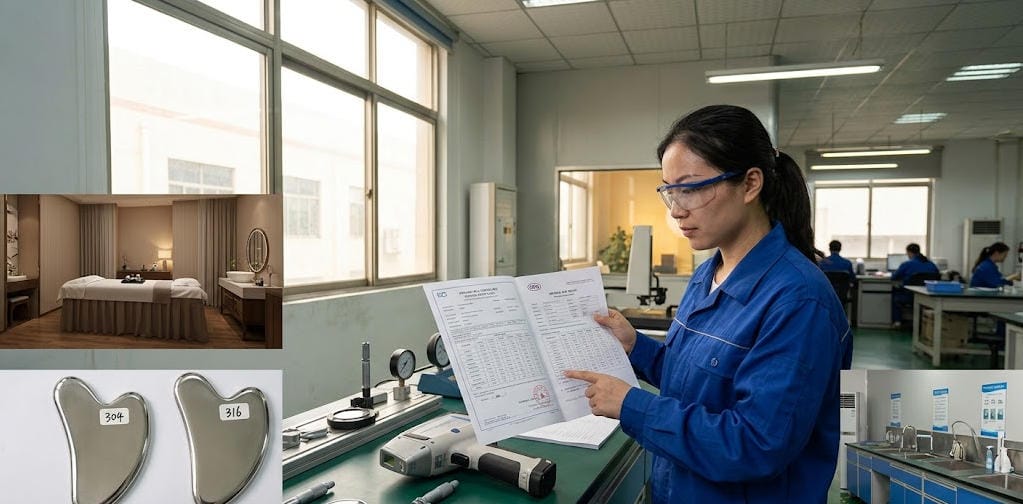
What the Molybdenum Actually Buys You
The price gap between 304 and 316 comes down to one added element: molybdenum. Industry reference material published by the International Stainless Steel Forum describes 316 as the standard molybdenum-bearing austenitic grade, with that molybdenum content giving it meaningfully better resistance to pitting and crevice corrosion than 304, particularly in chloride-heavy environments. So 316 isn’t “the fancier-looking option” — visually, a well-finished 304 and a well-finished 316 piece can look identical. What you’re actually paying for is a documented corrosion-resistance advantage in specific chemical environments, not a cosmetic upgrade. Before you lock a stainless steel gua sha wholesale contract into one grade or the other, it’s worth having your gua sha supplier walk you through which elements actually appear in the mill certificate for your specific batch, rather than taking a grade name at face value.
Matching Grade to Market Position
For everyday facial gua sha sold through mass-market beauty retail, 304 usually delivers a reasonable balance between material cost and functional performance, and most consumers will never expose the tool to the kind of chloride-heavy, high-corrosion environment where 316’s advantage actually matters. If your product sits in a Premium Beauty, Professional Spa, Luxury Skincare, or clinical-adjacent device category, 316 becomes easier to justify as a genuine material claim rather than marketing language — because in those categories, buyers are more likely to actually ask what grade they’re getting. This means the right grade decision isn’t “which one is objectively better,” it’s “which one matches the price point and claims your specific product line is making.” A guasha tools manufacturer that produces both grades in-house can usually walk you through this trade-off honestly, since they have no reason to steer you toward the more expensive option if your product line doesn’t need it.
A Practical Buying Checklist Before You Place a Wholesale Order
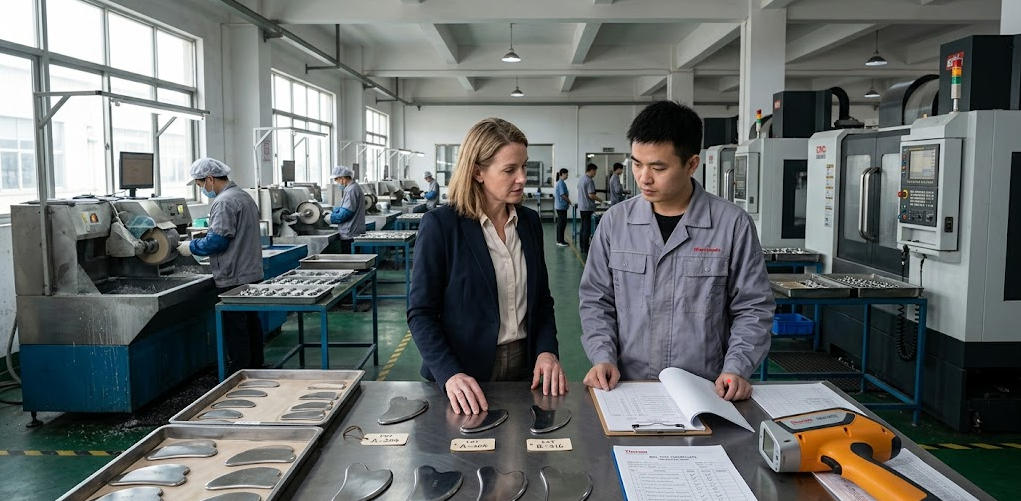
Before you commit budget to your next stainless steel gua sha wholesale run, walk through a short internal checklist rather than relying on a single supplier conversation. Confirm the exact grade in writing, request the relevant gua sha certificate documentation, decide whether your order size justifies sampled PMI testing, and match your grade choice — 304 or 316 — to how your product will actually be marketed and used. None of these steps require specialized equipment on your side; they mostly require asking your gua sha supplier direct, specific questions instead of a general one like “is this stainless steel?” That question alone won’t protect you, because almost every supplier will answer yes.
If you’re comparing quotes from more than one stainless steel gua sha manufacturer, it also helps to ask the same verification questions to each one and compare the answers side by side. A guasha tools manufacturer who answers with a specific grade, a named test method, and a sample gua sha certificate on request is telling you something useful about how their factory actually runs — and a supplier who deflects the question is telling you something too.
Twelve Years Behind the Machines: Where This Guidance Comes From
This breakdown reflects what shows up repeatedly when working directly with wholesale buyers who’ve already been burned once by a vague material claim. Donghua has spent more than 12 years producing crystal, jade, and stainless steel gua sha and facial tools as a source manufacturer, running CNC machining, polishing, and finishing lines in-house rather than subcontracting production out. As a stainless steel gua sha manufacturer working directly with 304 and 316 raw material, that background is shared here mainly so you know the perspective this article comes from — a factory floor, not a trading desk — and so you can ask any guasha tools manufacturer you’re evaluating the same grade-verification questions raised above, whether or not you ever place an order with us. If you’re sourcing a stainless steel gua sha wholesale order and want a gua sha certificate sample to see what a proper material declaration looks like, that’s a reasonable first question to bring to any gua sha supplier you’re currently vetting — including this one.
FAQs About Stainless Steel Gua Sha Wholesale
1. Does a magnet test prove a gua sha tool is genuine 304 stainless steel?
No. A magnet test can flag an obvious mismatch, but cold-worked or heavily machined 304 can develop localized magnetism, and 316 can behave similarly depending on processing. Treat a magnet test as a screening step, not proof of grade.
2. What’s the real difference between 304 and 316 stainless steel gua sha?
The difference is molybdenum content, which gives 316 stronger resistance to pitting and crevice corrosion in chloride-rich conditions. For most everyday facial tools, that advantage rarely comes into play, which is why 304 remains the more common choice for mass-market retail.
3. How do I request a material certificate from a gua sha supplier?
Ask directly for a Material Certificate, a Mill Test Certificate (MTC), or a PMI report referencing the specific grade — SUS304 or SUS316 — rather than accepting “stainless steel” as a sufficient answer on a purchase order or product spec sheet.