
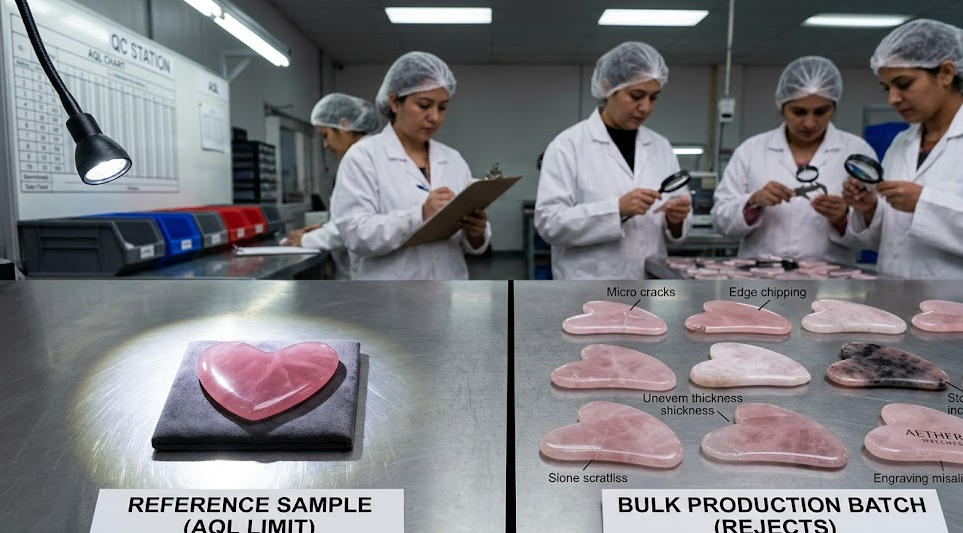
The single most expensive mistake in gua sha wholesale is not choosing the wrong design — it is assuming that a flawless sample guarantees a consistent bulk shipment. Industry return data from B2B wellness product importers consistently shows that over 60% of post-shipment disputes trace back not to a single defective unit, but to systematic inconsistency across an entire production batch. If you are sourcing gua sha wholesale products at scale, understanding how risk is generated and controlled at the manufacturing level is the only reliable way to protect your margins, your platform ratings, and your customer relationships.
This guide is written from the production floor outward. It covers seven categories of gua sha wholesale risks that every buyer — whether you are an Amazon private-label seller, a wellness brand, or a spa distributor — should evaluate before committing to a gua sha supplier. Each section moves from the highest-stakes risks to the operational details, giving you a structured framework you can use as both a sourcing checklist and a supplier audit tool.
Why Batch Consistency Is the Top 1 Gua Sha Wholesale Risk Most Buyers Underestimate
The Real Damage Happens After the Container Arrives
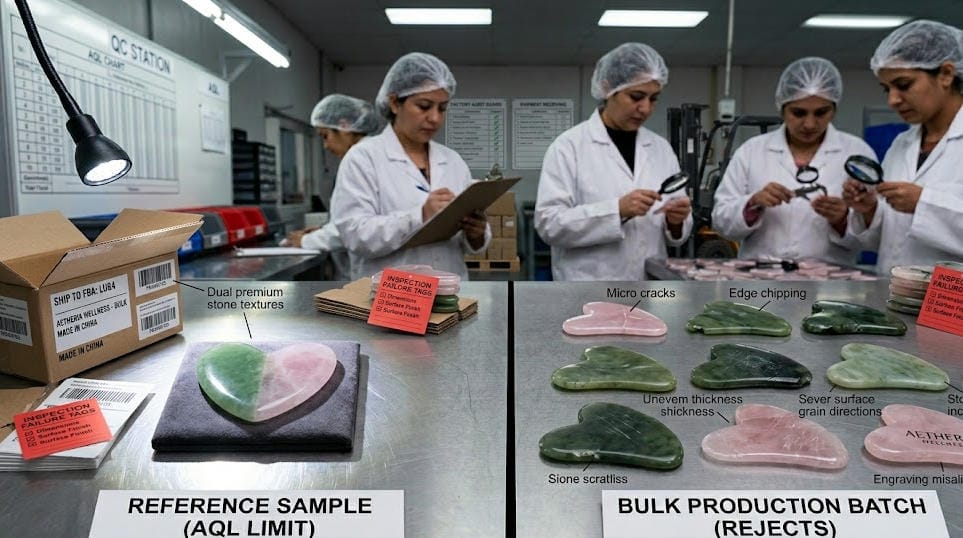
When a gua sha wholesale order fails, the financial impact is rarely limited to the cost of the defective products themselves. The true cost includes return shipping on fragile natural stone items, repackaging fees, Amazon FBA restocking charges, negative review accumulation during the period the defective units are in circulation, and the time cost of dispute resolution with an overseas gua sha supplier. A 2022 industry survey of wellness product importers estimated that the average cost of a batch-level quality failure — where 15–30% of units in a shipment fail inspection — is 3.2 times the value of the defective units themselves, once indirect costs are factored in.
Why Sample Approval Is Not Enough
A single sample from a gua sha factory is produced under controlled conditions, often by a senior craftsperson, using pre-selected raw material. It represents the theoretical maximum quality the factory can produce — not the average quality across 5,000 units. Natural jade, rose quartz, and bian stone all exhibit inherent material variability. Color tone, surface texture, translucency, and internal grain direction shift between quarry batches and even within the same block. Without a formal multi-stage inspection system in place at the gua sha manufacturer, these variables accumulate across a production run and result in a shipment that looks meaningfully different from the approved sample. This means that your customers’ first impression of your product is statistically likely to be worse than the impression the sample created for you.
The Three-Stage Inspection Standard That Separates Professional Factories
Reputable gua sha factory operations structure quality control around three mandatory checkpoints: Incoming Quality Control (IQC), which screens raw materials before processing begins; In-Process Quality Control (IPQC), which monitors dimensional accuracy and surface integrity during machining; and Final Quality Control (FQC), which validates finished goods against approved standards before packaging. According to quality management frameworks aligned with ISO 9001 certification guidelines, manufacturers operating all three stages reduce end-customer defect rates by an average of 47% compared to factories relying solely on final inspection. When you evaluate a gua sha supplier, asking specifically which of these three stages they operate — and requesting documented records from each — is one of the most direct ways to assess batch consistency capability. This means that your wholesale investment is protected by process design, not by luck.
1 — Raw Material Fraud and Quality Variance in Gua Sha Wholesale Sourcing
How Counterfeit and Substituted Materials Enter the Supply Chain
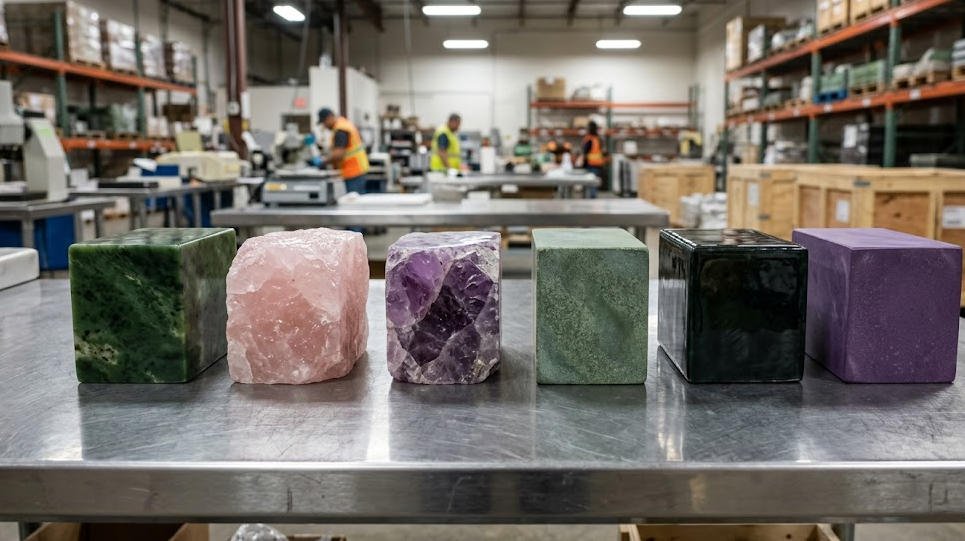
The most financially and legally damaging category of gua sha wholesale risks begins before a single tool is cut or polished. Natural jade, rose quartz, amethyst, and bian stone command significant price premiums over dyed quartzite, glass, resin composites, and synthetic stone — and that price gap creates a persistent incentive for raw material substitution at the supply chain level. In some cases, substitution occurs at the stone quarry or raw block trading level, before the gua sha manufacturer ever receives the material. In other cases, a lower-tier gua sha factory makes a deliberate sourcing decision to reduce input costs without disclosing the change to the buyer. The result, in either scenario, is a product that is marketed as natural jade or genuine crystal but is physically and chemically something else.
The commercial consequences for a wholesale buyer are severe and multilayered. When an end consumer or platform quality auditor conducts a gemological test — even a basic refractive index check using a handheld refractometer — a substituted material will fail immediately. The Gemological Institute of America (GIA) maintains a publicly accessible gem encyclopedia that documents the precise refractive indices, specific gravity values, and spectroscopic signatures of all major gemstones and their known imitations. Any gua sha supplier claiming to use natural nephrite jade, for example, should be able to provide material that tests within nephrite’s documented refractive index range of 1.600–1.641. A product that falls outside this range is, by definition, misrepresented — and the liability for that misrepresentation falls on whoever made the product claim to the end consumer, which in a private-label gua sha wholesale arrangement is typically the buyer’s brand.
How to Verify Material Authenticity Before Committing to a Bulk Order
The first and most reliable protection against material fraud in gua sha wholesale sourcing is requiring your gua sha supplier to provide third-party gemological certification for the raw material batches used in your production run. The Swiss Gemmological Institute (SSEF) and the International Gem Society (IGS) both publish testing methodologies and maintain certification services that cover the stone types most commonly used in gua sha tools. For high-value orders — typically above 500 units using premium jade or high-grade rose quartz — requesting a sample archive from each raw material batch, where the gua sha manufacturer retains a labeled specimen from the input stone, creates a traceable chain of evidence that protects both parties in the event of a dispute.
Beyond formal certification, buyers should establish a raw material supplier audit protocol as part of their standard gua sha wholesale purchasing terms. This means requiring your manufacturing partner to document where each stone type is sourced, which quarries or stone yards supply them, and how incoming batches are evaluated before entering production. A professional gua sha factory operating at a serious quality level will have this documentation available without hesitation. If a supplier cannot answer basic questions about their raw material sourcing, that inability is itself a significant risk signal — and one that experienced gua sha wholesale buyers learn to treat as disqualifying.
Managing Batch-to-Batch Color and Texture Variance in Natural Stone
Even when material authenticity is fully verified, natural stone presents a second category of raw material risk that is less about fraud and more about physics. No two quarry extractions of nephrite jade, green aventurine, or black obsidian are identical. Color saturation, surface texture, translucency, and the distribution of natural inclusions all vary between extraction batches, and sometimes within a single large block. For gua sha wholesale orders requiring consistent visual presentation across hundreds or thousands of units — particularly for retail display sets or private-label product lines with strict brand color standards — this natural variance is a legitimate production challenge that must be managed systematically rather than hoped away.
The operational solution used by experienced gua sha manufacturer operations is a formal raw material grading system applied before production begins. Incoming stone is sorted by color band, surface clarity, and inclusion density, and production batches are assembled from matched-grade material rather than mixed lots. Large wholesale orders, particularly those exceeding 1,000 units, should be negotiated with raw material inventory lock-in written into the production agreement — meaning the gua sha factory commits to holding a sufficient volume of matched-grade stone before cutting begins, rather than sourcing incrementally as production proceeds. This single operational commitment reduces within-order visual inconsistency more reliably than any post-production sorting process, and it means you can present a uniform product line to your retail buyers with confidence.
2 — Manufacturing Defects That Turn Gua Sha Wholesale Orders Into After-Sales Liabilities
Cracking and Fractures: The Most Costly Defect in Natural Stone Processing
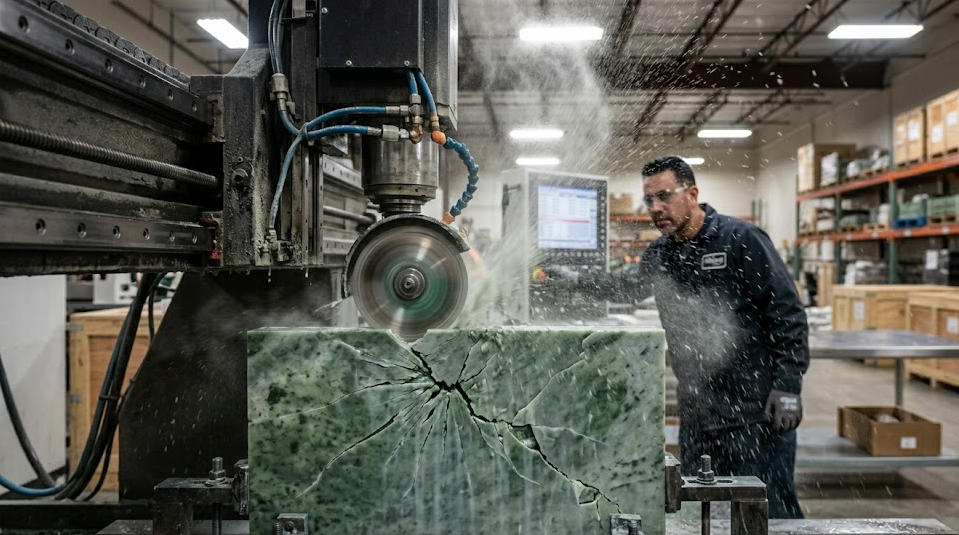
Of all the technical risks in gua sha wholesale production, cracking is the one that generates the highest volume of end-customer safety complaints and the most difficult-to-resolve supplier disputes. Jade, rose quartz, bian stone, and other crystalline materials used in gua sha tools are brittle by nature — they rank between 6 and 7 on the Mohs hardness scale, which means they resist surface scratching but are highly susceptible to propagating fractures when subjected to uneven mechanical stress. During the cutting, drilling, and profile-shaping stages of production, a gua sha factory that has not optimized its toolpath direction relative to the stone’s internal grain structure will consistently generate micro-fractures that are invisible at the time of finishing but propagate into visible cracks during shipping vibration or in the hands of the first user.
The commercial impact of this defect pattern is disproportionately severe for gua sha wholesale buyers operating on retail or e-commerce platforms. A cracked gua sha tool that reaches an end consumer generates not only a return and refund, but a product safety complaint — and on platforms like Amazon, a pattern of safety complaints triggers automated listing suppression that can remove an entire product SKU from sale within 48 hours. Research published by the Consumer Product Safety Commission (CPSC) confirms that personal care tools with documented fracture risks during normal use can be subject to mandatory recall procedures, creating liability exposure that extends well beyond the original product cost. A professional gua sha manufacturer addresses this risk at the process design stage — by establishing cutting direction protocols that align the tool blade with the stone’s least stress-sensitive axis, by controlling spindle feed rates to minimize heat buildup during shaping, and by implementing a mandatory semi-finished goods inspection stage where each piece is evaluated under raking light before polishing begins. This means that fracture-related returns can be reduced to below 1% of shipped units, rather than the 8–12% failure rates that buyers sometimes report from lower-tier suppliers.
Why “Close Enough” Is Not a Manufacturing Standard
A gua sha tool’s effectiveness and user comfort depend on precise geometry. The working edge radius, overall board thickness, lateral curve symmetry, and the transition angle between the concave and convex faces all contribute to how the tool distributes pressure across the skin during use. When these dimensions vary inconsistently across a production batch — even within a range that looks acceptable to the naked eye — the result is a set of tools that feel measurably different in the hand, despite having the same nominal specifications on paper. For gua sha wholesale buyers supplying professional spa operators, licensed estheticians, or premium retail channels, this tactile inconsistency is sufficient grounds for rejection of the entire shipment.
The standard of dimensional control that distinguishes a capable gua sha manufacturer from a price-driven stone workshop is the use of CNC (Computer Numerical Control) machining for all profile shaping operations, combined with a formally documented dimensional tolerance specification for each product model. CNC-machined gua sha tools produced on calibrated equipment can hold thickness tolerances of ±0.3mm and edge radius tolerances of ±0.2mm across thousands of consecutive units — a level of consistency that is physically impossible to achieve with manual grinding methods regardless of operator skill. According to dimensional quality benchmarks referenced in SME Manufacturing Engineering guidelines, CNC-controlled stone processing reduces batch dimensional variation by 62–74% compared to semi-manual alternatives. When you are evaluating a gua sha supplier, asking to see their tolerance specification documents and requesting a dimensional inspection report from a recent production batch gives you direct, quantifiable evidence of their process control capability. This means you can set consistent product specifications in your buyer contracts with confidence that the manufacturing partner can actually meet them.
How Surface Finish Failures Create Both Safety and Revenue Risks
Polishing quality is the final processing stage in gua sha wholesale production and the one that has the most direct impact on both user safety and perceived product value. A gua sha tool with insufficient polishing — whether that means visible surface scratches, uneven sheen distribution across the face, inadequately rounded working edges, or residual abrasive marks in recessed areas — presents a genuine skin safety risk during use. The working edge of a gua sha board makes repeated frictional contact with skin under deliberate pressure, and any surface irregularity in that zone translates directly into micro-abrasion injury. This is not a marginal quality concern — it is a product liability issue that a responsible gua sha factory must address through process design, not through post-shipment disclaimers.
The polishing process for natural stone gua sha tools should progress through a minimum of four abrasive grades — typically from 200-grit initial smoothing through 400, 800, and 1500-grit intermediate stages, followed by a final buff with cerium oxide or aluminum oxide compound to achieve the target surface finish specification. Each transition between abrasive grades should remove all scratch patterns from the previous stage before proceeding, which requires both the correct dwell time at each stage and consistent coolant application to prevent surface heat damage in crystalline materials. A gua sha manufacturer operating a serious quality program applies 100% visual inspection under standardized lighting conditions — typically a 60-watt diffused light source at 45-degree incidence angle — after the final polishing stage, with documented rejection criteria for scratch depth, edge condition, and minimum gloss level measured in GU (gloss units) using a calibrated glossmeter. This means that every unit leaving the production line has been individually verified against an objective safety and appearance standard, rather than evaluated subjectively by an operator working under production pressure.
The economic case for investing in polishing quality is straightforward. Data from gua sha wholesale return analysis consistently shows that polishing-related complaints — scratches during use, rough edges, dull appearance — account for approximately 28% of all one-star reviews on wellness product listings. Eliminating this defect category through upstream process control costs a fraction of what a single wave of negative reviews costs in suppressed organic ranking and lost reorder volume. You reduce your customer acquisition cost every time a unit ships without a polishing defect, because that unit is statistically more likely to generate a positive review that drives the next organic sale.
3 — Product Safety Failures That Create Direct Liability for Gua Sha Wholesale Buyers
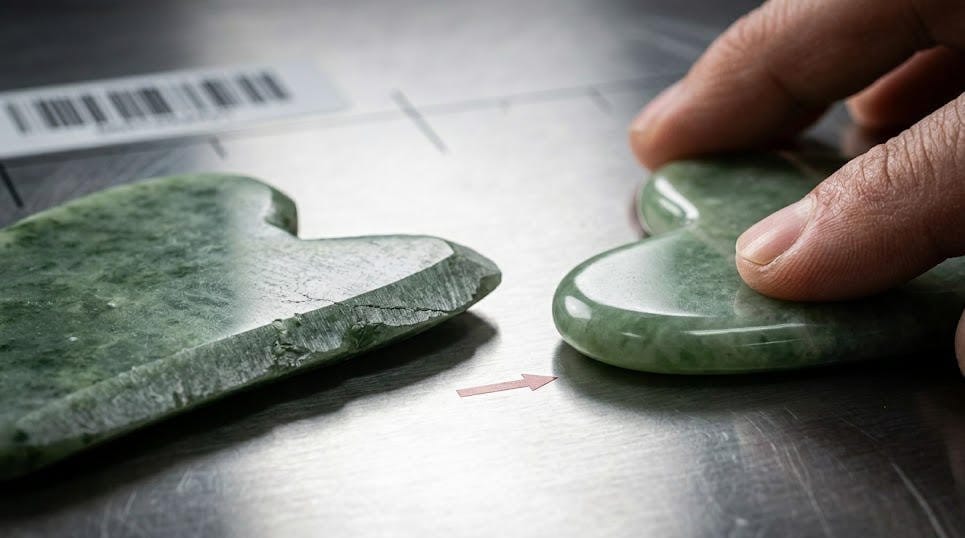
Edge Sharpness Standards: What a Responsible Gua Sha Supplier Must Guarantee Before Shipment
The edge geometry of a gua sha tool is not a design preference — it is a safety specification with direct legal implications for everyone in the distribution chain. A working edge that has been insufficiently rounded after machining can produce skin lacerations during normal use, particularly when the tool is applied with the moderate-to-firm pressure that traditional gua sha technique requires. For gua sha wholesale buyers operating in the United States, the European Union, or the United Kingdom, a documented pattern of edge-related skin injuries connected to a specific product creates exposure under product liability tort law regardless of whether the buyer manufactured the item themselves. The liability follows the brand on the label — which in a private-label gua sha wholesale arrangement is the buyer’s brand.
A professional gua sha manufacturer controls edge sharpness risk through three sequential mechanisms. First, a formally defined edge radius specification — typically a minimum 0.8mm radius on all working edges and a minimum 1.2mm radius on all corner transitions — is written into the product engineering drawing and communicated to every machining operator as a non-negotiable dimensional requirement. Second, a purpose-built edge profile gauge or radius template is used during IPQC checks to physically verify that each semi-finished piece meets the minimum radius specification before it proceeds to polishing. Third, a tactile safety check — where a trained inspector draws their fingertip along all edges of each finished unit under consistent, defined pressure — is performed as part of the FQC stage immediately before packaging. According to guidelines published by the U.S. Consumer Product Safety Commission, personal care tools that make repeated skin contact must demonstrate that edge sharpness has been evaluated as part of the manufacturer’s safety assurance process. When you source from a gua sha supplier that cannot document these three controls, you are accepting a product liability risk that your business insurance may not fully cover. This means that requesting written edge safety documentation from your manufacturing partner is not bureaucratic caution — it is basic commercial risk management.
How to Define Critical, Major, and Minor Defects in Your Supplier Agreement
Not all defects in gua sha wholesale production carry the same risk weight, and inspection resources should be allocated accordingly. The Acceptable Quality Level (AQL) framework, standardized under ISO 2859-1, provides a statistically valid sampling methodology for evaluating production batches without inspecting every unit — but it is only appropriate for defect categories where a small number of escaping defects does not create safety or legal consequences. For gua sha factory operations producing natural stone tools, this distinction is operationally critical and must be explicitly defined in the purchase agreement between buyer and supplier.
Minor defects — which include cosmetic issues such as slight color variation within the accepted grade range, minor surface haze in non-working zones, or marginal gloss level deviation — are appropriate candidates for AQL 2.5 sampling at General Inspection Level II. These defects affect perceived value but do not create user safety risk, and statistically managing their escape rate through sampling is a reasonable quality economics decision. Major defects — including significant dimensional deviation, visible surface scratches in the working zone, inadequate polishing on contact edges, or logo engraving that fails to meet the approved sample — warrant AQL 1.0 sampling, meaning a tighter statistical threshold that allows fewer defective units to pass per batch. Critical defects, however — defined as any defect that creates a direct risk of user injury or that constitutes a material misrepresentation of the product — must be subject to 100% inspection with zero acceptable escape rate. In gua sha wholesale production, critical defects include visible edge cracks, chipped working edges, exposed fracture lines on any surface that contacts skin, and any unit where the declared material does not match the actual material. A gua sha manufacturer that resists implementing 100% inspection on critical defects is telling you, in operational terms, that they are willing to accept a calculable probability of shipping an injurious product. This means that 100% critical defect inspection is a non-negotiable term that should appear in every gua sha wholesale purchase contract, not a premium service that buyers negotiate for separately.
4 — Custom Gua Sha Tools: Design Feasibility Failures and Logo Production Risks
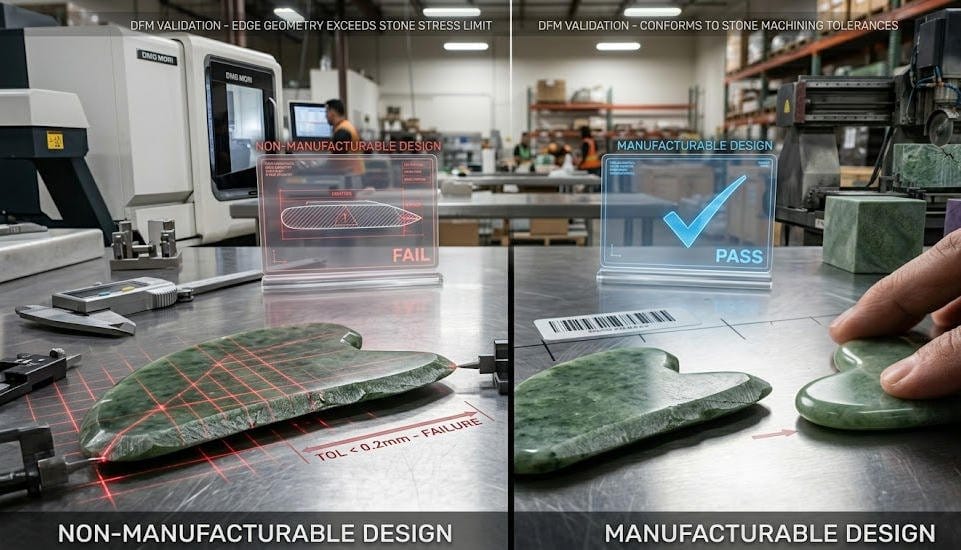
Why DFM Assessment Must Happen Before Sampling, Not After
Custom gua sha tools represent the highest-margin segment of the gua sha wholesale market and simultaneously the highest concentration of pre-production risk. The combination of natural stone’s brittleness, its directional grain structure, and the geometric constraints of gua sha tool ergonomics means that a significant proportion of custom designs submitted by buyers to a gua sha factory contain features that are either impossible to manufacture in the specified material or that result in structural weakness severe enough to cause in-use failure. Common problematic design elements include working edge radii below 3mm in jade or quartz (which produces a structurally fragile tip that fractures under normal use pressure), overall tool thickness below 4mm in crystalline materials (which creates a flexural stress concentration that cracks during shipping), and engraved logo depths exceeding 1.5mm on thin-profile tools (which removes enough material cross-section to create a stress riser at the engraving boundary).
The industry-standard solution to this category of gua sha wholesale risks is a formal Design for Manufacturability (DFM) assessment conducted by the gua sha manufacturer’s engineering team before any physical sample is produced. A DFM assessment evaluates the proposed design against the known mechanical properties of the specified stone material, the geometric capabilities of the available machining equipment, and the structural requirements for the tool to survive both use and shipping without failure. According to product development frameworks referenced by the Society of Manufacturing Engineers, products that undergo formal DFM review before tooling or sampling reduce prototype iteration cycles by an average of 40% and reduce production launch defect rates by 52% compared to designs that proceed directly to sampling without feasibility evaluation. For buyers ordering custom gua sha tools, this translates directly into faster time-to-market, lower sampling costs, and a substantially higher probability that the first production batch meets the approved standard. This means that insisting on a written DFM report before approving sample production is one of the highest-ROI steps available to any gua sha wholesale buyer commissioning a custom design.
How to Protect Your Brand Identity in Custom Production Runs
Logo application on custom gua sha tools is a technically demanding process that is consistently underestimated by first-time wholesale buyers and frequently executed poorly by suppliers without specific experience in stone surface finishing. The three primary logo application methods used in gua sha factory production — laser engraving, diamond-tip mechanical engraving, and pad printing — each carry distinct failure modes that must be controlled through pre-production sample verification rather than post-production inspection. Laser engraving on natural jade or quartz can produce inconsistent depth if the stone’s surface reflectivity varies across the logo area, resulting in characters that appear crisp on one side and faint on the other. Mechanical engraving applied without adequate fixture control produces position drift on curved surfaces, causing logo elements to shift laterally across the tool face. Pad printing — where ink is transferred to the stone surface via a silicone pad — is subject to adhesion failure if the stone surface has not been correctly degreased and primed, resulting in logo elements that peel or fade within weeks of the product reaching the consumer.
The control mechanism that prevents logo failures from reaching gua sha wholesale shipments is a three-stage verification process that begins before quantity production and continues through the first production units. The first stage is a signed golden sample approval, where the buyer physically approves a logo-applied sample against documented specifications for character depth, position coordinates, line weight, and surface finish in the engraved zone. The second stage is a first-article inspection of the initial 10–20 units from the production run, confirming that the production setup replicates the approved golden sample within tolerance. The third stage is a durability verification, where logo-applied samples are subjected to a standardized abrasion test — typically 500 cycles on a Taber abraser at defined load — to confirm adhesion performance before the full production batch proceeds. A gua sha supplier that implements all three stages gives you quantifiable assurance that your brand identity will be represented consistently and durably across the entire order. This means that the investment you make in custom logo design is protected by process controls that extend from the first sample through the last unit shipped.
5 — Production Capacity and Lead Time Risks During Gua Sha Wholesale Peak Seasons
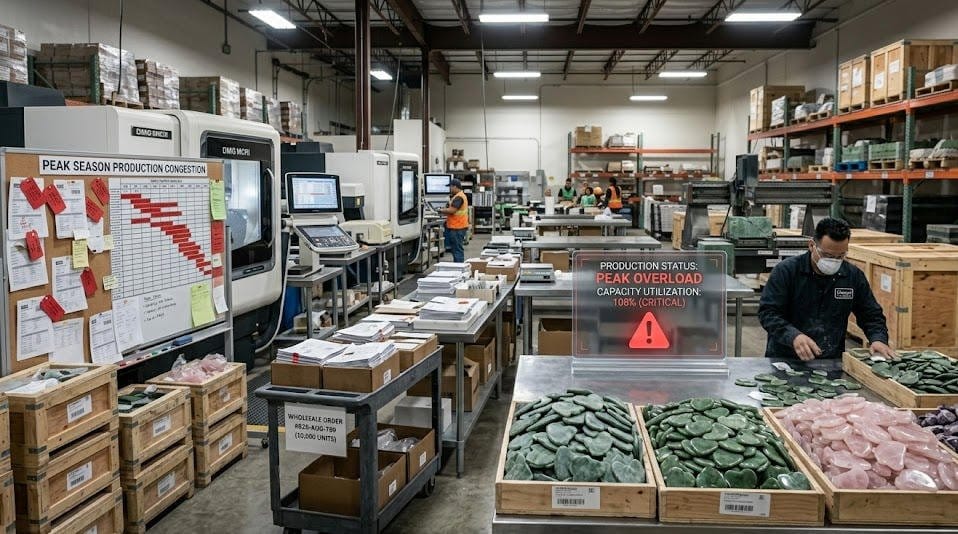
How Seasonal Demand Spikes Create Systemic Supply Failures
The gua sha wholesale market is not evenly distributed across the calendar year. Demand concentrates sharply around a small number of retail events — Black Friday, Christmas, Mother’s Day, and Amazon Prime Day — and the production lead time for natural stone gua sha tools means that manufacturing must begin 10 to 14 weeks before the target in-stock date to reliably meet those selling windows. A gua sha factory that is simultaneously managing orders from multiple wholesale buyers across these same peak periods operates under compressing capacity constraints that most buyers do not fully account for when placing orders. The consequence of underestimating this dynamic is not merely a delayed shipment — it is missing the selling window entirely, which for a seasonal product on a competitive e-commerce platform can mean the difference between a profitable quarter and a loss-generating one.
Data from wholesale logistics tracking services consistently shows that peak-season delivery failures in the natural stone wellness product category are responsible for an estimated 23% of annual buyer-supplier relationship terminations. The buyers who avoid this outcome are not simply the ones with better supplier relationships — they are the ones who treat capacity reservation as a procurement action item, not an assumption. A professional gua sha manufacturer will maintain a visible production calendar and offer capacity reservation agreements to established buyers, typically requiring a deposit against the reserved production slots 8 to 12 weeks in advance of the target ship date. If your current gua sha supplier does not proactively offer this mechanism, asking for it explicitly — and making it a standing term in your annual purchasing agreement — is a straightforward way to reduce your peak-season supply risk without changing suppliers. This means that your sales forecast for the fourth quarter can be backed by a confirmed production commitment rather than a verbal assurance.
How to Build Production Buffer Into Your Gua Sha Wholesale Purchasing Strategy
Natural stone gua sha tools have inherently higher production waste rates than equivalent products made from injection-molded polymers or die-cast metals, and this structural reality must be reflected in how gua sha wholesale buyers specify their order quantities. The waste occurs at multiple stages: raw material sorting rejects material that fails grade specifications before cutting begins; the cutting stage generates breakage from grain-direction misalignment and internal flaw propagation; the drilling and profile-shaping stages produce fractures in structurally compromised zones; and the polishing and inspection stages remove units that have developed surface defects through the preceding process steps. Across a well-managed production run at a capable gua sha factory, the aggregate yield rate for premium jade or high-grade quartz tools typically falls between 72% and 85% of input stone weight, depending on the complexity of the tool geometry and the grade specifications applied at inspection.
For a gua sha wholesale buyer, this yield reality has a direct and calculable implication: if you require 1,000 finished units that meet your quality specification, you should negotiate a production run sized at a minimum of 1,180 units to provide adequate buffer for normal process losses at an 85% yield assumption, or 1,390 units if working with a more complex geometry or stricter grade threshold. A gua sha manufacturer that quotes your exact target quantity without discussing yield assumptions and production buffer is either planning to ship units that should have been rejected, or planning to come back to you for an additional production run — both of which have cost and timeline consequences that you bear. Requesting a documented historical yield rate report, segmented by material type and tool complexity, from any gua sha supplier you are evaluating gives you the data to build realistic buffer quantities into your orders from the outset. This means your landed unit cost calculations remain accurate and your available-to-sell inventory levels match your sales plan, rather than falling short at the moment of peak demand.
6 — Packaging, Labeling, and Shipping Failures for Natural Stone Gua Sha Products
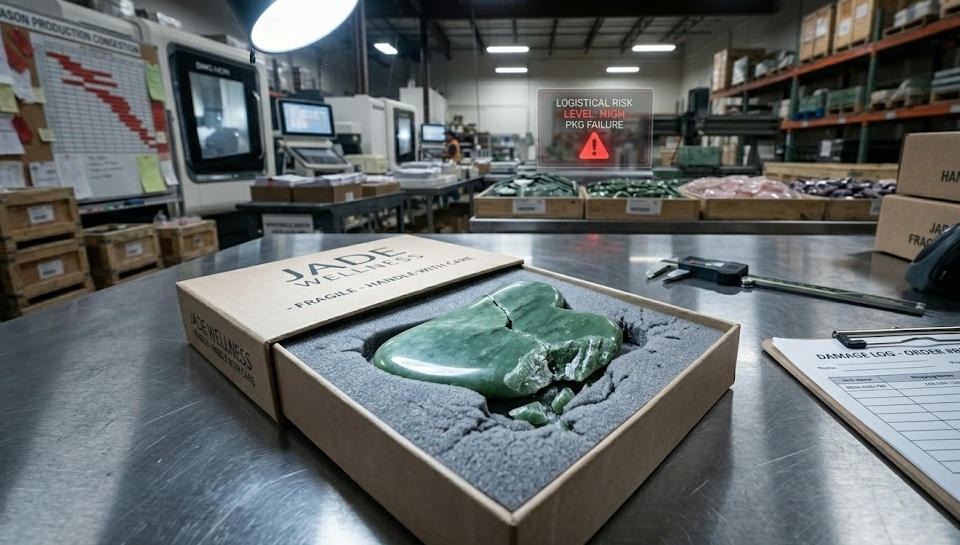
Drop Testing and Protective Packaging Standards for Fragile Stone Tools
Natural stone gua sha tools are among the most fragile product categories in the wellness goods segment, and their packaging must be engineered to that reality rather than selected primarily for aesthetic appeal or cost minimization. The failure mode for inadequately packaged stone tools in transit is specific and predictable: the tool impacts the interior wall of the outer carton during a handling drop event, the packaging material compresses fully without absorbing the remaining impact energy, and the tool edge or corner sustains a chip or fracture. This damage pattern is particularly common when a gua sha factory uses generic foam inserts sized for the outer dimensions of the tool without accounting for the mass concentration at the tool’s thickest cross-section, which generates a rotational impact dynamic that standard flat-foam packaging does not restrain.
The packaging standard that reliably prevents transit damage in gua sha wholesale shipments combines three engineered elements. The first is a custom-formed EVA (ethylene-vinyl acetate) inner liner molded to the specific contour of each tool model, which distributes impact force across the entire tool surface rather than concentrating it at contact points. The second is a minimum 25mm layer of low-density polyethylene foam or air-column cushioning material between the EVA liner and the outer carton wall, providing a secondary energy absorption stage for larger drop events. The third is a documented drop test protocol, where a sample of each packaged product configuration is subjected to drops from a minimum height of 80cm onto a concrete surface in six orientations — flat face, edge, and all four corners — before the packaging design is approved for production use. The International Safe Transit Association (ISTA) publishes standardized test protocols, including ISTA 2A, that are widely accepted by major e-commerce fulfillment operators as the benchmark for transit packaging validation. A gua sha supplier that has completed ISTA 2A testing on their standard packaging configuration can provide you with test reports that directly support your product listing claims and reduce your risk of damage-related returns. This means that your packaging investment is validated by an objective third-party standard, not by the supplier’s internal judgment about what constitutes adequate protection.
How Labeling Failures Create Downstream Inventory and Compliance Problems
Labeling errors in gua sha wholesale shipments generate two distinct categories of downstream damage that are both costly and time-consuming to resolve. The first category is operational: an incorrect barcode or mismatched SKU on a unit entering an Amazon FBA warehouse triggers a receiving exception that can delay the entire shipment’s availability for sale by 5 to 14 business days, during which your inventory is physically present in the warehouse but not sellable. The second category is regulatory: an incorrect material declaration — for example, labeling a green aventurine tool as “jade” or failing to declare the country of manufacture accurately — creates customs compliance exposure and potential platform policy violations that can result in listing suspension or account-level penalties under Amazon’s product authenticity and accurate description policies.
The labeling verification process at a responsible gua sha manufacturer operates through a two-stage confirmation system. The first stage is a pre-production label proof review, where the buyer confirms the exact text, barcode data, material declarations, country of origin, and any regulatory compliance statements on a physical label proof before printing is authorized. The second stage is a pre-shipment label audit conducted as part of the FQC process, where a trained inspector scans every barcode against the purchase order’s SKU list using a barcode verification scanner — not a standard barcode reader, which only confirms that a barcode scans, not that it scans to the correct data — and physically cross-checks material declarations on a random sample against the production batch documentation. According to fulfillment compliance guidelines published by Amazon Seller Central, barcodes that do not match the registered product ASIN at the unit level are among the top five causes of FBA receiving failures for wellness and beauty product categories. For gua sha wholesale buyers managing multiple SKUs across different material types — jade, quartz, bian stone, stainless steel — the risk of a label mix-up during high-volume packing operations is not theoretical. A barcode verification scanner at the packing station, combined with a cross-referenced pick list, reduces this error category to effectively zero at a per-unit equipment cost that is recovered within the first avoided shipment exception. This means that your inventory becomes available for sale on schedule, your FBA account remains in good standing, and your landed cost calculations are not disrupted by unexpected receiving delays.
7 — Regulatory Compliance Risks for Gua Sha Wholesale Across Global Markets
Which Compliance Certifications You Should Require from Your Gua Sha Manufacturer
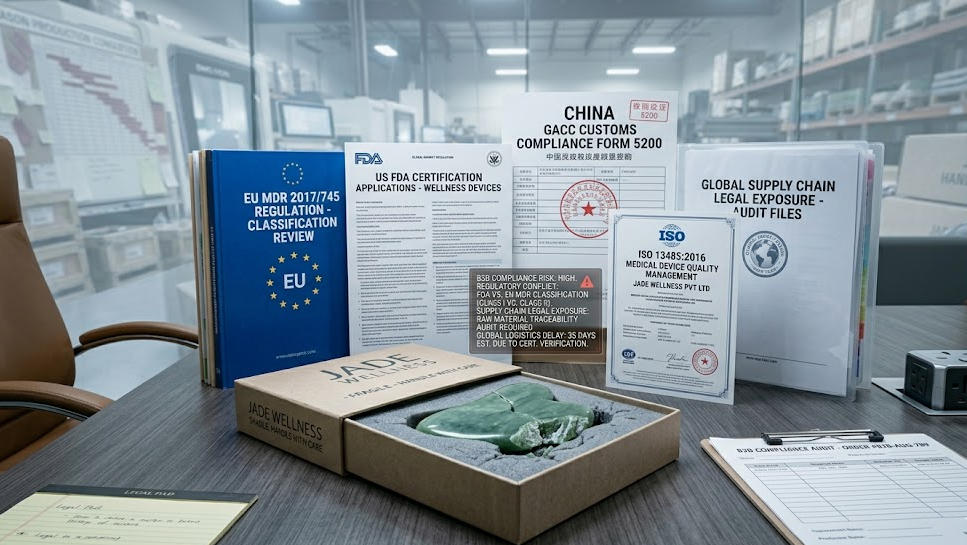
Regulatory compliance in gua sha wholesale is not a single standard — it is a matrix of market-specific requirements that shifts depending on where your product will be sold, what materials it contains, and how it is described in your product listing and packaging copy. Buyers who discover a compliance gap after a shipment has cleared customs are in the worst possible position: the product is physically present in the destination market but legally unsellable, and the cost of storage, retesting, relabeling, or destruction falls almost entirely on the importer of record. Understanding which compliance frameworks apply to your target market before production begins is the only position that gives you meaningful risk control.
For gua sha wholesale orders destined for the United States market, the primary compliance frameworks that apply to natural stone personal care tools are California Proposition 65 — which requires specific warnings if the product contains listed chemicals above threshold concentrations, including certain heavy metals that can be present as natural mineral constituents in some stone types — and CPSC general product safety requirements under the Consumer Product Safety Act. The California Office of Environmental Health Hazard Assessment (OEHHA) maintains the current Proposition 65 chemical list and threshold values, and any gua sha manufacturer supplying the US market should be able to provide heavy metal migration test reports — typically covering lead, cadmium, chromium, and nickel — conducted by an accredited third-party laboratory within the preceding 12 months. For the European Union market, the applicable framework shifts to REACH regulation (Registration, Evaluation, Authorisation and Restriction of Chemicals), administered by the European Chemicals Agency (ECHA), which restricts the presence of Substances of Very High Concern (SVHC) in articles placed on the EU market. A gua sha supplier exporting to EU buyers should hold current REACH compliance documentation confirming that the product does not contain SVHC substances above the 0.1% weight/weight threshold.
How Compliance Documentation Protects Your Business at Every Stage of the Supply Chain
The commercial value of maintaining a complete compliance documentation file extends well beyond the immediate regulatory requirement. When a gua sha wholesale buyer holds current, third-party-verified compliance reports for each product SKU, that documentation serves simultaneously as a customs clearance accelerator, a platform policy compliance asset, a product liability defense tool, and a competitive differentiator in wholesale buyer negotiations. Retail chain buyers and spa distributors sourcing custom gua sha tools for professional use increasingly require suppliers to provide compliance documentation as a standard onboarding requirement — and the ability to produce a complete compliance package on request, rather than initiating a new testing cycle, can be the deciding factor in a competitive sourcing decision.
The recommended compliance documentation set for a gua sha wholesale product line selling across the US and EU markets includes: a heavy metal migration test report (US Prop 65 scope), a REACH SVHC screening report, a material authenticity certification from a recognized gemological authority such as the GIA or SSEF for natural stone claims, an ISTA 2A transit packaging test report, and a manufacturing facility audit record confirming the production site’s quality management system status. A gua sha manufacturer that maintains this documentation set on a rolling 12-month update cycle can provide you with a complete compliance package at the point of purchase order confirmation, rather than requiring a 4 to 6 week testing delay that compresses your lead time. This means that your compliance posture becomes a commercial asset rather than a procurement bottleneck, and your product can move from purchase order to live listing without regulatory interruption.
The Regulatory Boundaries of Material and Efficacy Claims in Gua Sha Marketing
The intersection of gua sha wholesale risks and marketing compliance is an area where buyers frequently create legal exposure without recognizing it as a regulatory issue. The two most common categories of non-compliant claims in the gua sha wholesale market are material misrepresentation and unauthorized health claims, and both are actively enforced by platform operators and regulatory authorities in major markets.
Material misrepresentation occurs when a product is described as containing a material that it does not actually contain, or when qualifying language is omitted that would be necessary for an accurate description. Describing a green aventurine tool as “jade” without qualification, describing a synthetic composite as “natural crystal,” or claiming “100% nephrite jade” for a product that contains nephrite-pattern dyed quartzite are all actionable misrepresentations under FTC guidelines in the United States and equivalent consumer protection regulations in the EU and UK. The Federal Trade Commission’s guidelines on jewelry and gemstone marketing — which courts and platform operators have extended by analogy to natural stone wellness products — require that any material description be accurate, that qualifying terms be used where the material does not meet the standard definition, and that composite or treated materials be disclosed. A gua sha manufacturer that produces your private-label product should be contractually required to provide the accurate material description for every SKU in writing, so that your product listings reflect the actual material content rather than a marketing approximation.
Unauthorized health claims create a separate and potentially more serious compliance risk. Describing a gua sha tool as capable of “treating,” “curing,” or “healing” any medical condition — or making implied therapeutic claims through language such as “clinically proven,” “medically recommended,” or “detoxifying at the cellular level” — subjects the product to medical device regulation in most major markets, which carries a dramatically higher compliance burden and enforcement risk than standard consumer product regulation. The FDA’s guidance on wellness products and device classification makes clear that the intended use communicated through product labeling and marketing — including Amazon listing copy and social media content — determines whether a product is regulated as a medical device, regardless of its physical form. For gua sha wholesale buyers, establishing an internal listing copy review process that screens all product descriptions against a defined list of prohibited claim types is a low-cost risk control that eliminates one of the most common causes of platform listing suppression and regulatory inquiry. This means your product listings remain active and your account standing is protected by a content discipline that costs far less to implement than the consequences of a single enforcement action.
Building a Gua Sha Supplier Relationship Based on Manufacturing Transparency
Key Questions to Ask a Gua Sha Factory Before Placing Your First Wholesale Order
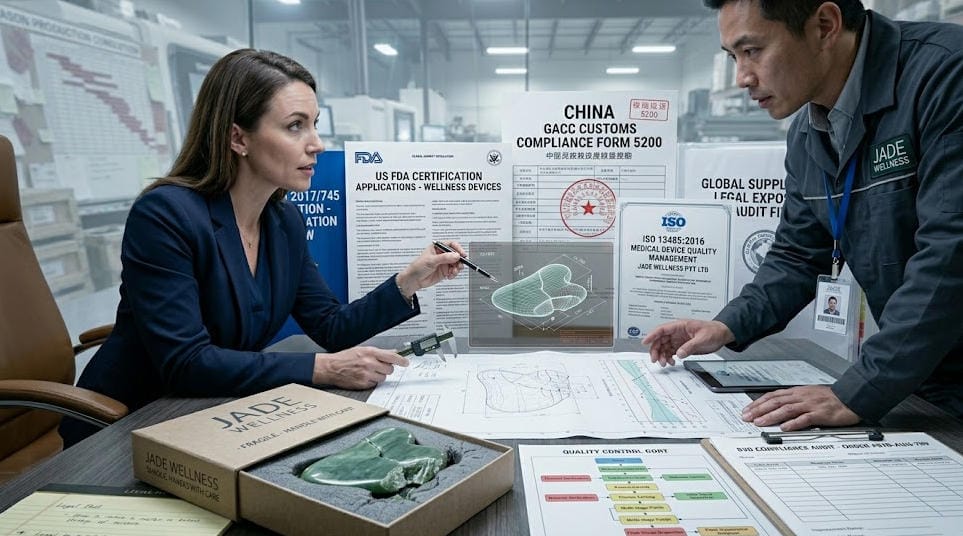
The risk framework described across this guide converges on a single practical question: how do you evaluate a gua sha factory before committing capital to a production run? The answer is not found in factory photographs or website claims — it is found in the specific, documented responses a supplier provides to direct questions about their production processes, quality systems, and compliance infrastructure. The following questions are designed to elicit responses that reveal operational capability rather than marketing positioning, and each question connects directly to one of the risk categories covered in this guide.
Ask your prospective gua sha supplier to describe their raw material sourcing process and provide documentation of their supplier qualification criteria for stone yards and quarries. Ask them to specify their dimensional tolerance standards for each product category and provide a sample IQC, IPQC, and FQC inspection record from a recent production batch. Ask them to explain their critical defect definition and confirm in writing whether critical defects are subject to 100% inspection or AQL sampling. Ask them to describe their DFM assessment process for custom gua sha tools and provide an example DFM report from a previous custom project. Ask them to confirm which compliance test reports they currently hold for their standard product range and their update frequency. Ask them to describe their packaging drop test history and provide ISTA test reports if available. A gua sha manufacturer that answers these questions with documented evidence rather than verbal assurances is demonstrating, through the quality of their response, that their quality management system is real rather than aspirational. The questions cost nothing to ask — and the answers tell you more about a factory’s true capability than any factory visit or product photograph.
The Structural Advantage of Eliminating Intermediary Information Gaps
Every layer of intermediary between a gua sha wholesale buyer and the actual production facility introduces an information gap — a point where quality decisions are made, process deviations occur, or material substitutions happen without the buyer’s knowledge or consent. A trading company or sourcing agent positioned between the buyer and the gua sha factory has limited visibility into production-floor decisions and limited authority to enforce quality requirements at the process level, regardless of what their purchase contract with the factory states. When a quality problem occurs in this structure, the trading company’s primary interest is in managing the buyer relationship, not in resolving the root cause at the manufacturing level — which means the same problem is statistically likely to recur in subsequent orders.
Direct engagement with a gua sha manufacturer that operates its own production facility eliminates this structural information gap. When your quality requirements are communicated directly to the engineering team that designs the production process, the production managers who supervise the machining and polishing operations, and the quality control staff who conduct inspections, the probability that those requirements are actually implemented — rather than interpreted and filtered through an intermediary — increases substantially. For custom gua sha tools in particular, where design intent, material specification, logo application standards, and packaging requirements must all be executed precisely and consistently, direct manufacturer engagement is not a preference — it is a risk control mechanism. You gain real-time visibility into production status, direct access to quality documentation, and the ability to resolve emerging issues before they become shipment-level failures. This means that your gua sha wholesale business is built on a supply chain architecture where quality accountability is traceable to the people and processes that actually determine product outcomes — which is the only foundation on which a scalable, sustainable wholesale operation can be reliably built.
The Manufacturing Risk Framework Every Gua Sha Wholesale Buyer Needs
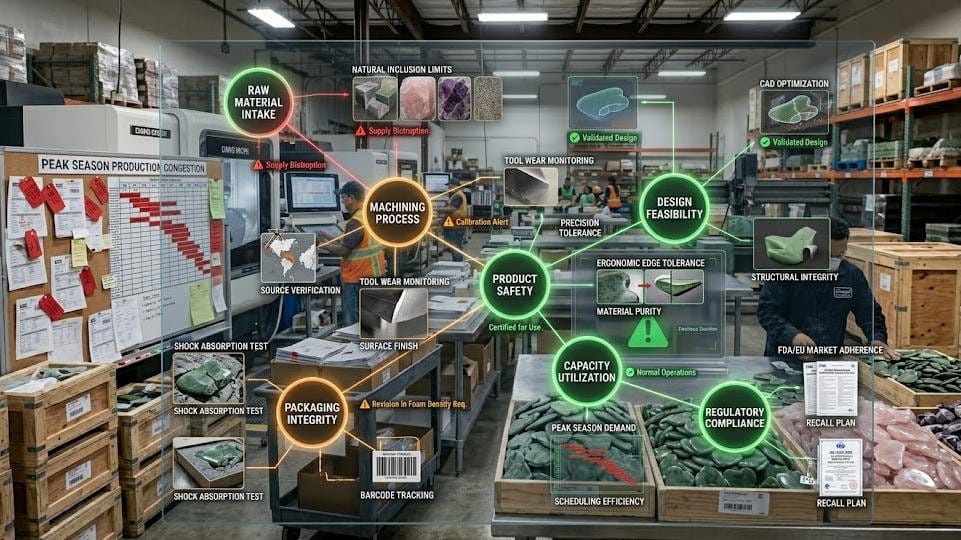
The seven risk categories documented in this guide — raw material authenticity and variance, manufacturing defects, product safety failures, custom design feasibility, production capacity constraints, packaging and labeling failures, and regulatory compliance — are not independent problems. They are interconnected points in a single production system, and a weakness in any one of them creates vulnerability across the others. A gua sha wholesale buyer who controls raw material risk but neglects packaging validation will still face transit damage claims. A buyer who mandates 100% critical defect inspection but skips DFM assessment for custom gua sha tools will still face production launch failures. Effective risk management in gua sha wholesale sourcing requires addressing all seven categories as a system, not as a checklist of optional precautions.
The four variables that experienced gua sha wholesale operators consistently identify as the highest-leverage control points in natural stone production are raw material grade stability, cracking and fracture control during machining, polishing quality consistency, and batch-to-batch dimensional uniformity. These four variables account for the majority of quality failures and after-sales costs in the natural stone wellness tool category, and they are all controllable through process design at a capable gua sha manufacturer — not through post-production sorting or buyer-side inspection. Investing the time to verify that your gua sha supplier has robust systems for all four before you place your first significant order is the most reliable way to build a gua sha wholesale business that grows through repeat orders and positive reviews rather than being constrained by quality disputes and supply chain failures.
Faqs About Gua Sha Wholesale Risks
1. How can I verify that a gua sha supplier is using genuine natural stone?
Request third-party gemological test reports from accredited institutions such as GIA or SSEF, and require raw material batch documentation for every production run before approving manufacturing.
2. What is the minimum order quantity for custom gua sha tools?
Most gua sha manufacturers set custom order minimums between 200 and 500 units, depending on material type and design complexity. DFM assessment is recommended before committing to any custom production run.
3. How do gua sha factories control product consistency across large wholesale orders?
Professional factories apply IQC, IPQC, and FQC inspection at three production stages, combined with raw material grading systems that match stone color, texture, and clarity before cutting begins.
4. Which compliance certifications are required for gua sha wholesale products sold in the US?
US-market gua sha products typically require California Proposition 65 heavy metal test reports and CPSC general safety compliance documentation. Certification requirements vary by state and distribution channel.
5. What causes transit damage in gua sha wholesale shipments, and how is it prevented?
Inadequate inner packaging is the primary cause. Custom EVA liners, secondary cushioning layers, and ISTA 2A drop testing prevent transit damage before a packaging design enters production use.