
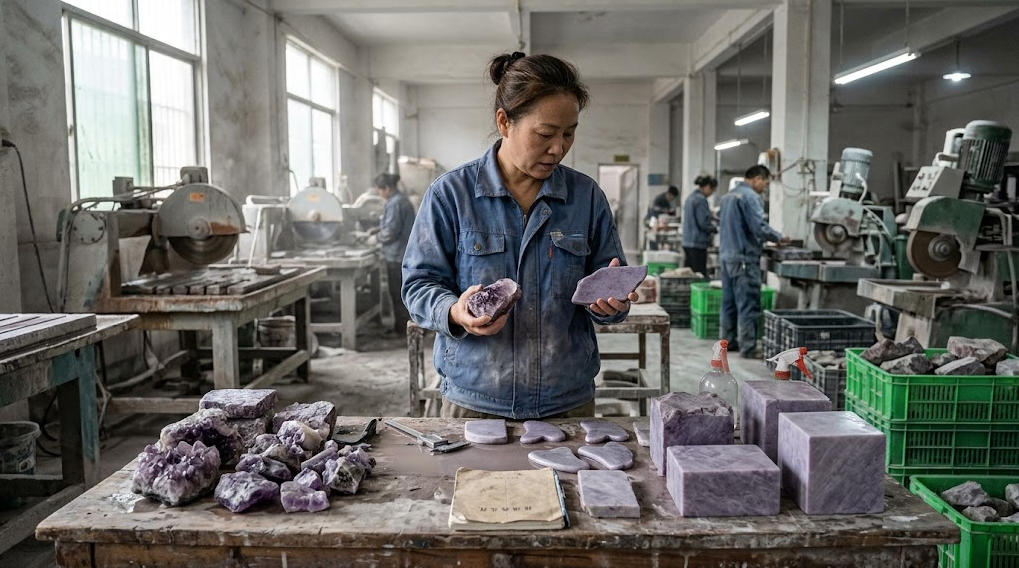
Gua Sha R&D comes down to one number from 2022. When amethyst supply tightened mid-year, a substitute stone known internally as “purple stone” arrived at about one-third of amethyst’s raw-material cost, roughly 66.7% lower. It still needed several rounds of testing before approval, because a low price says nothing about whether a stone can be cut, polished and used safely on skin.
This article is a risk disclosure from a gua sha factory with more than 12 years of experience in jade and crystal tools. You will see what a cheaper stone really costs per finished piece, which safety checks you should ask for, and where new gua sha R&D can go wrong before a product reaches your shelves. Treat it as a checklist for your next sourcing call.
Ready to start? Begin with the money, because that is where most substitute-stone decisions go wrong.
Table of Contents
Gua Sha R&D Cost Reality: Is a Substitute Guasha Material Really Cheaper?
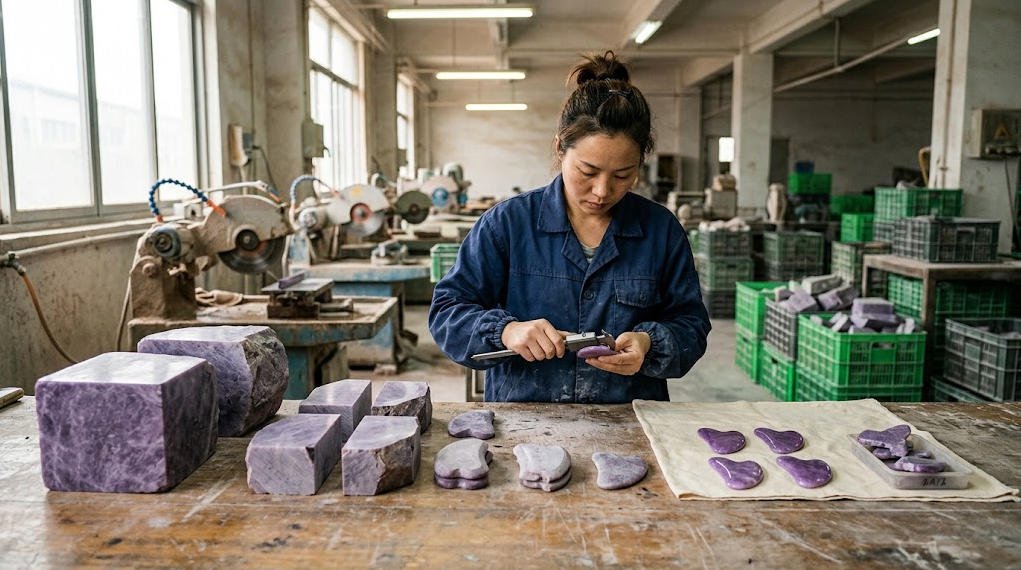
A cheap stone is not the same as a cheap product. Raw stone is only the first line on your cost sheet, and cutting, shaping, polishing, breakage, sorting and testing all land on the same finished piece. Good Gua Sha R&D compares those totals, not the price per kilo of rock. This means you can avoid approving a substitute on a quote that looks 67% cheaper and ends up costing more per finished piece.
The 2022 amethyst squeeze showed how fast this plays out. Orders for purple tools kept rising while raw supply tightened, so extra demand added purchasing, scheduling and delivery pressure instead of easing it. Dropping the colour was not an option for brands that had already planned their ranges around it. That is why the search for a substitute started.
How to Calculate Total Gua Sha R&D Cost per Piece
You can run the numbers yourself in four moves. First, divide the raw cost per blank by the yield to get the raw cost per finished piece. Second, add processing cost per finished piece, meaning cutting, CNC shaping and polishing labour. Third, add your share of development cost, such as samples, lab tests and the trial run. Fourth, compare the totals instead of the stone prices.
The table below uses an illustrative index, not measured production data. Amethyst is set at 100 per blank with an 85% yield. The substitute is 33.3 per blank with a lower 70% yield and slightly higher processing cost.
| Material | Amethyst | Purple stone |
|---|---|---|
| Raw cost per blank | 100 | 33.3 |
| Yield | 85% | 70% |
| Raw cost per finished piece | 117.6 | 47.6 |
| Processing per finished piece | 30 | 35 |
| Total per finished piece | 147.6 | 82.6 |
Even with a 15-point yield penalty, the total lands about 44% lower. This means you can ask any supplier for its yield and processing assumptions and see the real saving in one line.
What a One-Third Raw Price Means for Your Gua Sha Wholesale Margin
In that example the saving shrinks from 66.7% to about 44%, because lower yield and extra processing absorb part of the gap. For a gua sha wholesale order, that 44% decides whether you cut the retail price, protect your margin, or fund a wider colour range. Each path is valid, but each needs a different standard for colour range and surface finish. This means you can decide the purpose of the substitute before the sample stage, not after the invoice arrives.
Gua Sha R&D ROI: When Does the Raw-Cost Advantage Disappear?
Using the same index, the substitute only matches amethyst’s total cost when yield falls to roughly 30%. Below that line, you pay more for the cheaper stone. A batch with hidden fractures can still drop that far, which is why a Gua Sha R&D project should trust the trial run more than the quote.
Development cost matters too. Samples, lab tests and the trial run are spent before the first paid order, so a small order carries a larger per-piece share of them. This means you can set a minimum pilot-run yield in your sample approval, and ask how development cost is spread across your first order.
Gua Sha R&D Compliance: Which Safety Checks Must a New Stone Pass?
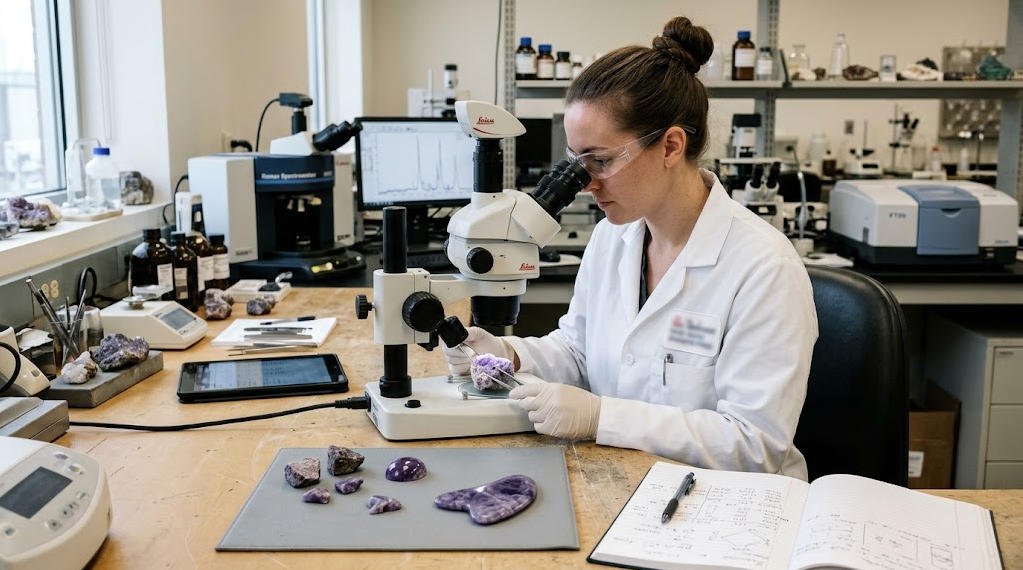
Safety deserves the most attention in any new gua sha R&D project, because the tool presses on skin. Colour and smell cannot tell you what a stone contains, and a purple stone can look right while being the wrong material. Our review of purple stone followed four stages: identity, harmful elements, release risk, and finished product. Any gua sha manufacturer you work with should be able to show all four on paper. This means you can use the same four stages as your supplier questionnaire.
How to Confirm Mineral Identity Before Gua Sha R&D Moves to Production
Start with the name. GIA lists amethyst as a quartz variety with a Mohs hardness of 7, and the same page notes that any gem can be imitated, sometimes by natural materials chosen to impersonate it. “Purple stone” is an internal trade name, not a mineral name, so your listing should carry the species a laboratory actually confirms for the guasha material. Gem laboratories such as SSEF and GIA issue identification reports that state species and whether a stone is natural or synthetic. You can ask an accredited laboratory for the same kind of identification on representative samples of a gua sha lot. This means you can stop a mislabelled stone before it reaches your packaging and your customers.
Which Harmful-Element and Release Tests Fit Skin-Contact Gua Sha?
Test choice depends on composition, contact and market. REACH applies to consumer products sold in the EU, and Annex XVII restricts substances such as lead, cadmium and nickel. For jewellery, the limits are 0.05% lead and 0.01% cadmium. Gua sha tools are not jewellery, so those figures are reference points rather than automatic limits, and labs quoting REACH usually default to Annex XVII.
Detecting an element is also different from proving it is released in normal use. Content, chemical form and exposure route all matter, so a sound plan tests release only where the composition points to a risk. This is general guidance, not legal advice, so confirm the rules for your target market with a compliance laboratory. This means you can ask for test items matched to your stone and your market instead of paying for a generic panel.
Why a Lab Report Does Not Replace Batch Checks
A report describes a stone on the day it was tested. SSEF makes this point itself: it states that its findings reflect the stone’s condition at the time of testing and carry no guarantee afterwards. The same logic applies to your orders, because a certificate for one sample says little about the next shipment from a different vein.
Coatings, dyes and adhesives can also change the risk profile of the finished tool, even when the raw stone is clean. So ask for lot records, retained samples and a re-test rule that triggers whenever the source or lot changes. This means you can write the checks into your purchase agreement and hold every shipment to the same evidence.
Gua Sha R&D Stone Testing: Hardness, Toughness and Yield
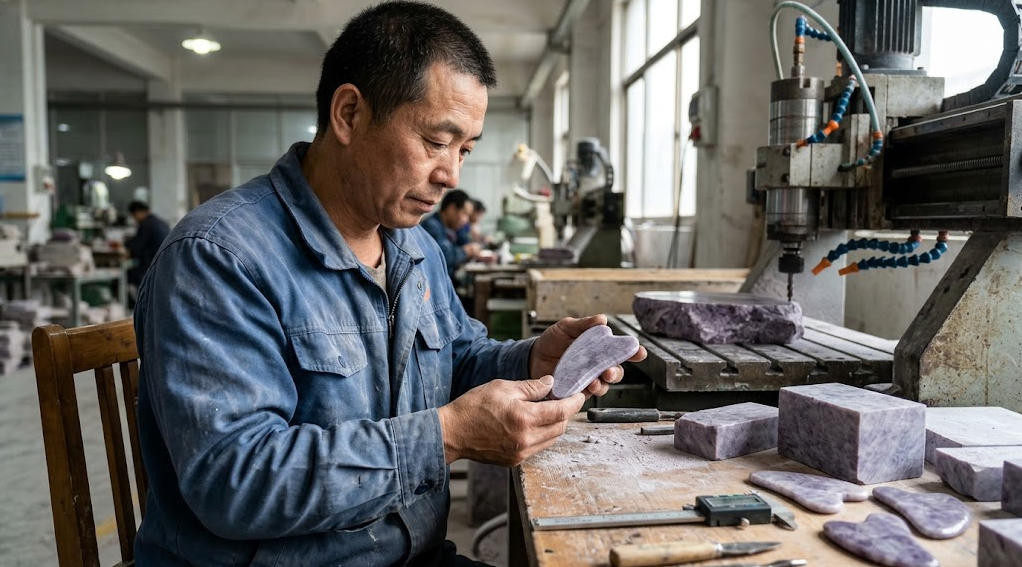
Once a stone passes the identity check, the next question is whether it survives a production line. This is the stage of Gua Sha R&D where an attractive rock most often turns into scrap. Hardness and toughness decide whether a blank becomes a finished tool or a pile of chips. This means you can predict breakage costs before they show up on your invoice.
Hardness vs. Toughness: Which Matters More for Gua Sha CNC Shaping?
The two are different properties. Hardness is resistance to scratching. The Mohs scale, created by Friedrich Mohs in 1812, ranks it from 1 for talc to 10 for diamond, with quartz at 7 and topaz at 8, according to the International Gem Society. The same source points out that the scale says nothing about toughness, and that some very hard minerals are brittle. GIA describes toughness as resistance to breaking and chipping, and lists hardness, toughness and stability as the three factors of durability.
On the shop floor, hardness shapes tooling, abrasives and polishing time, while toughness shapes chipped edges and cracked thin sections. A harder stone is not automatically better, because it may need slower cutting and cause heavier tool wear. A softer stone may struggle to hold a clean polish. Keep both numbers in every Gua Sha R&D file. This means you can ask a supplier for hardness and toughness in plain words before you accept any substitute.
How to Run a Gua Sha R&D Sample Test Step by Step
You can copy the sequence that purple stone went through. First, slice the raw material and look for cracks or unexpected breakage. Second, run CNC shaping and edge work, and note whether the cutting stays stable. Third, polish the piece and inspect it for chipped edges, cracks or surface defects that cannot be repaired. Fourth, repeat the process on several lots, because batches differ. Fifth, measure the finished pieces against the agreed size, shape and surface requirements.
Each check feeds one figure: pieces lost per hundred blanks. That figure is the backbone of any Gua Sha R&D budget, because it sets the yield in the cost model above. This means you can turn a small sample test into a yield estimate and catch a cost problem while it is still small.
Why “Can It Be Cut?” Is the Wrong Question for Guasha Material Selection
Almost any stone can be cut into a rough shape. The real question is whether it can be shaped, finished and repeated at an acceptable cost and quality, lot after lot. A stone may pass slicing and still chip during thin-edge work, or finish well in one lot and crack in the next.
A gua sha factory that only reports “it can be processed” is giving you half an answer. When you evaluate any guasha material, ask for loss rate, rework rate and lot-to-lot differences. This means you can compare two candidate stones on stable output instead of one good sample.
Gua Sha R&D Case File: How the 2022 Amethyst Shortage Led to Purple Stone
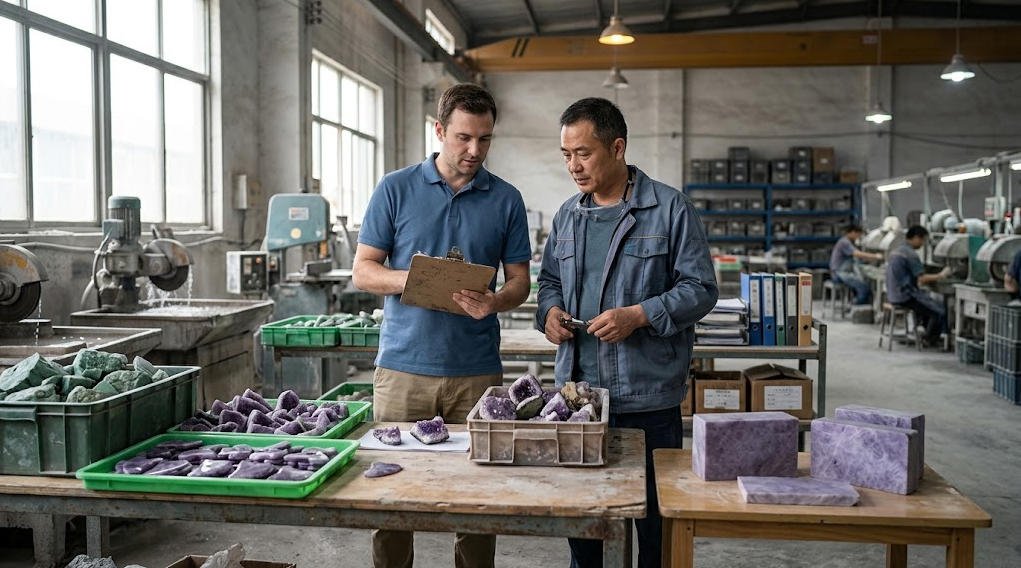
From mid-2022, amethyst raw material became scarce while purple gua sha orders kept growing. Rising orders sound like good news, but they put extra pressure on purchasing, scheduling and delivery. Raw material costs climb, lead times stretch and purchase volumes fall short. That pressure started the new gua sha R&D work described here. This means you can watch for the same early signs in your own supply chain: growing orders, longer quotes and slipping lead times.
Why Colour Match Alone Fails When You Choose an Amethyst Substitute
The obvious move is to find another purple rock. But two stones that look alike in the raw can differ in hardness, toughness, internal structure, cutting behaviour and polish. One purple candidate may have a strong colour but many fissures, so thin outlines break. Another may machine well and polish to the wrong shade. A third may be cheap per kilo and lose the saving to breakage.
Sound Gua Sha R&D treats colour as a screening filter for any guasha material, never as the verdict. This means you can reject any substitute proposal that rests on colour and price alone.
How Gua Sha R&D Narrowed the Field to One Candidate
After several rounds of screening, the gua sha factory chose the stone it calls purple stone. Its raw cost was about one-third of amethyst’s, which is 66.7% lower. Price opened the door, but it did not close the decision. The team then evaluated hardness, toughness, internal composition and potential release risk before accepting it as a candidate production material.
Note the word candidate. Approval at this stage means “worth a pilot run”, not “ready for every order”. This means you can treat any supplier’s “approved material” claim as the start of validation and ask which stages are still open.
What Stayed Undecided After Approval
A risk disclosure should say what remains open. First, “purple stone” is a trade name, so any product page should state the mineral name confirmed by a laboratory and never call the stone amethyst. Second, natural stone varies by lot, so colour, texture and internal structure can shift between shipments. Third, the substitute does not replace amethyst for every customer. Some buyers want the amethyst name and will pay for it, while others want a purple tool at a lower price. Those are different products with different standards.
A gua sha manufacturer that blurs the two shifts the risk onto your brand. Your gua sha wholesale contract should name the exact material on the sample card. This means you can ask for separate product names, separate sample standards and separate test files for each material.
Gua Sha R&D Roadmap: From Sample to Bulk Order in Four Stages
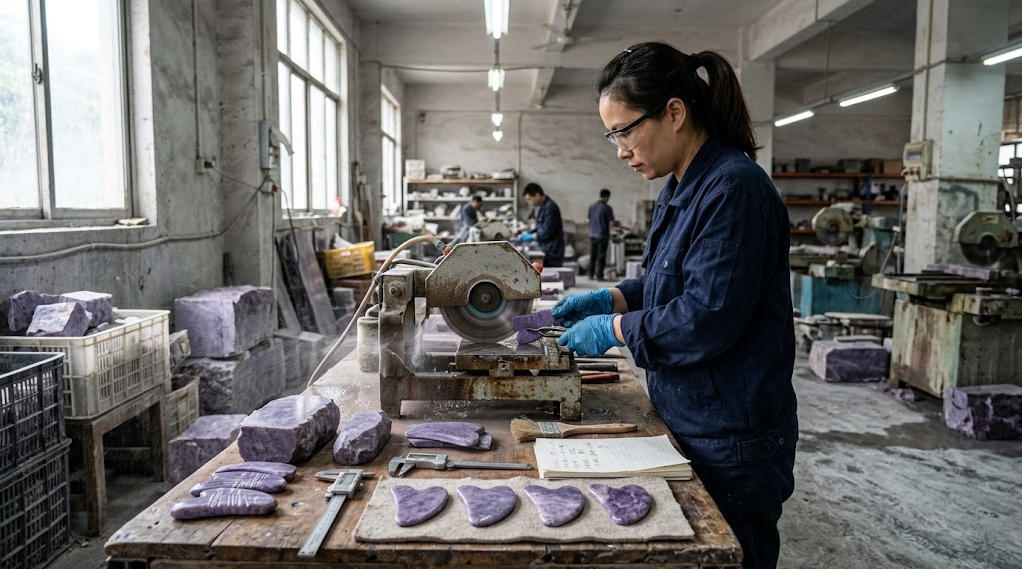
Passing the first screen does not mean a stone is ready for volume. A material that behaves in ten samples can fail across a thousand blanks, so new gua sha R&D scales its checks in steps: sample, finished inspection, pilot run, written standard. Each stage costs more than the last, which is why the cheap tests come first. This means you can drop a weak candidate early and spend your budget only on stones that keep passing.
How to Run a Small-Sample Trial for a New Guasha Material
Use the real process, not a gentle version of it. Cut, shape, grind and polish the sample with the same steps a bulk order would use. Record every parameter that changes for the new stone, such as feed speed or polishing time, along with any cracks, chips or surface faults. A stone that needs a different recipe also carries different labour and tooling cost, and that cost belongs in your model. This means you can see the true processing cost before a single bulk blank is bought.
How to Inspect Finished Pieces for Colour, Transparency and Natural Variation
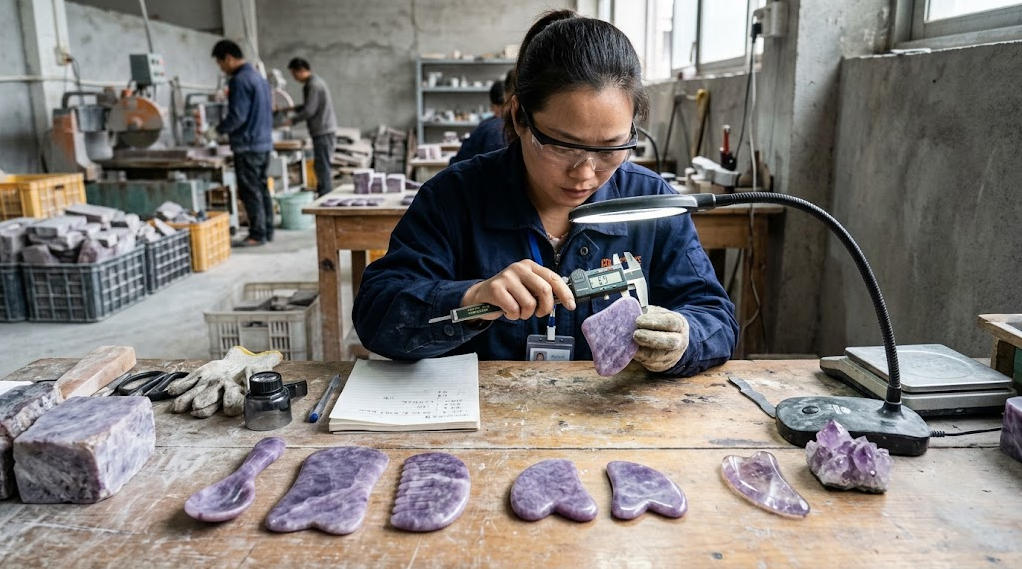
Check the shape, size, edge state and polish of each sample, then judge colour, transparency, texture and internal structure. Natural stone will never match like moulded plastic, so the useful question is how much variation you accept. Agree on that range with your gua sha manufacturer before production, using a signed sample or a standard sample card. Natural variation is not a defect, but undefined variation turns into disputes. This means you can reject pieces against a written range instead of an opinion.
What a Pilot Run Reveals About Yield, Rework and Batch Consistency
A pilot run turns lab results into production data. Track loss, rework, size stability and lot-to-lot differences across a small batch. If yield drops sharply compared with the samples, there are three options: adjust the process, tighten raw-material selection, or reopen the commercial case. In the cost model from the first chapter, the yield figure moved the total more than any other input. This means you can ask your gua sha factory for pilot yield and rework rate, and use them to check any quote.
Which Approved Standard Sample Prevents Disputes in Gua Sha Wholesale Orders?
Before the first paid order, write the requirements down. The file should hold the material identity and source record, the accepted colour and texture range, size tolerance, surface-defect limits, packaging requirements and the test documents that apply. For a gua sha wholesale buyer, the signed standard sample is the document that settles an argument on delivery day. This means you can compare each shipment against the same reference and avoid renegotiating quality after the goods are made.
Gua Sha R&D Mistakes: Five Risks to Check Before You Approve a Substitute
Five errors appear again and again in substitute-stone projects. None needs special equipment to avoid, only the habit of asking for evidence. Which of them could already be sitting in your current supplier file?
Why Price-Only Decisions Backfire in Gua Sha R&D
The first mistake is approving a stone because the raw price is low. Higher breakage or heavier quality control can erase the saving, as the illustrative index showed: a 66.7% raw-material gap shrank to about 44% per finished piece, and it would vanish near 30% yield. A gua sha factory that quotes you only a per-kilo figure is hiding most of the cost build-up. Compare raw price, processing cost, yield and positioning together. This means you can request the full cost breakdown and decide on the real number.
Why Look-Alike Naming and Hardness Shortcuts Create Risk
The second mistake is treating similar colour as the same material. A purple stone is not amethyst because it is purple, and GIA’s own pages note that merchants are required to say whether a gem is natural or synthetic. The same honesty applies to naming: state the real mineral so your product claims match what is in the box.
The third mistake is judging quality by hardness alone. A stone can score high on the Mohs scale and still fracture along internal fissures, while an easy-to-cut stone still needs surface-quality and safety checks. Use several measures together for any guasha material. This means you can challenge a supplier claim that rests on a single number.
How to Control Batch Variation and Product Positioning in Gua Sha R&D
The fourth mistake is ignoring lot differences. A sample that looks perfect does not guarantee that next quarter’s raw material matches it. Control it with raw-material sorting, lot inspection and a standard sample, and confirm the accepted range with your gua sha wholesale partner before production begins.
The fifth mistake is leaving the substitute’s role undefined. If the new stone looks different from the original, selling it as a separate line is often cleaner than forcing it to stand in for the old one. A gua sha manufacturer should be able to say whether the goal is lower cost, wider colour choice, supply security or a new range, because each goal sets different quality limits. This means you can write the goal into the project brief and judge every later decision against it.
Gua Sha R&D Decision Guide: Line Extension or Substitution?
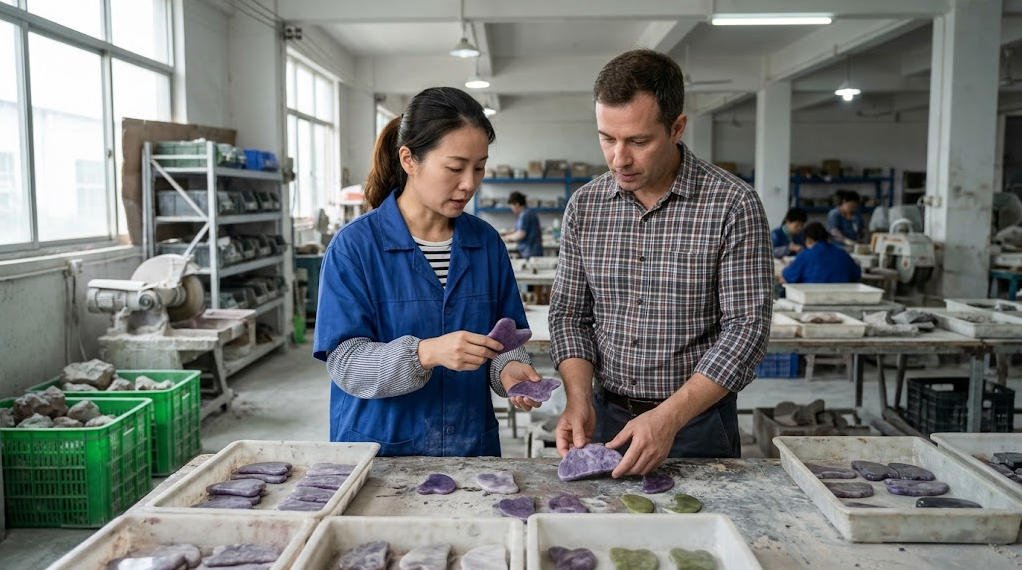
Brands add stones to a range for two different reasons, and mixing them up is expensive. Knowing which one you are solving saves weeks of testing. This is the last question to settle before you ask any gua sha wholesale supplier for samples.
How to Decide Between a New Colour Line and a Replacement Stone
A line extension widens colour and texture choice and gives a range a distinct look. A substitution protects supply of a product that already sells. The first asks whether shoppers will want the new stone, while the second asks whether the original specification survives a change of material.
For a substitution, list what must stay, such as the purple colour, and what may move, such as mineral composition, texture, transparency or cost. Spotting an attractive stone is only the starting point of new gua sha R&D. Supply channel, shaping yield, polish result, defect rate and cost all have to hold up as well. This means you can match the test plan to your goal and skip checks that do not serve it.
What to Ask Your Gua Sha Manufacturer Before the Next Order
Bring four questions to your next call. What is the confirmed mineral name, and which laboratory confirmed it? Which tests apply to your target market, and which lot do they cover? What yield did the pilot run reach, and what rework rate came with it? Which signed standard sample will each shipment be checked against?
Donghua, a gua sha factory with 12+ years of jade and crystal tool work, can share sample test notes and talk through these points before you commit to a lot. Any supplier that answers with documents instead of adjectives is worth keeping. This means you can sort partners by evidence within one conversation.
Honest Gua Sha R&D will sometimes tell you that a cheaper stone is not worth it. That answer protects your margin, your customers and your brand name. The 2022 amethyst shortage taught one lasting lesson: a substitute is only as good as the testing, the naming and the standard sample behind it.
Frequently Asked Questions About Gua Sha R&D and Substitute Stones
1. What is Gua Sha R&D, and why would a factory start it when a stone runs short?
Gua Sha R&D is the process of finding, testing and approving a new material or product before it goes into bulk production. In 2022, amethyst supply tightened while purple gua sha orders kept growing, so a gua sha factory had to screen replacement stones instead of dropping the colour. This means you can expect any supplier facing a shortage to show you its screening steps, not just a new stone.
2. How much cheaper is a substitute guasha material than amethyst?
In the 2022 case, the substitute known internally as “purple stone” cost about one-third of amethyst in raw material, roughly 66.7% lower. Raw price is only part of the bill, though. In the illustrative cost model, lower yield and extra processing cut the saving to about 44% per finished piece. This means you can treat the raw-price gap as a ceiling and the finished-piece cost as the number that matters.
3. How do I calculate the real cost per finished piece?
Divide the raw cost per blank by the yield, add the processing cost per finished piece, then add your share of development cost such as samples, lab tests and the trial run. Compare totals between materials instead of stone prices per kilo. This means you can ask your gua sha manufacturer for yield and processing assumptions and verify any quote in a few minutes.
4. At what yield does a cheaper stone stop saving money?
In the illustrative model, the substitute only matches amethyst’s total cost when yield falls to roughly 30%. The exact break-even depends on your own raw, processing and development costs. This means you can set a minimum pilot-run yield in your sample approval and walk away if the stone misses it.
5. Can a purple substitute be sold as amethyst?
No. “Purple stone” is an internal trade name, and amethyst is a specific quartz variety. A listing should carry the mineral name that a laboratory confirms, so your product claims match what is in the box. This means you can protect your brand by requiring the confirmed mineral name on every spec sheet and product page.
6. Is a new stone compliant for skin-contact gua sha tools?
It depends on the stone’s composition, your target market and how the product is classified. EU REACH applies to consumer products, and Annex XVII restricts substances such as lead, cadmium and nickel, but the 0.05% lead and 0.01% cadmium limits come from jewellery rules and serve as reference points for gua sha. This is general guidance, not legal advice, so confirm requirements with a compliance laboratory for your market. This means you can ask for tests matched to your stone and market instead of a generic panel.
7. What tests should a gua sha manufacturer run on a new stone?
Four stages cover the essentials: mineral identity, harmful elements, release risk, and finished-product verification including coatings, dyes or adhesives. Alongside these, the factory should record hardness, toughness and yield from sample cutting and polishing. This means you can use the same four stages as a supplier questionnaire.