
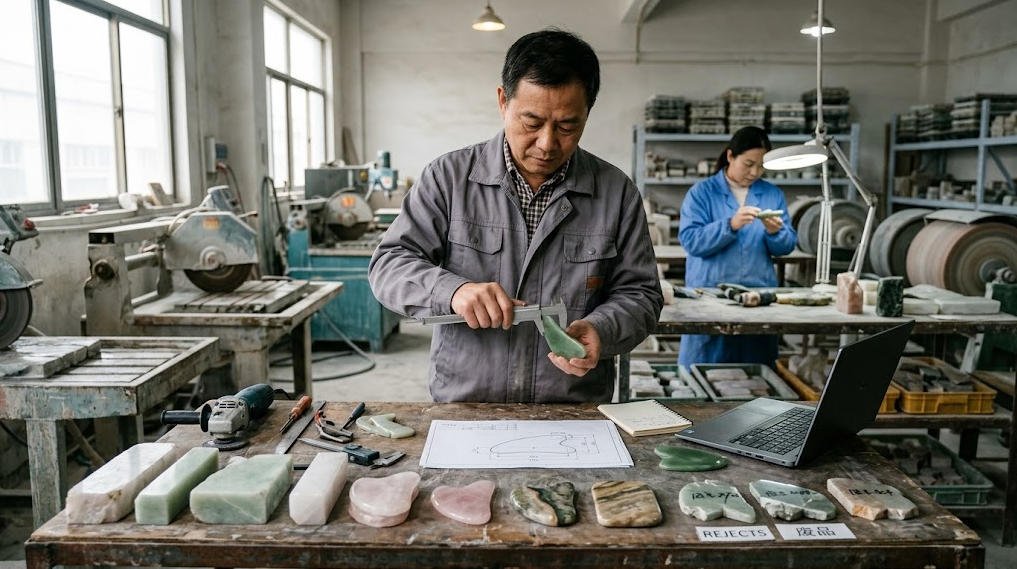
A gua sha custom project succeeds or fails on three numbers: material yield, unit cost after tooling, and the tolerance you can actually inspect. Take a $300 development fee. At 100 pieces it adds $3.00 to every unit, at 500 pieces $0.60, and at 2,000 pieces just $0.15, before a single stone is cut. Jade and quartz crystal both sit between Mohs 6 and 7, hard enough to polish well but unforgiving at a thin edge or a deep groove. This guide shows how a gua sha manufacturer judges whether your design can be repeated at volume, so you can spot problems before you pay for samples. Every figure labeled “example” is for illustration only and is not a quote.
Can a Gua Sha Factory Mass-Produce Your Gua Sha Custom Design?
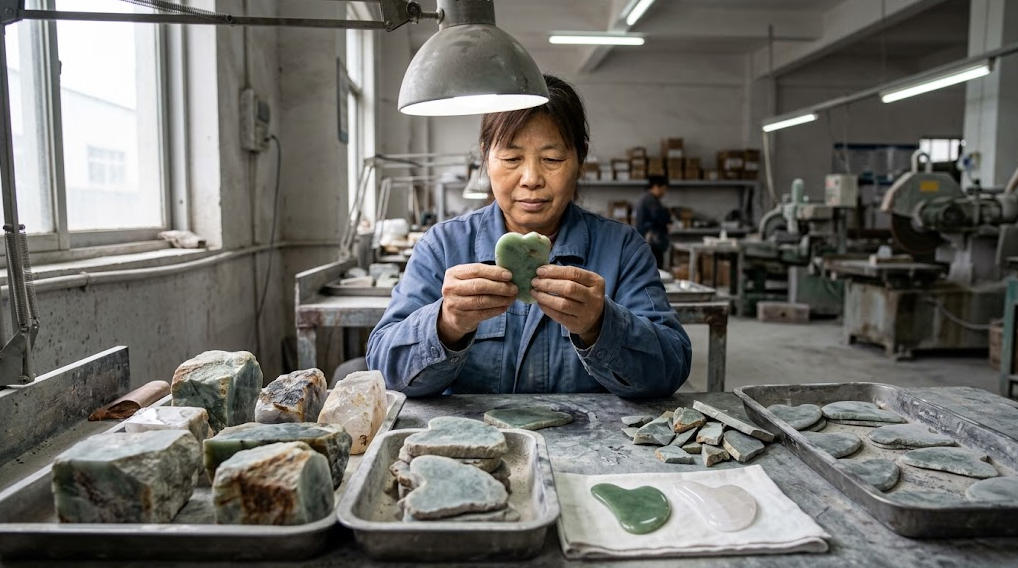
A sample proves that one skilled person once got a shape out of one block. Mass production proves that a team can repeat it 2,000 times without breakage eating your margin. A gua sha factory has to answer the second question before the first, and you should ask for that answer in writing.
Why a Single Sample Doesn’t Prove Your Gua Sha Custom Design Is Ready
Hand finishing hides a lot. A polisher can nurse a thin edge or a tight curve through one piece and take as long as needed, while a production line has to hit the same result on every piece in the batch. At volume, each weak point turns into a cracked piece or a size that drifts out of tolerance. The usual troublemakers are walls thinner than the stone can carry, sharp inside corners, and grooves cut deeper than the thickness allows. This means you can ask a gua sha manufacturer for an estimated yield per batch instead of a single sample photo, and avoid paying to develop a shape that only works once.
Jade and Crystal: Where Natural Stone Actually Breaks
Jade and quartz crystal behave differently on the wheel. GIA lists jadeite at 6.5 to 7 on the Mohs scale and nephrite at 6 to 6.5, and its care guidance describes both as very resistant to breaking or chipping once finished. Quartz sits at Mohs 7, and the International Gem Society’s quartz gallery shows how widely color, banding and inclusions vary from one crystal to the next. Hardness measures scratch resistance, though, not how a thin edge reacts while it is being cut and ground. A hidden fracture inside the block can still end a piece halfway through shaping. This means any natural-stone gua sha custom quote should carry a loss allowance, and thinner edges or deeper grooves will push that allowance up.
Texture matters as much as strength. Banded jade and clear quartz won’t look identical in two production runs, because the stone itself changes from block to block. If your gua sha custom brief demands identical color across 2,000 pieces, say so before the quote, since matching means rejecting more blocks. This means you can trade a little color tolerance for a lower unit price, if your brand can live with natural variation.
How to Pre-Check Your Gua Sha Custom Drawing in Three Steps
You don’t need an engineering degree to catch most problems before the quote stage. Run these three checks on your drawing first:
- Mark the thinnest edge and the deepest groove, then write down both measurements.
- Ask whether the outline fits inside the stock thickness the factory plans to use.
- State which natural variation you will accept, such as banding or small color shifts, and which you won’t.
Send those three items with your drawing, and a gua sha OEM project can often be judged in a single reply instead of a long email chain. This means you spend less time waiting and avoid sample fees on designs that were never going to pass.
Does Your Target Price Work for Gua Sha OEM? Cost, MOQ and Margin Check
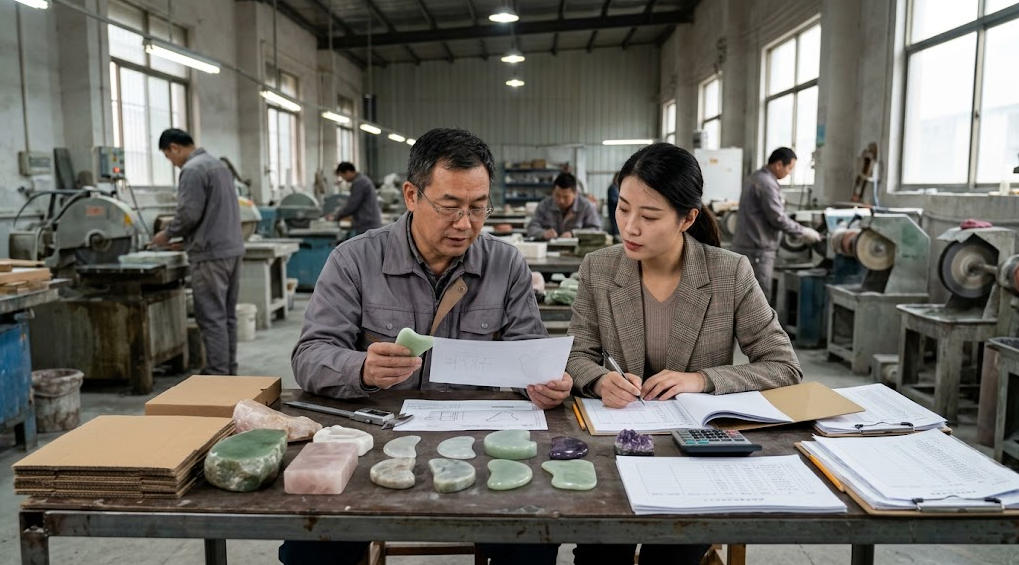
Your target price is where the negotiation starts, not where the math ends. A gua sha OEM quote has to cover design, tooling, material loss, finishing and inspection, and your gua sha custom target price either covers all of that or it doesn’t. Here’s how to check it yourself before you argue over cents.
How Development Cost Changes Your Gua Sha Custom Unit Price
Two costs sit inside every gua sha custom quote. The first is a one-time development cost: design review, tooling or fixtures, and sample making. The second is the per-piece production cost: material, cutting, polishing, packaging and inspection. Only the first one shrinks as your order grows. Using the $300 example from the introduction, development adds $3.00 per piece at 100 units, $0.60 at 500 and $0.15 at 2,000. If production costs $2.00 per piece (an assumption for this example), your all-in cost is $5.00 at 100 pieces and $2.60 at 500, a 48% drop per unit. This means you can cut unit cost nearly in half by ordering 500 instead of 100, or by agreeing to pay development separately so the per-piece price reflects production only.
Now set that against a common request: 100 pieces at $2.50, development included. The cost is $5.00, so the order loses $2.50 on every piece, or $250 across the batch. No gua sha manufacturer can absorb that, and one who agrees will recover the loss somewhere else, usually in finishing or inspection. This means a price far below cost is a quality risk you would be buying, not a discount you would be winning.
Gua Sha Custom ROI: A $4.00 Target Price, Line by Line
Here is a gua sha custom order at a $4.00 target price, with each cost line shown so you can see where the money goes.
| Cost line | Per piece |
|---|---|
| Target price | $4.00 |
| Material and processing | $2.10 |
| Surface finishing and packaging | $0.60 |
| Inspection and expected loss | $0.30 |
| Development cost share | $0.40 |
| Full unit cost | $3.40 |
| Unit profit | $0.60 |
The formula is simple: unit profit equals unit revenue minus full unit cost. Here that leaves $0.60, a 15% margin, before overhead, payment terms and rework. That margin is thin, so a breakage rate above plan can erase it within one batch. Check that every quote you compare uses the same delivery basis too, because Incoterms define who handles transport, cost and risk between buyer and seller, and a quote that leaves out freight is not comparable to one that includes it. This means you can line up two suppliers on equal terms instead of being pulled toward the one with the lowest headline number.
How to Close the Gap When the Target Price Is Too Low
A gap between your target and the real cost does not end the conversation. It tells you which variable to move, and a gua sha factory can usually adjust several of them:
- Simplify the shape. Fewer deep curves and sharp corners means fewer rejected pieces.
- Reuse an existing structure. Keeping a proven shape and customizing only logo, color or packaging removes the $300 development cost, which takes the 100-piece example from $5.00 to $2.00 per piece, 60% lower.
- Raise the quantity. A larger run spreads setup cost across more pieces.
- Split the fee. Quote development and production as separate lines.
- Relax the schedule. Rush work costs more than a normal production window.
Each of these keeps inspection and safety checks intact, which is the one place not to cut. This means you can lower the unit price of a gua sha OEM order without paying for it in quality. And when you present your gua sha custom scope as a smaller, better-defined job, you give the factory room to quote closer to your number.
How Do You Set Gua Sha Custom Quality and Compliance Standards You Can Inspect?
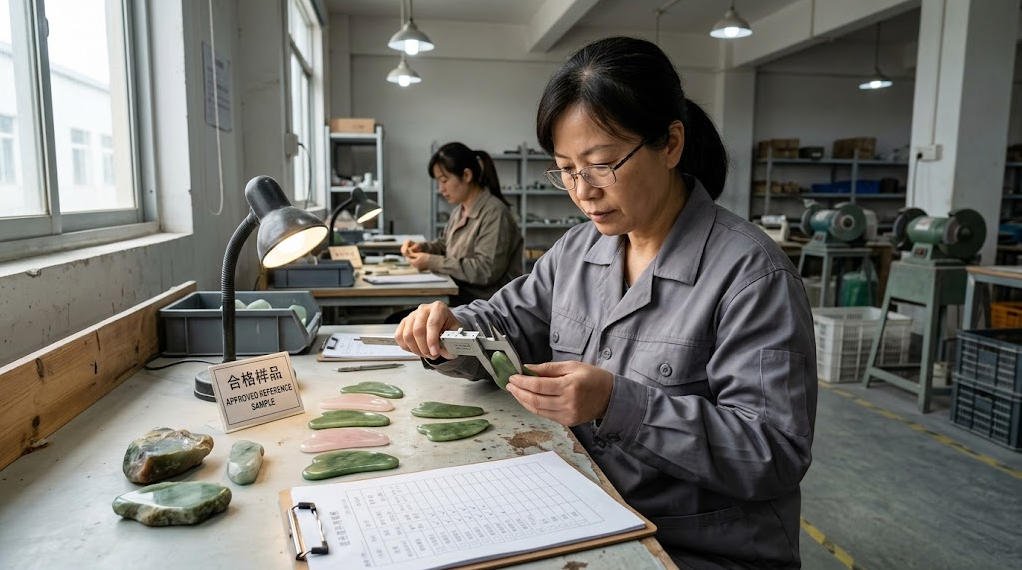
“Smooth edges” and “nice finish” mean different things to different people, and that gap is where most disputes start. A quality standard only works if two people with a ruler and a lamp reach the same verdict. Here is how to write one for your gua sha custom order, and where the compliance questions begin.
How to Turn “Smooth Edges” into a Gua Sha Custom Spec Sheet
Write the spec in five parts. Size covers nominal length, width and thickness, the allowed tolerance, and the point where each is measured. Edges and curves need a minimum edge radius and a rule against sharp burrs. Appearance covers scratches, pits and polish level, judged against an approved sample. Structure means no cracks, warping or loose parts. Batch rules fix the sampling method, the defect categories, and what happens to rejected pieces. A gua sha ODM project, where the factory helps develop the structure, needs this sheet even more, because there is no existing product to point at. This means you can reject a bad batch against a signed document instead of arguing about taste, and your gua sha custom spec stays valid across reorders.
Golden Sample Rules for Natural Gua Sha Custom Orders
A golden sample is the approved piece that every later unit is judged against. For natural stone it fixes color, texture, shape and finish, but it can’t make two blocks identical, so you also need to write down which differences are acceptable. For jade, add one more question: has the stone been treated? GIA notes that jade can be dyed, bleached, heated, waxed and impregnated. In the grading system used in China, “A” jade is natural or wax-polished jadeite, “B” is bleached and polymer-impregnated, and “C” is dyed. Ask your gua sha manufacturer to state in writing which category the material falls into. If the answer matters for your product claims, an independent lab can test it, and SSEF, a Swiss gem lab, offers a free introductory jade course covering jade treatments and testing. This means you can keep an untreated-stone claim off your listing unless the paperwork supports it, which protects your gua sha custom line from a returns dispute.
Is Your Gua Sha Custom Order Compliant? Nickel, Claims and Testing
Rules differ by market, and this section is general information, not legal advice, so confirm details with a regulatory adviser before you ship. Start with stainless steel. In the EU, REACH Annex XVII, entry 27 restricts nickel in articles intended for direct and prolonged skin contact when the release rate exceeds 0.5 µg/cm² per week, and the reference test method is EN 1811. The limit covers release, not nickel content, so a steel grade that contains nickel can still pass if it releases little. Whether a short gua sha session counts as “prolonged” contact is an interpretation question, so you can ask your gua sha factory for an EN 1811 report as a precaution before you ship steel pieces to Europe.
In the US, the question is less about materials and more about wording. FDA’s general wellness policy covers low-risk products intended only for general wellness, and FDA says it does not intend to examine such products as medical devices. Claims about treating a disease change the intended use, and with it the regulatory picture. This means you can keep a gua sha OEM product page inside the wellness category by choosing your claims carefully, and decide which test reports to request from the factory before the first shipment, not after.
Will a Gua Sha Factory Meet Your Lead Time? Capacity and Delivery Check
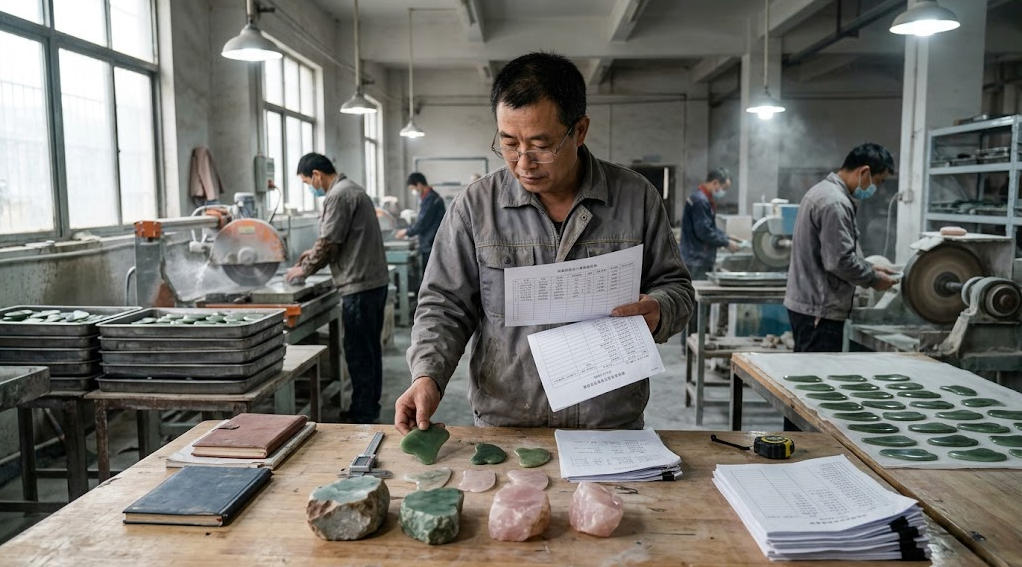
A product can be makeable and affordable and still arrive late. A delivery date is only real if it survives breakage, rework and inspection, and most schedules fail at those points, not at the cutting machine. Here is how to read a lead time promise before you plan your gua sha custom launch around it.
Five Stages of a Gua Sha Custom Project, from Design Sign-Off to Shipment
Every gua sha custom project passes through five stages, and each one uses calendar time. Design confirmation locks drawings, dimensions, material and acceptance standards. Sampling and revision tests structure, process and appearance, and it often takes more than one round. Trial production checks yield, timing at each workstation and stability before the full run begins. Mass production schedules raw material, equipment and people. Inspection and shipping covers final checks, packing and transport preparation. A schedule that quotes only the fourth stage is quoting one stage out of five. This means you can ask any gua sha manufacturer for a date per stage and see exactly where the risk sits.
Why Machine Speed Is Not a Delivery Date for Gua Sha Custom Orders
Theoretical machine speed ignores everything around the machine: waiting for raw stone or steel, waiting for tooling, changing over between jobs, polishing, rework, inspection and packing. Yield changes the math too. Suppose you need 2,000 finished pieces. At 90% yield, the line must start 2,223 blanks, and at 85% it must start 2,353. That is 130 more pieces to cut and polish, and the extra time lands on your delivery date. A date that holds only with zero loss is a hope, not a plan. A date that holds only if inspection is skipped is not a plan either. This means you can ask what yield the quoted date assumes, and whether the order will push other jobs aside at the gua sha factory, which tells you how much of the promise is capacity and how much is optimism.
How to Check a Gua Sha OEM Lead Time Before You Commit
Ask four questions in writing. First, which event starts the clock: drawing approval, sample approval or deposit? Second, how many sample rounds does the date assume? Third, what yield and loss allowance sit behind it? Fourth, does the order need special raw material or new tooling, and how long does each take? Compare the answers across suppliers. The one who answers all four with numbers has planned your gua sha OEM order, and the one who answers with a single date has not.
Then test the date. If the plan assumes 85% yield, ask for the revised date at 80%, because the gap between the two shows how fragile the schedule is. Also pin down where “delivered” is counted, since a ship date at the factory gate and an arrival date at your warehouse differ by the full transit time, and Incoterms define who handles transport, cost and risk at each point. This means you can set your launch against the worse-case date instead of the best-case one, and avoid paying for air freight to catch up later.
Go, Conditional Go or Decline? How a Gua Sha Manufacturer Makes the Final Call
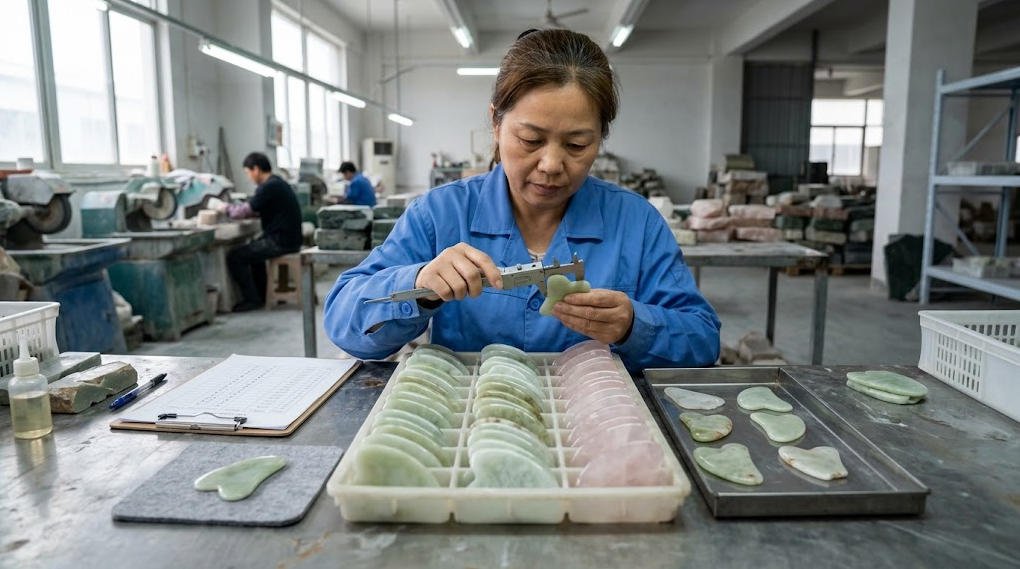
Risk doesn’t automatically mean no. A gua sha custom request ends in one of three answers, and knowing which one you are likely to get saves you weeks of email. The sorting rule is simple: some risks can be fixed by engineering, some can only be controlled by testing, and some can’t be accepted at all.
Three Outcomes for a Gua Sha OEM Request: Proceed, Proceed with Conditions, Decline
| Outcome | When it applies | What happens next |
|---|---|---|
| Proceed | Design is clear, the process is proven, quality is measurable, cost and schedule hold | Formal quote, sampling, production planning |
| Proceed with conditions | A fixable issue exists: edges too thin, color hard to repeat, quantity below MOQ, a tight deadline | Design change, material swap, quantity change or a pilot run first |
| Decline or pause | The core structure is unsafe, a key quality target can’t be held, a compliance requirement can’t be met, or the buyer rejects unavoidable material variation | Redesign, or end the project |
Most real projects land in the middle row. A conditional yes is not a polite no, because it comes with a list of specific changes you can act on. Take a pilot run as an example. At the $3.40 full unit cost from Chapter 2, a 50-piece pilot costs about $170, while a 2,000-piece run costs about $6,800 (illustrative figures). This means you pay about 2.5% of the volume to learn the real yield before committing the other 97.5%, and a failed pilot costs hundreds of dollars instead of thousands in a gua sha OEM order.
Which Gua Sha Custom Risks Engineering Can Fix, and Which It Cannot
Sort every risk in your gua sha custom brief into three buckets. The first bucket is fixable by engineering: a thin edge can be thickened, a deep groove made shallower, a sharp corner rounded, or a fixture redesigned. The price is extra development time and cost, but the problem disappears. The second bucket is controllable but not removable: natural color and texture variation, and loss in stone processing. You manage these with a golden sample, a trial run, written tolerances and a sampling plan. The third bucket is unacceptable: a structure that cracks in normal use, a quality target beyond what the process can hold, or a compliance requirement that can’t be met. This means you can tell which of your requirements are negotiable and which will end the project, before you spend anything on samples.
Risk Disclosure: What No Gua Sha Custom Contract Can Remove
Some risks stay no matter how carefully the contract is written, and a trustworthy gua sha manufacturer will say so up front. Natural stone differs from block to block, so a contract can define an acceptable range but can’t make the material uniform. Yield is an estimate until trial production, and a yield below plan raises unit cost or pushes the date. A good sample does not guarantee the same result at volume. For jade, treatment status needs documentation, and if your marketing claims depend on it, an independent lab such as SSEF can test the stone. Compliance depends on the market and on your claims, and a test report reduces risk without replacing legal advice. This means you can price these items into the order as a loss allowance, a color tolerance and a test budget, instead of discovering them in a dispute.
Before you sign, ask the gua sha factory to mark every requirement in your brief as fixed, adjustable or at risk. That one document turns a vague “we’ll see” into a decision map for your gua sha custom order. This means you can walk into the final negotiation knowing exactly which points you can trade and which you must hold.
What Should You Send Before Requesting a Gua Sha Custom Quote?
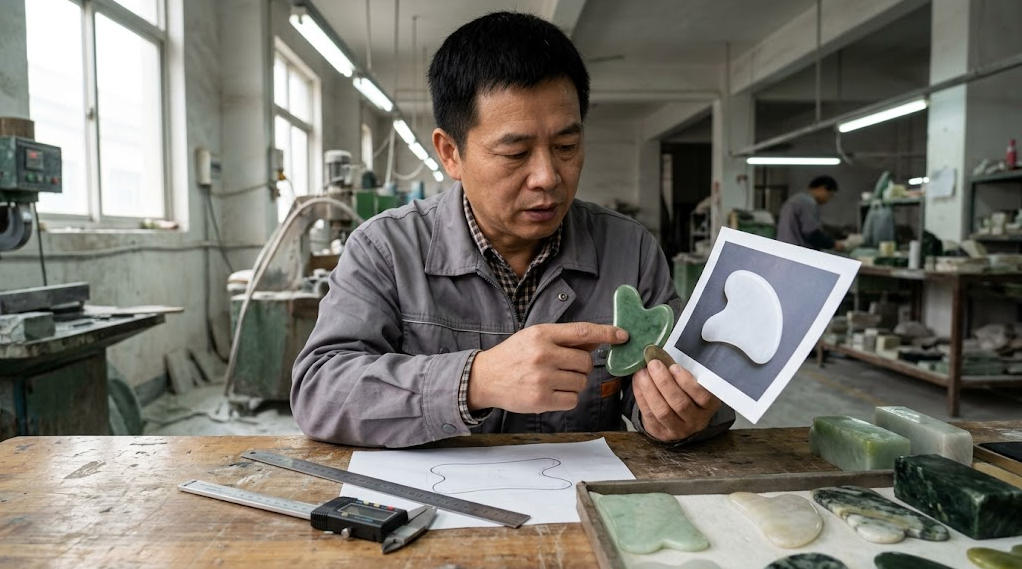
Most delays in a gua sha custom project start with a missing detail, not a hard design. The less a factory has to guess, the faster you get a quote that holds. Gather the items below first, and you can often get a real answer in one round.
Seven Specs a Gua Sha Custom Quote Needs
| Spec | What to write |
|---|---|
| Use | Face, body or both; retail, spa or gift set |
| Structure | Shape, edge profile, grooves or notches, plus a drawing or reference photo |
| Size | Length, width, thickness and the tolerance you accept |
| Material | Jade, crystal, stainless steel or other, with grade or color preference |
| Surface | Polish level, matte or mirror, color, texture |
| Branding | Logo position and method, packaging requirements |
| Quantity | First order size and expected reorders |
Quantity matters more than most buyers expect, because it decides how development cost is spread, as the cost section above showed. If you plan reorders, say so, since a gua sha ODM development fee can then be quoted against a longer run. This means you get one number you can compare across suppliers, instead of a range that shifts after the first reply.
What If You Only Have One Reference Photo?
A photo is enough to start the conversation but not enough to fix a final price. Send it with the intended use and a target size, and a gua sha factory can reply with questions about edge thickness, material and finish. Expect a first answer that lists what is missing and which parts look risky, not a firm quote. This means you can treat the photo as step one and use the three-step drawing pre-check from the first section of this guide to fill in the rest.
Gua Sha Custom FAQ
1. Can a gua sha manufacturer quote from a picture alone?
It can give a rough range, but a firm quote needs size, material, finish and quantity. A photo can’t show wall thickness or tolerance, and those two drive yield. This means you can use a picture for an early estimate and wait for a spec-based quote before you commit any money.
2. Does your target price decide whether a factory takes the order?
It starts the conversation, but full cost decides the outcome. If the target sits below cost, the realistic fixes are a simpler shape, a larger quantity or a separate development fee. This means you can often keep your price and change the scope instead.
3. Why do natural jade and crystal pieces differ in color within one batch?
Each block formed differently, and the International Gem Society’s quartz gallery shows how widely color, banding and inclusions vary in crystal alone. A golden sample plus a written color range sets the limits. This means you can accept a defined range instead of demanding identical pieces, which also keeps rejection rates and unit cost down.
4. Is an unclear brief a reason to reject a gua sha custom request?
No. An unclear brief usually means missing information, not an impossible project. Start with use, size and quantity, then settle the details through sampling. This means you can begin with what you know and let the first sample sharpen the rest.
5. Can a gua sha OEM project start from an existing structure and only add a logo?
Yes, and it is the lowest-cost route, because it skips most of the $300 development cost from the earlier example and took a 100-piece order from $5.00 to $2.00 per piece. This means you can test a market with a logo-only run before you pay for a new shape.