
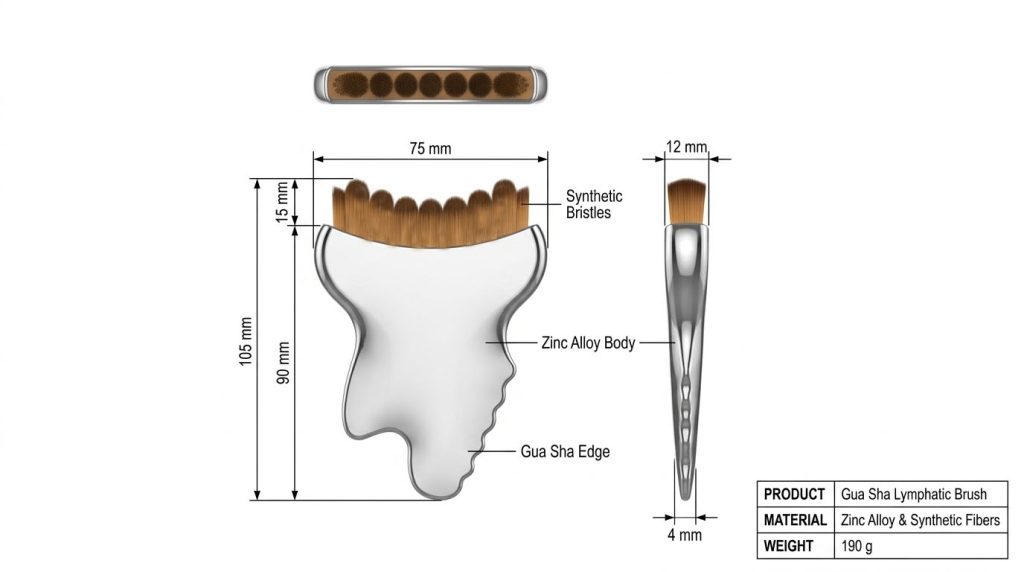
If you are sourcing a Gua Sha Lymphatic Brush from a gua sha manufacturer, here is the short answer. This 2-in-1 zinc alloy tool weighs 190 g, measures 75 × 105 mm, and costs $5.55 to $5.97 per piece depending on volume. Logo engraving adds $0.5 per piece with a 100-piece minimum. The zinc body is a one-piece mirror-polished casting, and a 15 mm synthetic-fiber brush is glued on afterward, so the glue joint is where your quality risk sits. This article walks you through the pricing, the specs, and the checks that decide whether a brush stays attached after months of use. That means you can judge gua sha wholesale quotes with real numbers instead of guesswork.
Table of Contents
What Does Gua Sha Wholesale Cost When You Order from a Gua Sha Manufacturer?
Price is the first thing you check, so here it is without a warm-up. A gua sha manufacturer sets unit prices by volume, and the Gua Sha Lymphatic Brush follows four tiers, from 500 pieces to more than 5,000 pieces. Every price below is in US dollars and covers the standard product without a logo. This means you can drop the numbers straight into your sourcing sheet today.
Gua Sha Wholesale Price Tiers by Order Quantity
| Order quantity | Price per piece |
|---|---|
| Up to 500 pcs | $5.97 |
| Up to 1,000 pcs | $5.89 |
| Up to 5,000 pcs | $5.65 |
| Over 5,000 pcs | $5.55 |
The gap between the first and last tier is $0.42 per piece, a 7% drop from $5.97 to $5.55. Between 500 and 1,000 pieces the saving is only $0.08 per piece, so most of the discount is not available at small volumes. The bigger step comes at 5,000 pieces, where the price falls $0.24 below the 1,000-piece rate, which makes a 5,000-piece order $1,200 cheaper than the same quantity at $5.89. This means you can start at 500 pieces to test demand and move to the 5,000-piece tier once your sell-through data supports it. Do you really need to commit to the largest tier on your first order?
How to Calculate Your Margin on Metal Gua Sha Wholesale Orders
Margin math takes four steps, and you can finish it in about ten minutes. First, add the unit price and any logo fee. Second, add freight and import duty, and check the duty rate for your product code in the USITC Harmonized Tariff Schedule. Third, subtract marketplace fees, which Amazon lists on its seller pricing page. Fourth, compare the total with your planned retail price.
Here is a worked example. A 1,000-piece order at $5.89 plus $0.5 for engraving comes to $6.39 per piece, or $6,390 in total. If you list the tool at $19.99 (an assumption for illustration, not a quote), your gross margin before freight and fees is $13.60 per piece, about 68%. This means you have room to cover shipping and advertising and still keep a healthy margin per unit.
What a Gua Sha Manufacturer Charges for Logo Engraving
Colorless laser engraving costs $0.5 per piece, with a minimum of 100 pieces. A 100-piece branded test therefore costs you $50 in engraving. The fee adds about 8.4% to the $5.97 tier and 9.0% to the $5.55 tier, so branding becomes a smaller share of your cost as volume grows. Because the engraving is colorless, your logo shows as a clean mark on the mirror-polished zinc surface. That means you can put your name on a small test batch for $50 before you decide on a bigger run.
What Makes These New Guasha Tools Different from a Traditional Metal Gua Sha?
The short answer is the brush. A traditional metal gua sha is one hard edge, while this Gua Sha Lymphatic Brush puts 90 mm of polished zinc and 15 mm of soft synthetic fiber on a single 105 mm body. The brush takes up about 14% of the height and the metal about 86%, so the tool does two jobs without a second SKU. This means you can sell one product to customers who want scraping and to customers who want a gentler lymphatic routine.
Why a 2-in-1 Gua Sha Lymphatic Brush Covers More Uses Than a Standard Board
The metal section works on the face and body in the usual scraping motions. The brush end is meant for the face and neck, where the lymph nodes sit close to the skin. A shopper comparing listings sees one tool that replaces two, and that is a clear reason to pick it over a plain board. When you stock new guasha tools, a visible difference like this matters more than another color option. That means you can write a product page around “two tools in one” without stretching the truth.
How a Soft Brush Head Changes Lymphatic Massage
A hard metal edge is not comfortable on the neck and jawline. The Cleveland Clinic describes lymphatic drainage massage as a gentle technique that relies on light pressure. Soft fibers spread contact over a wider area than a metal edge does, which suits that light-pressure approach. This means you can present the brush end as the gentle option in your product copy, without making medical claims.
Specifications to Verify with Your Gua Sha Manufacturer
Check every number below against the sample you receive.
| Specification | Value |
|---|---|
| Width | 75 mm |
| Height | 105 mm |
| Thickness | 4 mm (thinnest) to 12 mm (thickest) |
| Brush height | 15 mm |
| Metal-only height | 90 mm |
| Weight | 190 g |
| Materials | Zinc alloy body, synthetic-fiber brush |
The thickness range means the body tapers by 8 mm from its thickest point to its thinnest. Measure both points with calipers, weigh three sample pieces on a scale, and compare the results with this table. This takes about five minutes and tells you whether production matches the spec sheet. That means you can catch a dimension problem before it reaches your customers.
Why a Gua Sha Manufacturer Uses Zinc Alloy with a Mirror Polish
The zinc body is formed as one piece and then polished to a high-gloss mirror finish. The brush is glued on later by hand, so the polishing step never touches the fibers. For metal gua sha wholesale orders, you should check the finish under a bright light for pits, scratches, and uneven reflections. The International Zinc Association publishes general information on zinc and its alloys if you want background on the material. This means you can judge surface quality yourself in under a minute per piece, and you can request material test reports for any skin-contact product.
How Does a Gua Sha Manufacturer Control Brush Quality and Bonding Strength?
The brush is glued on by hand after the zinc body is polished, so the glue joint is the part of a Gua Sha Lymphatic Brush most likely to cause returns. A tool that looks finished is not necessarily bonded well. A light tug by hand cannot prove a joint will survive months of use. This means you can ask any supplier for a written test method before you pay a deposit.
How to Set Brush Acceptance Standards with Your Gua Sha Manufacturer
A brush is not better just because it is softer or denser. Fiber material, length, diameter, density, and layout all change how the tool feels on skin. The usual risks are length, color, and density drifting within one batch, fibers that feel too stiff, uneven rows, and bristles bent in transit. Four steps keep this under control:
- Approve a golden sample before production starts.
- Turn length, density, softness, and appearance into written checks that anyone can repeat.
- Keep a sealed reference piece on your side and one at the factory.
- Agree on how defects are counted and what happens to a failed lot.
This means you can reject a drifting batch with evidence rather than an opinion.
How to Verify Bond Strength After Curing
Assembly is not the finish line. The glue has to cure first, and the joint must be tested afterward. Ask your supplier to document the curing time, the ambient conditions, the sampling quantity, and the pass or fail rule for the pull test. Do not accept a force number borrowed from another product, because the right value depends on your brush base and mounting surface. For sampling, the ISO 2859-1 standard defines acceptance sampling plans by lot, so you can write the plan into your purchase contract. That means a weak joint shows up in the test record, not in your customer reviews.
What Causes Glue Overflow, Tilt, and Weak Joints on Metal Gua Sha Wholesale Orders?
Most joint failures trace back to a handful of causes. The brush base may not match the mounting surface, the glue may not suit zinc and fiber together, or the amount may be off. Spreading can be uneven, the brush can be placed at an angle, and curing can be rushed in cold or humid conditions. Ask for photos of the gluing station and a few cut-open samples from each lot. This means you can see overflow and tilt before the cartons are sealed.
Why Does Multi-Stage Inspection Beat a Single Pre-Shipment Check?
One final inspection finds problems only after the money is spent. Four checkpoints work better: zinc body inspection, incoming brush inspection, post-assembly inspection, and finished-goods inspection. A body that cannot take the brush, or brush parts that arrive late, show up early this way. This means you can fix a problem at the cheapest stage.
Is Your Gua Sha Wholesale Order Compliant for Skin Contact?
Requirements depend on your target market and product claims. For the EU, REACH restricts nickel release from articles that touch skin for long periods, and ECHA lists these on its restricted substances page. For the US, the CPSC business guidance is the starting point. Ask your supplier for a third-party test report that matches your market and keep it on file. This means you can answer a marketplace compliance request in a day instead of a month.
Why Do New Guasha Tools with Brush Heads Cost More to Make at a Gua Sha Manufacturer?
A plain zinc board is one part, while a Gua Sha Lymphatic Brush is two materials that have to be joined by hand and tested after curing. That extra work lands in three places: development, assembly time, and scheduling. This means you can read the price gap between a board and a brush tool as paid-for process control, and ask for each piece of it in writing.
How Mold Revisions and R&D Shape the Cost of a Gua Sha Lymphatic Brush
The brush base has to hold its fibers under repeated pressure, so its strength, shape, and fit to the zinc body all need testing. Each failed trial can mean another round of design changes, and some of those changes mean reworking the mold. A traditional board skips most of this. Ask your supplier whether the mold fee is quoted separately and how many revisions it covers. That means you can compare two quotes on the same basis instead of choosing the lower number and finding the mold costs later.
How the Extra Bonding Step Changes Lead Time
Hand gluing adds a workstation, and curing then ties up space and hours before the tool can be packed. Rushing a cure is how weak joints get through, so a schedule that skips it deserves a question. The ISO 9001 overview describes documented process control, which is the standard way a factory shows that a step like curing follows a fixed method. Ask for the cure time to be listed inside the quoted lead time, not added on top. This means you can set a launch date you can keep and avoid paying for advertising on stock that has not shipped.
How a Gua Sha Manufacturer Coordinates Brush Supply with Zinc Body Production
Two production lines have to meet at one assembly point, and four things can go wrong there. The zinc body may be finished before anyone discovers it does not suit the brush base. The brush parts may arrive late. Curing may eat time that was meant for packing. Or the tool may look perfect while the brush is not firmly fixed. Here is how you can reduce the risk:
- Ask for a fit trial of the brush on a polished body before mass production.
- Confirm the brush delivery date matches the body schedule.
- Request photos of cured samples from the first lot.
That means you can find a mismatch while it is still a sample problem, not a container problem.
Is the Metal Gua Sha Wholesale Price of $5.55 to $5.97 Reasonable for a Two-Material Tool?
Look at what inspection protects. At the 5,000-piece tier of $5.65, an order totals $28,250. A 1% failure rate on that order is 50 pieces, or $282.50 of product (an illustration, not a quoted defect rate). A joint failure that reaches customers costs more than that in refunds, replacements, and lost reviews. So the extra steps behind metal gua sha wholesale pricing are cheaper than the returns they prevent. This means you can treat the per-piece premium over a plain board as insurance on your reviews, and negotiate on volume tiers rather than on inspection steps.
How Do You Start a Gua Sha Wholesale Order with a Gua Sha Manufacturer?
Start with a sample, not a purchase order. A sample costs little, and it tells you whether the polish, the brush feel, and the glue joint match the spec sheet. The path from first message to shipped goods takes four steps, and you control the pace of each one. This means you can walk into a 500-piece order with a signed-off sample in your hand.
What to Prepare Before You Request a Metal Gua Sha Wholesale Quote
A supplier can only quote what you describe, so a vague request gets a vague price. Send your target quantity, which of the four tiers you are aiming at, and whether you want the $0.5 colorless laser logo (100 pieces minimum). Add your destination country and your sales channel, since an Amazon listing and a spa order ask for different paperwork. Then ask for the mold fee, the number of revisions it covers, the lead time with curing included, and the packing method. That means you can compare three quotes on identical terms in one afternoon.
How to Check a Gua Sha Lymphatic Brush Sample Before Mass Production
Run these checks in order:
- Measure width, height, and both thickness points with calipers, then weigh three pieces against the 190 g spec.
- Inspect the mirror finish under a bright light for pits and scratches.
- Look at the brush from the side for length drift, uneven rows, and tilt.
- Ask for the written bond test method and the record from the sample lot.
- Keep one sealed piece as your reference for later lots.
This means you can reject a bad production lot by pointing to a physical piece, not by arguing about taste.
Risk Disclosure: What a Gua Sha Manufacturer Cannot Promise Without Your Data
Some numbers do not exist until your project defines them. Pull-test values depend on your brush base and mounting surface, so any figure quoted before testing deserves a follow-up question. Skin-contact compliance depends on your market, so a test report only helps if it matches where you sell. Product claims matter too, because the FTC advertising guidance says health-related claims need evidence behind them. Describe the brush as a gentle massage tool and avoid promising medical results. That means you can launch with copy that holds up if a marketplace or regulator asks you to back it.
Why Choose Donghua as Your Gua Sha Manufacturer?
Donghua has worked on jade, crystal, and metal gua sha tools for more than 12 years, covering processing, design, manufacturing, and sales. Your best next step is to send your quantity target and logo file, and we will return a quote and sample schedule for the Gua Sha Lymphatic Brush. If you are weighing new guasha tools against a plain board for your next range, ask for both quotes side by side. Request your gua sha wholesale quote today, and bring the checklist above to the conversation. This means you can start with 100 engraved pieces and scale only after your sample passes your own tests.