
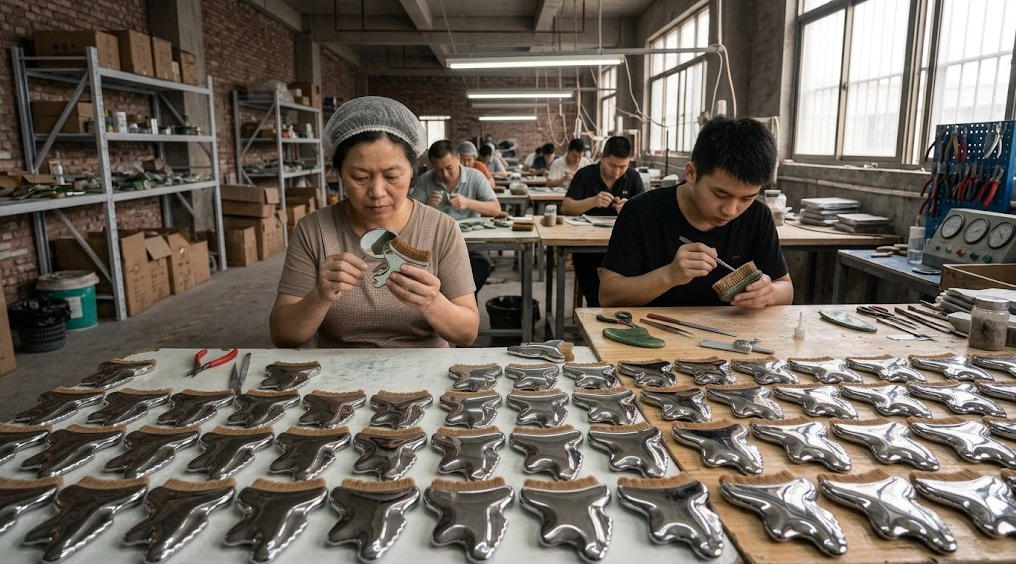
A Gua Sha Lymphatic Brush manufacturer runs two production lines for a single product, and that one fact explains why a 2-in-1 jade brush costs more and ships later than a plain jade board. In our example comparison, a standard jade gua sha takes 25 days to make, while the 2-in-1 version takes 35 days, which adds 10 days, or about 40%. The extra time comes from a second chain of work: bristle sourcing, fixing, curing, trimming and a joint inspection. If you are comparing quotes from any gua sha factory, that gap decides whether your launch date holds. This guide shows you where the days and dollars go, which gua sha risks to check before you sign, and how to brief a gua sha manufacturer so your guasha custom order arrives on schedule. Think of it as advice from a friend who has stood on the factory floor, not a sales pitch.
Why a Gua Sha Lymphatic Brush manufacturer Treats the 2-in-1 as a Different Product
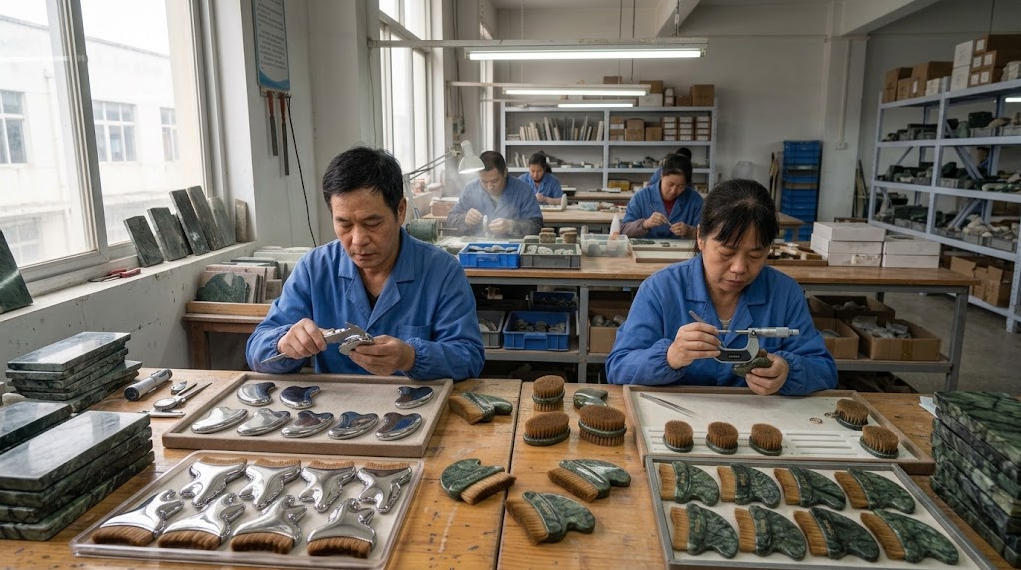
Most buyers picture a 2-in-1 brush as a jade board with bristles glued on. A Gua Sha Lymphatic Brush manufacturer sees two materials, two quality standards and two schedules that have to meet on one bench. Once you see that split, quotes, lead times and sample rounds start to make sense. This means you can read any quote line by line and tell which costs belong to the stone and which belong to the bristles.
What the Stone and the Bristles Each Do
Traditional gua sha boards come in familiar outlines such as heart, fish, V and crescent, and a new outline alone rarely sets a brand apart. A 2-in-1 design pairs a natural stone body, with its own color, texture and cool touch, with a bristle section that feels completely different on skin. One product therefore carries two selling points, and your customers no longer need to buy two tools. This means you can build a product page around the contrast between hard and soft touch instead of a minor shape tweak.
The stone half is predictable when you know the numbers. GIA lists jadeite at 6.5 to 7 on the Mohs scale and nephrite at 6 to 6.5, and it describes both as very resistant to breaking and chipping (GIA jade care guide). The International Gem Society profiles jadeite and nephrite as separate gem materials, so your spec sheet should name which one you are buying. Any Gua Sha Lymphatic Brush manufacturer you shortlist should ask for that line before quoting. This means you can write a material clause that keeps look-alike stones out of your order.
How a Gua Sha Lymphatic Brush manufacturer Turns Design Choices Into Brand Identity
A stone-and-bristle product hands you far more design levers than a plain board. You choose the stone’s color, transparency and texture, then the bristle color, length, density and softness. The ratio between stone and bristles, and the way they connect, change the look as much as the stone does. Gift boxes, storage trays and logo placement finish the set, so a guasha custom project on this product looks more like brand building than logo engraving. This means you can own a visual identity that a rival cannot copy by changing one engraving.
Be careful with the word “lymphatic”. It is a common beauty-market term, yet a bristle structure alone does not prove that a tool improves lymph circulation, detoxifies the body or treats disease. The same caution applies to the word “trend”, because only sales growth, repeat purchases and channel feedback can confirm demand. Would you rather defend a claim in front of a regulator, or a texture in front of a customer? Every one of the gua sha risks you skip at the claims stage can return later as complaints and returns, and a Gua Sha Lymphatic Brush manufacturer who asks about your wording early is protecting you, not slowing you down. This means you can pitch the brush as a differentiated beauty tool and keep your wording on solid ground.
Two Production Chains: How a Gua Sha Lymphatic Brush manufacturer Keeps Stone and Bristles on One Schedule
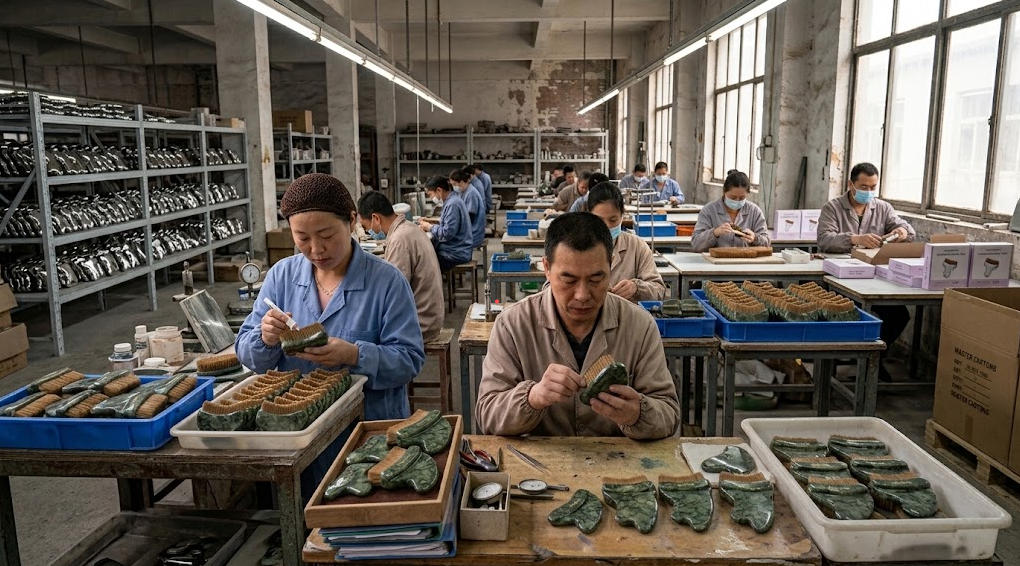
Think of your order as two roads that must reach the same crossroads on the same day. If one road runs late, the whole gua sha production run waits, no matter how good the other half looks. This means you can ask the gua sha manufacturer for two separate dates instead of one vague delivery promise.
Inside Gua Sha Production: Chain A, Chain B and the Meeting Point
Chain A handles the stone: raw material screening, cutting, shaping, fine grinding, polishing and stone inspection. Chain B handles the bristles: sourcing, spec confirmation, fixing or tufting, curing, trimming and bristle inspection. The two chains run side by side early on, then merge at assembly, where connection checks, cleaning, appearance and touch checks, packing and shipping happen. This means you can map every order onto five dates: stone finished, bristles arrived, assembly, inspection and packing.
Here is why the example jumps from 25 to 35 days. A stone polished on day 20 cannot ship if the bristles arrive on day 30, and a finished bristle set cannot ship if the stone batch slips because of natural veining or rework. Curing time cannot be rushed by adding workers either, since fixing material needs time to set. The finish date comes from the slowest chain plus assembly, inspection and packing, not from adding every step together. A Gua Sha Lymphatic Brush manufacturer that quotes you one total number of days has probably not split the chains. The 10-day gap, a 40% increase, is an illustration rather than a fixed rule. This means you can stop asking “how many days in total?” and start asking “which chain is the slowest?”
How a Gua Sha Lymphatic Brush manufacturer Controls Two Quality Standards
A plain jade board is judged on color, texture, size, cracks, edge smoothness and polish. A brush adds a second list: bristle softness, density, length, arrangement, fixing strength, shedding, powder residue and how easy the product is to clean. The stone half still hides variables, because SSEF’s introductory jade course opens with the point that jade is a rock, and rocks vary from block to block (SSEF jade course). GIA also notes that jade can be dyed, bleached, heated, waxed and impregnated (GIA jade buyer’s guide), so a treatment statement belongs in your purchase terms. This means you can protect your brand from surprises on both halves of the product.
Bristle fixing is the step most buyers underestimate. Uneven density shows up as visual and touch differences, loose fixing causes shedding, uneven trimming spoils the look, and an unsuitable mounting area makes assembly harder. Shedding is one of the gua sha risks that usually appears after launch, not before it. Here is a test you can run on a sample: wash it twice the way a customer would, run your fingers against the bristles, tug gently, then check for loose hairs, a shifting joint or leftover powder. After more than 12 years of making jade and crystal gua sha tools, Donghua’s advice is simple: do not approve a brush sample you have not washed, and any gua sha factory worth your time will welcome that test. This means you can catch a loose joint before a full order ships.
How to Plan Lead Time With a Gua Sha Lymphatic Brush manufacturer Without Losing Weeks
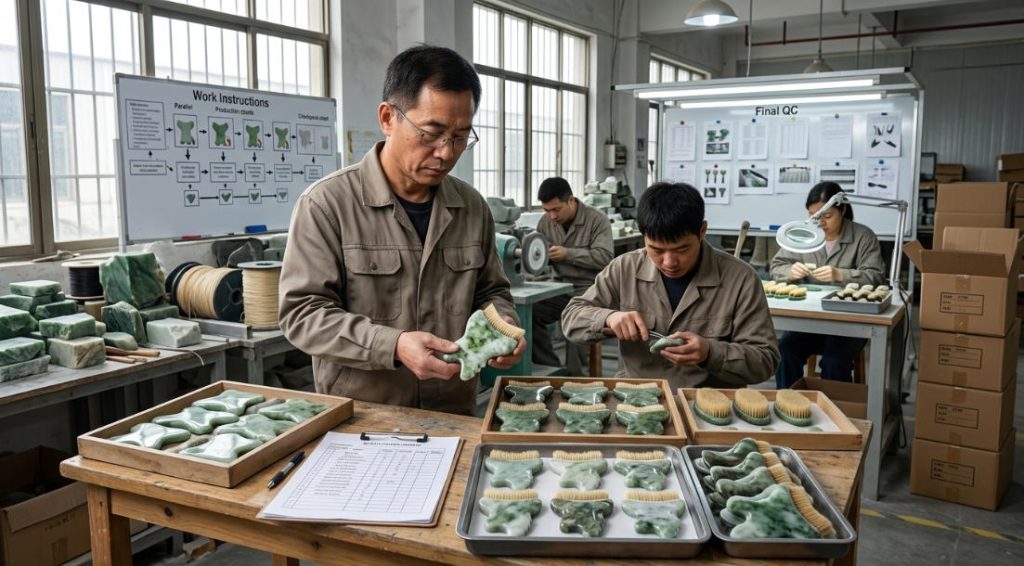
Lead time is the most negotiable part of a 2-in-1 order, provided you split it early. A Gua Sha Lymphatic Brush manufacturer can only protect your date if the two of you agree on checkpoints before the first cut. This means you can turn “about five weeks” into dates you can actually chase.
How to Turn 35 Days Into Four Checkpoints
Start with the example numbers: 25 days for a plain jade board, 35 days for the 2-in-1, which is a 10-day or 40% increase. Now divide that window the way the work really runs. In one illustrative plan, the stone chain finishes on day 20, the bristle chain finishes fixing, curing and trimming on day 24, assembly and joint inspection fill days 25 to 32, and packing closes days 33 to 35. This means you can see at a glance that the bristle chain, not the stone, controls the finish date.
Here is how to apply that to your own order. Ask your gua sha manufacturer for four written dates and compare each one against the plan:
- Stone finished and inspected.
- Bristle material received and checked.
- Assembly started.
- Joint inspection passed.
Request a short photo or video at each checkpoint, and if a date slips, ask which chain moved and whether the other can wait without damage. Any Gua Sha Lymphatic Brush manufacturer who answers that question with specifics is managing the job, not guessing. This means you can catch a delay in week three instead of discovering it in week five.
Where the Extra 10 Days Hide, and How a Gua Sha Lymphatic Brush manufacturer Protects Your Buffer
The extra 10 days come from five places: bristle purchasing and spec checks, fixing and curing, trimming and assembly, a joint inspection after the parts meet, and a rework buffer. Curing is the stubborn one, because fixing material that has not set properly can loosen later, and extra workers cannot make it set faster. Trimming and assembly speed up with more hands only to a point, since a rushed trim shows up as uneven bristle length. This means you can expect real gua sha production time to come from curing and checking, not from a labor shortage.
You can shorten the schedule without cutting corners. Approve the Golden Sample before mass production, so bristle length, density and softness are agreed on paper. Place the bristle material order on the same day you approve the stone, so both chains start together. Then keep a rework buffer in the plan, because a batch that fails a pull test needs time to be redone, not rushed. Ask whether your Gua Sha Lymphatic Brush manufacturer builds that buffer in, since a gua sha factory that shows it to you is being honest about risk. Late bristles belong on every list of gua sha risks right next to cracked stone. Why gamble a retail launch on a buffer that does not exist? This means you can promise your retailers a date and keep it.
Cost and ROI: What a Gua Sha Lymphatic Brush manufacturer Charges For and Why
Unit price is only half of the cost story. Your real return depends on how many pieces you order and how many you sell. This means you can compare quotes by profit per order instead of by price tag.
What Sits Inside the Unit Price
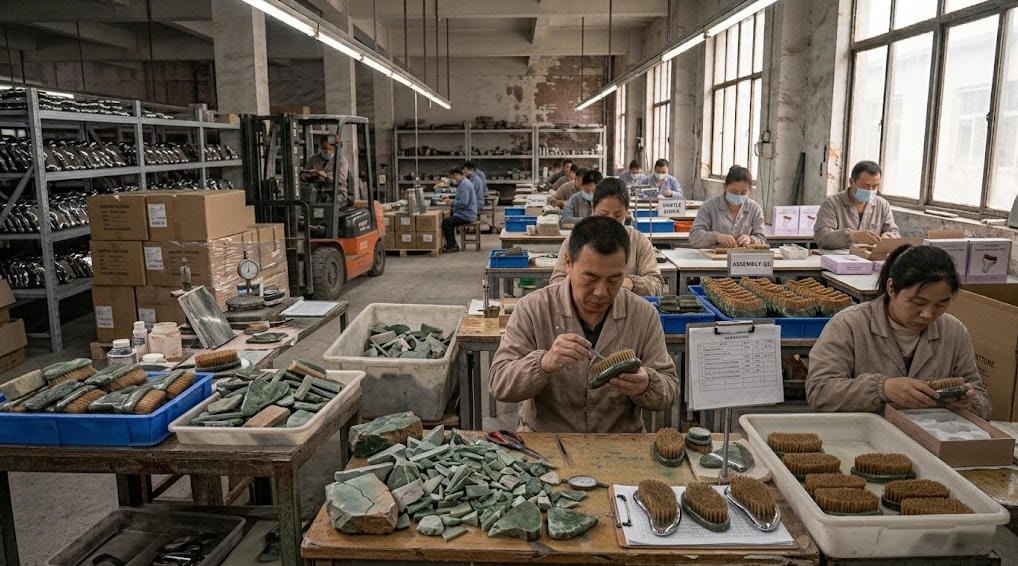
A plain jade board carries stone, stone processing, sample development, quality checks and packing. A 2-in-1 brush adds bristle material, fixing and assembly labor, a second sample round, extra inspection for bristles and joints, and packing that keeps bristles from being crushed or contaminated. Stone processing can change as well, since the mounting area needs a shape and finish that suits assembly. When a Gua Sha Lymphatic Brush manufacturer splits the quote into stone, bristle, assembly, inspection and packing lines, you can see exactly where one supplier differs from another. This means you can negotiate a single line instead of arguing over one blended number.
Do not expect a fixed percentage uplift. A simple stone with a plain bristle set may add a modest amount, while a rarer stone, a complex outline, dense bristles and a gift box can widen the gap sharply. GIA’s jade guide lists color, texture, transparency, carat weight and cut among the factors used to judge jade quality (GIA jade guide, PDF), and each one moves your stone cost before a single bristle is priced. Every extra guasha custom detail, from bristle color to box inserts, also adds a line to the quote. This means you can control cost by choosing which factors you pay for.
How a Gua Sha Lymphatic Brush manufacturer Spreads Setup Costs Across Your Order Size
Setup work, such as sampling, fixtures, process checks and packaging development, is paid once and then divided across your pieces. The table below is a teaching example, not a quote: it assumes a variable cost of 10 units per piece and 1,500 units of upfront cost.
| Order quantity | Setup cost per piece | Total cost per piece |
|---|---|---|
| 500 | 3.00 | 13.00 |
| 1,000 | 1.50 | 11.50 |
| 2,000 | 0.75 | 10.75 |
| 5,000 | 0.30 | 10.30 |
Moving from 500 to 1,000 pieces cuts the unit cost by 1.50, about 11.5%. Moving from 2,000 to 5,000 pieces cuts it by only 0.45, about 4.2%. The curve flattens quickly, so the first doubling pays the most. This means you can capture most of the price benefit without committing to the largest tier.
Now test the risk. Assume you resell each piece at 25 units. A 1,000-piece order costs 11,500 and brings in 25,000 if everything sells, a gain of 13,500. A 5,000-piece order costs 51,500, so if only 2,000 pieces sell, revenue is 50,000, you lose 1,500, and 3,000 pieces still sit in your warehouse. Is saving 1.20 per piece (11.50 versus 10.30) worth tying up that much cash? A gua sha factory will quote either tier, but only your sales data can tell you which one is safe. A fresh bristle spec in a guasha custom first run also carries more setup than a reorder, so expect the first order to cost more per piece. This means you can size your first order to proven sales speed and move up a tier once repeat purchases confirm demand.
Gua Sha Risks and Compliance: What a Gua Sha Lymphatic Brush manufacturer Can and Cannot Promise
Every product page makes promises, and every promise has to survive a complaint, a retailer audit or a regulator’s letter. A gua sha manufacturer can build a product to your spec, but it cannot make your legal promises for you. When you know where the gua sha risks sit in the stone, the bristles and your wording, you can fix them before launch. This means you can treat compliance as a design step instead of a fire drill.
Material and Build Gua Sha Risks You Can Test Before Shipping
Start with the stone. For jadeite, the trade uses A, B and C labels. GIA explains that “B” jade has been bleached with acid and filled with polymer resin, “A” is natural or wax-polished only, and “C” is dyed (GIA jade buyer’s guide). A treated stone sold as natural is one of the gua sha risks that can end a retailer relationship overnight. Ask your supplier to state in writing which mineral the stone is and whether it is natural, waxed, dyed or impregnated. This means you can match your product page to the paperwork, so a “natural stone” line is true on the day you print it.
Next, test the bristles. Shedding, loose joints, residue and trapped moisture are the build problems specific to a 2-in-1 design, and each one can be checked. Repeat the wash-and-tug sample test described earlier on three random pieces from the pre-shipment batch, not on one polished showpiece, and record the result with photos. A gua sha factory that keeps those records, along with its inspection notes from each gua sha production batch, hands you evidence if a buyer disputes quality later. Check the packing too, because bristles pressed flat inside a tight box arrive bent. This means you can reject a bad lot with proof instead of an argument.
How a Gua Sha Lymphatic Brush manufacturer Helps You Keep Claims and Safety Paperwork Clean
Claims come first. A Gua Sha Lymphatic Brush manufacturer can print your wording on the box, but it cannot take legal responsibility for it. In the United States, the FTC’s Health Products Compliance Guidance says health-benefit claims need competent and reliable scientific evidence, and it applies to all health-related products, not only supplements (FTC guidance PDF). The guidance generally expects randomized, controlled human testing for such claims, and testimonials do not escape the same standard. So a line like “boosts lymphatic drainage” needs proof that a bristle shape alone cannot supply. Safer copy describes what the product is: stone type, bristle softness, size and care steps. This means you can sell the texture without inviting a claims dispute.
Safety paperwork comes second. In the EU, the General Product Safety Regulation (EU) 2023/988 has applied since 13 December 2024 (UL Solutions summary). Products placed on the market need an internal risk analysis and a technical file, companies outside the EU must name a responsible person there, and supporting documentation must be kept for 10 years (Intertek bulletin). Which rule applies to your brush depends on how you market it, so confirm the classification with a compliance adviser, because this article is not legal advice. Here is the practical step: ask your supplier for a material declaration, a stone treatment statement, the bristle material spec, inspection records and batch numbers for every guasha custom order. This means you can open your technical file on day one instead of the day a customer complains.
How to Vet a Gua Sha Lymphatic Brush manufacturer Before You Pay a Deposit
A deposit is the moment your leverage drops, so ask your questions before it. Six clear answers separate a gua sha manufacturer that has built 2-in-1 brushes from one that is learning on your order. This means you can shortlist suppliers in a week instead of three months.
Six Questions to Ask a gua sha manufacturer Before You Commit
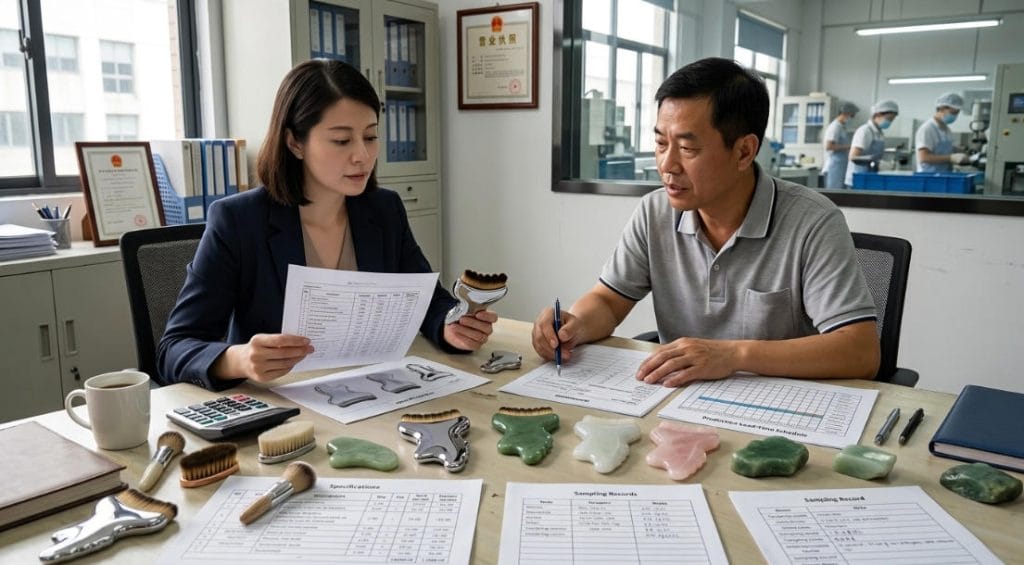
When you interview a Gua Sha Lymphatic Brush manufacturer, begin with the product itself. First, define where the tool is used, such as the face or the scalp, because different brush structures should not be mixed under one spec. Second, fix the stone standard in writing: mineral name, color range, texture tolerance, size tolerance and the natural variation you will accept. Third, fix the bristle spec: material, length, density, softness, arrangement and fixing strength. This means you can compare quotes on identical specifications instead of guesses.
Fourth, require a written Golden Sample that both sides sign and keep as the reference for production and inspection. Fifth, split the lead time into the four checkpoints described above. Sixth, compare landed cost per sellable piece, covering materials, processing, losses, rework, packing and transport risk, because the lowest ex-factory price often hides rework. Ask each gua sha factory to answer in writing, since a vague verbal reply cannot be enforced. If a supplier cannot answer these six, what will it do when your first batch fails an inspection? This means you can rank suppliers on finished cost and reliability instead of the cheapest headline price.
How a Gua Sha Lymphatic Brush manufacturer Should Run Sampling and Golden Sample Approval
A 2-in-1 needs more sample rounds than a plain board because two specifications must agree. Round one confirms stone shape, color and polish. Round two confirms bristle feel, density and fixing. The final round confirms the joined product after washing. Photograph every sample, log each change and mark the approved piece with a signed label. This means you can trace any later difference back to a specific change.
Next, ask your Gua Sha Lymphatic Brush manufacturer to keep a sealed duplicate of the approved sample and compare mass-production pieces against it at inspection. Look for color shift, bristle height differences, loose hairs and joint movement. A reorder of a guasha custom design only stays identical when the reference piece survives, so store yours in a dry, sealed bag. Consistent gua sha production across reorders depends on that single object more than on any contract clause. This means you can reorder in six months and receive the same brush your customers already like.
Summary: What a Gua Sha Lymphatic Brush manufacturer Offers You and Where to Start
The short version fits in a few lines. A 2-in-1 brush is a different product from a plain jade board, and the difference shows up in your calendar, your unit cost and your checklist. This means you can decide with facts instead of trend talk.
What to Take Away From This Guide
A 2-in-1 brush joins two materials, two quality standards and two production chains into one product. That joining adds bristle materials, fixing and assembly work, extra inspection and a second sample round. In the example, those additions stretch 25 days to 35, a 40% increase. The cost illustration shows the other side: moving from 500 to 1,000 pieces cut the unit cost by about 11.5%, while moving from 2,000 to 5,000 saved only about 4.2%. This means you can place a first order sized to proven demand and scale up after repeat sales confirm it.
Demand is not proven in every market, so judge it by sales growth, repeat purchases and channel feedback rather than by headlines. Keep your claims to what you can document, and check the three gua sha risks this guide covered: stone treatment, bristle shedding and wording. A reliable gua sha manufacturer shows you its chain dates, its inspection records and its sample log without being asked twice. This means you can judge a supplier by its paperwork, not by its promises.
About Donghua: Your Next Step With a Gua Sha Lymphatic Brush manufacturer
Donghua is a source manufacturer of jade and crystal gua sha tools, with more than 12 years of experience in processing, design, manufacturing and sales. Its approach balances quality control with production efficiency, and it works directly with brands that want custom stone, bristle and packaging combinations. This means you can talk to the people who cut the stone and fix the bristles instead of a trading layer.
Start with a short brief: stone type and tolerance, bristle spec, target quantity, packaging idea and launch date. Send it to any Gua Sha Lymphatic Brush manufacturer on your list, and ask for four checkpoint dates, a cost split by line and a written sample plan. If you want a quote on a guasha custom brush, a gua sha factory that answers with questions about your brief is showing you how it will treat your order. This means you can move from idea to a signed Golden Sample in fewer rounds.
FAQ: 2-in-1 Gua Sha Lymphatic Brush Manufacturing
1. How much longer does a 2-in-1 brush take to make than a plain jade gua sha?
In our example, a plain jade board takes 25 days and a 2-in-1 brush takes 35 days, which is 10 extra days, or about 40%. The extra time comes from bristle sourcing, fixing, curing, trimming and joint inspection. Treat these figures as an illustration, because your actual schedule depends on the stone, the bristle spec and the order size. Ask your Gua Sha Lymphatic Brush manufacturer for four checkpoint dates instead of one total.
2. Does a 2-in-1 brush cost a fixed percentage more than a plain board?
No. A simple stone with a plain bristle set may add a modest amount, while rarer stone, dense bristles and gift packaging can widen the gap. The added costs are bristle material, fixing and assembly labor, an extra sample round, extra inspection and packing that protects the bristles. Ask for a quote split by line so you can see which part drives the price.
3. Why is the unit price higher on small orders?
Sampling, fixtures, process checks and packaging development are paid once and divided across your pieces. In the teaching example, 500 pieces cost 13.00 each and 1,000 pieces cost 11.50 each, a drop of about 11.5%. Going from 2,000 to 5,000 pieces saves only about 4.2%. Size your first order to your proven sales speed.
4. Can I say the brush improves lymph circulation or detoxifies the body?
Not on the strength of the bristle structure alone. “Lymphatic” is a common beauty-market term, and health-benefit claims generally need competent and reliable scientific evidence under FTC guidance. Safer copy describes the stone type, bristle softness, size and care steps. Confirm your wording with a compliance adviser for each target market.
5. What should I check on a sample before approving it?
Wash it twice the way a customer would, run your fingers against the bristles, tug gently, and look for loose hairs, a shifting joint or leftover powder. Also ask for a written statement of the stone’s mineral type and any treatment. Once approved, keep a signed Golden Sample as the reference for production and inspection.
6. What should I send a Gua Sha Lymphatic Brush manufacturer to get an accurate quote?
Send a short brief: stone type and tolerance, bristle material, length and density, target quantity, packaging idea and launch date. The more of these you fix in writing, the less room there is for price surprises later.