

Why a Longer Lead Time Rarely Means a Slower Gua Sha Manufacturer
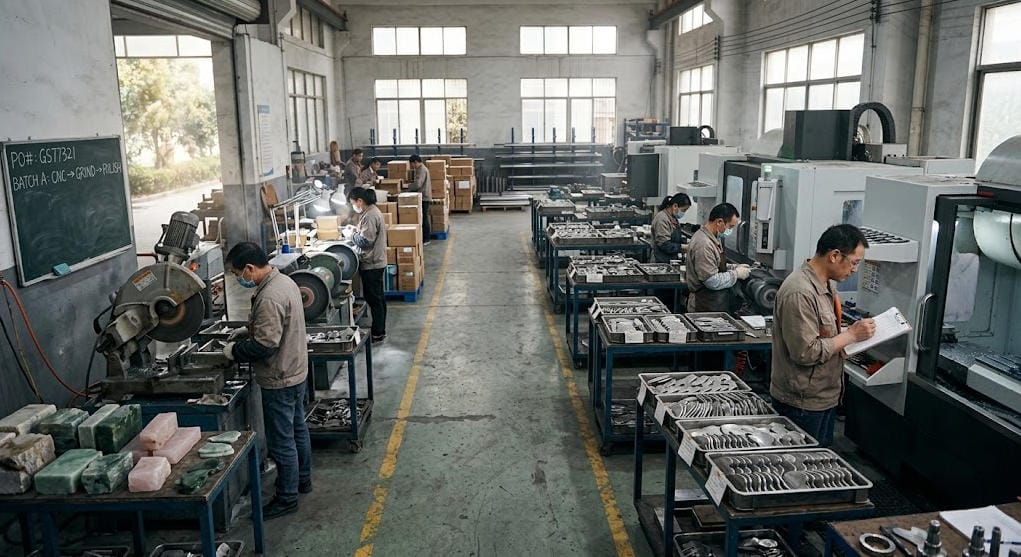
When the same gua sha manufacturer quotes you 35 days for a first order and 50 days for a repeat order of the identical product and quantity, the factory has usually not become slower. The extra 15 days typically come from queue time before your order reaches the machines, not from the work itself. In the example below, waiting for a production slot grew from 5 days to 18 days, while CNC forming stayed at 10 days. That one line explains most of the gap. This means you can stop asking “why so slow?” and start asking where the 15 days landed.
Here is the part that surprises most buyers. Guasha lead time is not printed into the product like a serial number. It describes how long your order takes to travel through the factory’s system on the day you place it. Two identical orders placed in different months can travel through very different systems, even though the sample on your desk never changed. This means you can treat 35 days as a snapshot of one moment, not as a permanent promise.
What Sits Inside a Gua Sha Lead Time
Think of the total as six blocks stacked on top of each other: production queue, raw material preparation, machining and forming, grinding and polishing, QC with packing, and a small buffer. In the earlier order those blocks added up to 35 days, and in the later order they added up to 50. The queue alone added 13 days, raw materials and polishing added two days each, and a smaller buffer gave two days back. This means you can read a longer quote like a map, because the block that grew tells you whether the cause is a full order book, a stock problem or a bottleneck.
A gua sha production run moves through CNC cutting, edge trimming, rough grinding, fine grinding, polishing, QC and packing, in that fixed order. A stone piece cannot skip a station. If one station is full, everything behind it waits, and extra speed at the earlier stations recovers nothing. This means you should always ask which station is full, because a jam at polishing behaves very differently from a delay in buying raw stone.
How a Gua Sha Manufacturer Fills a Production Slot
A gua sha factory never runs one order at a time. Your 5,000 pieces share CNC machines, grinding benches and a polishing team with other buyers’ orders. When the order book is thin, your batch starts within days. When several buyers confirm orders in the same week, your batch joins a line.
As a gua sha manufacturer with more than 12 years in jade and crystal tools, Donghua sees this pattern every peak season. That is why a fair quote for a gua sha wholesale order carries two numbers instead of one: the normal production cycle, and the current scheduling status. This means you can plan your launch date against the real slot on the calendar rather than against last quarter’s memory.
Where the Extra 15 Days Go: A Gua Sha Manufacturer’s Line-by-Line Breakdown
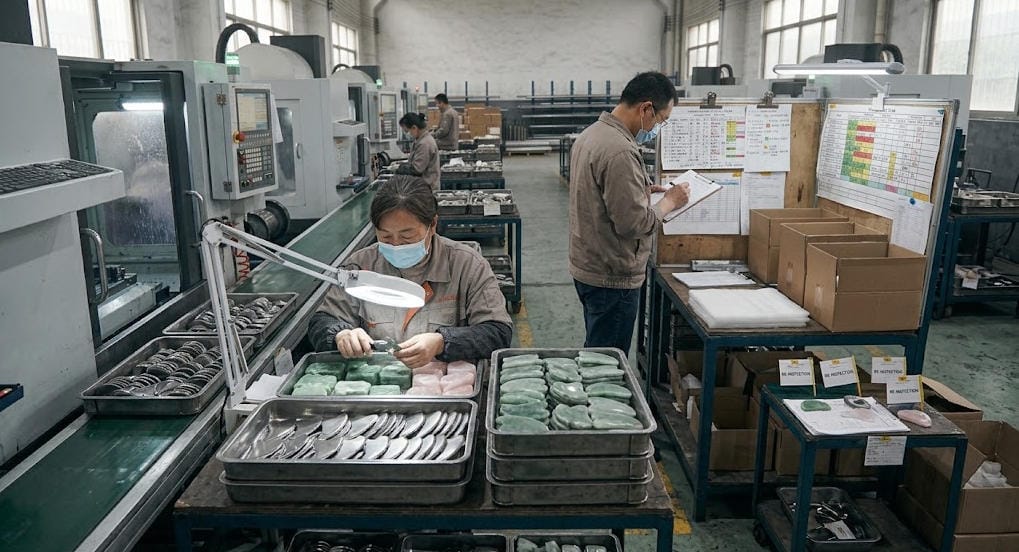
Talking about queues only helps so much, so here are the actual numbers from the earlier example. The same 5,000-piece order was scheduled twice, and the two schedules differ in only a few places. Check the table before reading on, and notice how many rows did not move at all.
| Stage | Earlier order (days) | Later order (days) | Change |
|---|---|---|---|
| Production queue | 5 | 18 | +13 |
| Raw material preparation | 3 | 5 | +2 |
| CNC / forming | 10 | 10 | 0 |
| Grinding and polishing | 8 | 10 | +2 |
| QC and packing | 5 | 5 | 0 |
| Buffer | 4 | 2 | −2 |
| Total | 35 | 50 | +15 |
The production queue grew by 13 days, roughly 87% of the whole increase. CNC forming, QC and packing stayed exactly where they were. In other words, the machines and inspectors on the gua sha production line worked at the same speed both times, and the order simply waited longer for its turn. This means you can rule out a workshop slowdown before you start negotiating.
Reading the Numbers the Way a Gua Sha Manufacturer Does
A gua sha manufacturer reads a schedule from the tightest station backward. The two-day rise in grinding and polishing looks small, yet polishing is where natural stone pieces wait longest for skilled hands, so even a small change signals a crowded bench. Raw material preparation grew by two days as well, which usually means a fresh purchase instead of stock already on the shelf. This means you can trace each extra day to a specific cause and ask about it by name.
One row deserves a warning. The buffer shrank from 4 days to 2, and a thin buffer leaves no room for rework. When a guasha lead time looks tight on paper, is it really tight, or just optimistic? Ask what happens if a batch fails its first inspection, because the answer shows whether 50 days is a plan or a hope.
What 15 Days of Delay Costs Your Launch
Delays cost money before they cost patience. Suppose, as an illustration, that your 5,000 pieces would sell through in 60 days at a wholesale price of $8 each, which is $40,000 of revenue. Each day of delay then defers about $667 in sales, and 15 days defers about $10,000. Replace these assumed figures with your own sell-through and price, and you have a working ROI number for every day of lead time you can recover. This means you can decide with arithmetic whether ordering earlier is worth it.
Recovering those days is a matter of timing more than negotiation. In gua sha wholesale purchasing, the easiest days to remove are queue days, and you remove them by confirming your slot early. Ask your gua sha factory for the date your order enters production, not only the date it ships, and place repeat orders while next month’s schedule is still open. If a full-quantity slot is not available, splitting the order into two shipments can let the first batch start sooner. This means you can protect your launch date without paying a rush premium.
Same Quantity, Different Load: What Your Gua Sha Manufacturer Is Really Scheduling
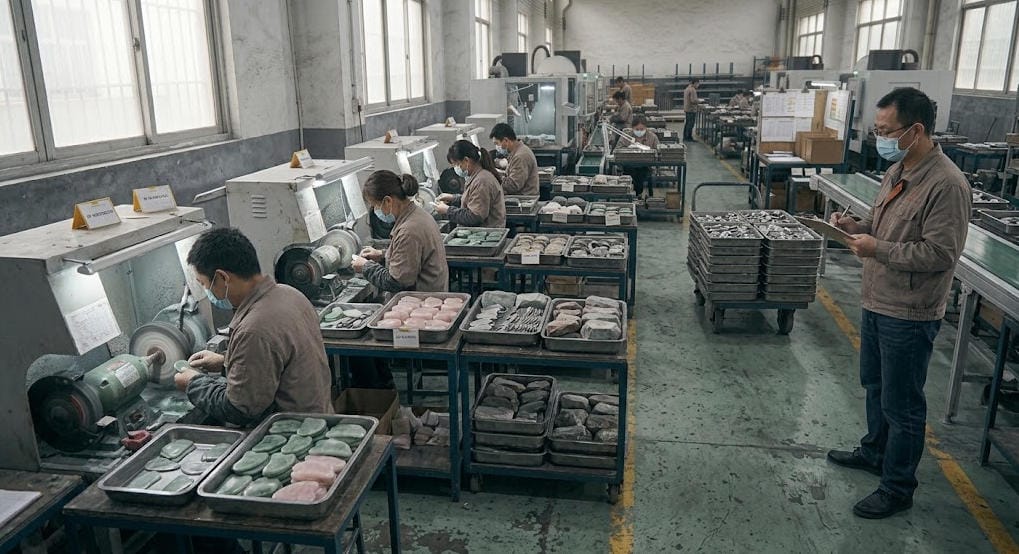
Two orders of 5,000 pieces look identical on a purchase order, yet they can load a workshop very differently. Quantity counts pieces, while load counts the machine hours and bench hours those pieces claim during weeks when other buyers are claiming them too. In a quiet month, your batch runs from start to finish without interruption. In a busy month, the same batch shares a CNC machine and a grinding line with several other jobs, and each job waits its turn. This means you can never predict your lead time from quantity alone.
Picture the route your pieces travel: CNC cutting, edge trimming, rough grinding, fine grinding, polishing, QC and packing. Each station has its own daily capacity, and the slowest station sets the pace for the whole line. A gua sha production schedule is only as fast as its most crowded bench, however quickly the earlier machines run. This means you should ask about capacity at the tightest station, not at the machine everyone talks about.
Why a Gua Sha Manufacturer Watches Polishing Before CNC
CNC cutting is programmed, repeatable and easy to scale, because a second shift can start within days. Polishing works differently. Each piece needs edge finishing, curve work, fine grinding, a final polish and a visual check, and much of that depends on trained hands and eyes. A gua sha manufacturer can add machine time quickly, but teaching a new polisher to reproduce the same edge feel takes far longer. This means you should expect polishing to be the last stage that can be sped up when the schedule tightens.
Here is an illustration with assumed numbers. If one polishing bench finishes 40 pieces a day, 5,000 pieces need 125 bench-days. With 10 benches free, that is about 12.5 days. If six of those benches are already committed to other orders, only four remain, and the same batch needs about 31 days. Nothing broke and nobody worked slower; the free capacity simply shrank. This means you can see how a polishing queue alone adds weeks to a guasha lead time without a single machine fault.
How to Check for a Bottleneck Before You Order
You do not need to walk the factory floor to find a bottleneck. Send your gua sha factory four short questions:
- Which station is the fullest this month?
- How many pieces per day does that station finish on my product’s shape?
- How many of that station’s hours are already booked?
- Does the quoted date assume today’s bookings, or bookings you expect to move?
Then compare the answers with what you would expect from a supplier who is planning rather than guessing. A supplier who replies with pieces per day and booked hours is showing you a real schedule. A supplier who replies “busy season” and nothing else is not. Would you sign off on a delivery date if nobody could tell you which bench will finish your pieces? This means you can separate real capacity from general reassurance before you pay a deposit on a gua sha wholesale order.
Natural Stone Raw Material Risk: What a Gua Sha Manufacturer Cannot Standardize
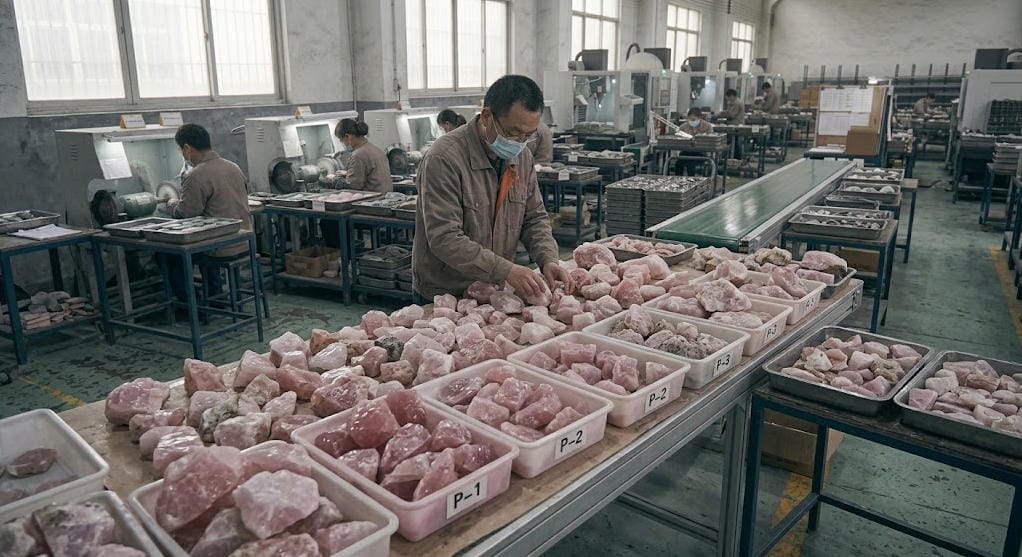
Steel arrives in grades, but natural stone arrives in pieces. Two blocks of rose quartz from the same source can differ in color depth, translucence and internal texture. According to GIA’s rose quartz description, the pink color comes from microscopic inclusions of aligned silicate mineral fibers, and those same inclusions give the stone its cloudy translucence. Because the inclusion pattern varies inside a single block, no purchasing department can order “the same pink” the way it orders a roll of packaging film. This means you can treat color range as a property of the material, not as a decision your factory made.
GIA also reports that the most appealing color typically occurs in larger sizes, and that small specimens with good color are rare. Most gua sha shapes are cut from mid-size pieces, so the slabs that match a Golden Sample are only a fraction of what arrives. When your first batch used stock that was already sorted, your second batch has to start the search again. This means a repeat order of “the same rose quartz” can need two to five extra days of material preparation before any cutting begins, which matches the 3-day and 5-day figures in the earlier schedule.
How Rough Sourcing Adds Days to Guasha Lead Time
GIA names Brazil as the usual home of the best rose quartz rough, with India, Madagascar and Sri Lanka as other sources. Rough stone that crosses borders passes through traders, ports and customs before it reaches a cutting workshop. Each handoff is a place where a delay can enter your guasha lead time, and none of them sit under the control of the workshop that cuts your pieces. This means you can ask your supplier for raw material status as its own milestone, separate from production status.
A gua sha production plan for natural stone follows a short chain: rough arrives, gets sorted into color bands, gets checked against your approved sample, and only then goes to the saw. If the color band is narrow, more rough is rejected and the buying cycle repeats. A wide color range is faster to fill but gives you more variation between pieces in the same carton. This means you can choose between tighter color and shorter lead time, and it is cheaper to make that choice before you order than after the first inspection.
Treatment Disclosure: A Compliance Note from a Gua Sha Manufacturer
Natural stone can also be dyed, coated or impregnated, and a certificate only describes what the lab saw on the day of testing. Swiss lab SSEF made this point in a trade alert on emeralds, explaining that every report reflects the stone’s condition at the time of testing only, and that LMHC guidelines make treatment disclosure obligatory when it affects value. The same logic applies to any stone you buy, including the material behind your gua sha wholesale order. This means you can ask for a written material statement and photos for each lot instead of relying on an old document.
The US regulator points the same way. Section 23.24 of the FTC Jewelry Guides says sellers should disclose a treatment that significantly affects a stone’s value or requires special care, and it applies at every level of trade. Gua sha tools are not jewelry, so whether those guides bind your product is a question for your own legal adviser. They still show what regulators expect: say plainly what was done to the stone. If your listing says “natural” and the stone was dyed, who carries that risk? This means you can write “untreated natural stone” into your specifications only when your supplier’s documents support it.
Stricter QC on a “Same Product” Repeat Order: What Your Gua Sha Manufacturer Adds to the Schedule
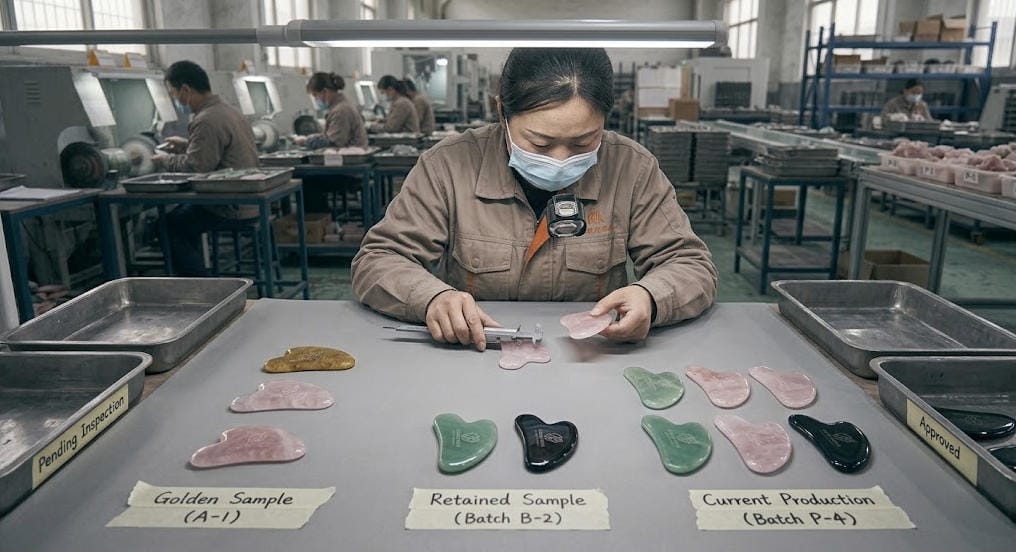
A repeat order can carry the same product name and a heavier inspection load. On the first run, many buyers approve a sample and accept natural variation in color and texture. On the second run, the same buyers often ask for pieces close to the last batch, tighter translucence, an edge check on every piece, a fresh confirmation of logo position and a carton check on each unit. Each request is reasonable, and each one adds a step between the saw and the shipping dock. This means you can see why “the same product” and “the same lead time” are two separate claims.
The extra steps show up first in raw material. As an illustration, suppose 75% of cut blanks pass a loose color range and only 50% pass a tight one. To deliver 5,000 finished pieces, a gua sha manufacturer must then cut about 6,700 blanks under the loose range and 10,000 under the tight range, which is 50% more stone to cut, sort and polish. That extra volume costs both days and material, and the cost lands in your guasha lead time and your unit price at once. This means you can decide how tight your color tolerance needs to be before you pay for it.
How a Gua Sha Manufacturer Matches Color and Edge to Your Last Batch
Sorting starts from the approved sample or Golden Sample. Inspectors compare each blank against retained pieces from your previous batch under the same light, because color that looks matched in a warehouse can drift in daylight. Edges get a hand check as well, since a gua sha tool is pressed against skin and a rough edge becomes a user complaint. This means you can ask for a written color range and photos under standard light instead of accepting phrases like “close match.”
Logo confirmation deserves its own mention. When the placement changes, the workshop often waits for your reply, and those waiting days belong to no machine at all. Have you counted how many days your own approval steps take? A gua sha factory cannot start laser marking or printing until the artwork is locked, so a slow reply shifts the whole schedule. This means you can save days by sending final artwork and position marks together with the purchase order.
Reading an AQL Statement Before You Approve a Repeat Order
Most inspection agreements rest on sampling. ISO 2859-1 defines sampling schemes indexed by acceptance quality limit (AQL) for lot-by-lot inspection, and its third edition, published in January 2026, adds skip-lot procedures alongside switching rules (see ISO 2859-1:2026). Under those rules, inspection tightens when defects rise and can relax when quality stays stable. The standard supplies the sampling plans, but you and your supplier still agree the AQL number and the defect classes. This means you can write your own limits into the order, for example a lower AQL for major defects such as cracks and a higher one for minor cosmetic marks.
Natural stone needs defect classes that generic checklists miss: edge chips, hairline cracks along inclusion lines, color outside the approved range and offset logos. For gua sha wholesale orders, spelling these out before gua sha production starts prevents an argument about “acceptable” after the goods are packed. When a lot fails and inspection tightens, re-sorting takes extra time, so ask how a failed lot re-enters the schedule. This means you can budget rework days in advance instead of discovering them at the end.
Holidays, Peak Season and Staffing: Why Your Order Date Matters to a Gua Sha Manufacturer
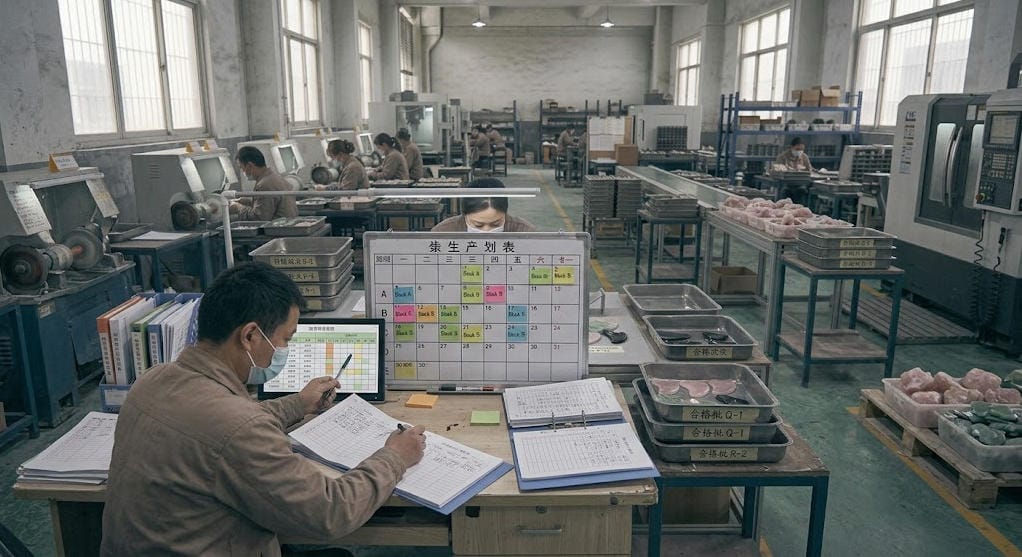
The calendar is a production input, just like stone and labor. Two identical orders placed a few weeks apart can meet different holidays, different staffing levels and different order books. China’s State Council published its 2026 holiday calendar on 4 November 2025, with a nine-day Spring Festival break and a seven-day National Day holiday (China Briefing summary). Mid-Autumn Festival falls on 25–27 September and National Day runs from 1 to 7 October, so an order confirmed today meets both breaks before it finishes. This means you can predict part of your delay from the calendar before you send a deposit.
Now the arithmetic. A 35-day production cycle that straddles the nine-day Spring Festival break becomes 44 calendar days before any ramp-up loss. Add the first week after the break, when workers often return in stages and benches run below full capacity, and a quote can pass 50 days without a single machine fault. This means you can add holiday days to your plan the same way you add shipping days.
How a Gua Sha Manufacturer Plans Around Peak Season
Retail calendars pull orders forward. Buyers preparing for year-end gifting and spring promotions confirm their orders in the same few weeks, and those are the weeks when the polishing queue is longest. A gua sha factory that books its capacity full in those weeks has little room for late changes, such as a new logo position or a revised color range. Overtime helps CNC cutting, but hand finishing cannot be stretched the same way. This means you can lock your specifications before peak season starts and keep your place in the queue.
Staffing adds a quieter kind of delay. Leave around festivals, absences and temporary hires all change how many trained polishers sit at the benches, and a new polisher needs weeks to match an experienced hand on edge feel. Logistics adds more days after packing, through port and courier congestion that no workshop controls. Does your quoted date end at the factory gate or at your warehouse? This means you can ask each supplier to state the end point, so your guasha lead time comparison is fair.
Building an Order Calendar You Can Use
Work backward from the day you need stock on your shelf. Subtract transit time, then the production cycle, then any holiday days that fall inside it, then a buffer of 7 to 10 days. As an illustration, 30 days of ocean transit, 35 days of production, a 9-day holiday and a 10-day buffer total 84 days, or 12 weeks. Confirm the slot in writing, with the date your order enters gua sha production and the date it leaves the dock. This means you can set your confirmation date 12 weeks before launch and avoid paying for rush freight.
Ordering early costs less than most buyers assume. Take a 30% deposit on a $22,500 order, which is $6,750; at an assumed 8% annual cost of capital, paying it 14 days earlier costs about $21. Nine days of deferred sales at the earlier $667-per-day assumption comes to roughly $6,000. In gua sha wholesale purchasing, that ratio makes the early deposit the cheaper side of the trade, because a calm schedule also gives the gua sha manufacturer room to sort stone and finish edges properly. This means you can treat order timing as a cost decision you control, not as luck.
How to Read a Gua Sha Manufacturer’s Lead Time Quote Before You Pay a Deposit
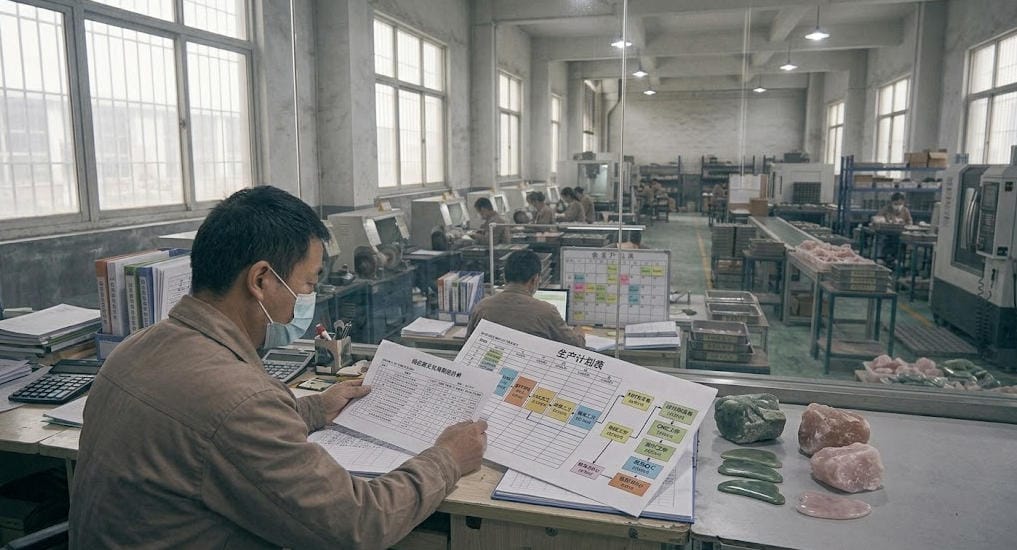
A number of days means nothing until you know where the count starts and where it stops. One supplier counts from the deposit, another from raw material confirmation, and a third from the first day of cutting, so “35 days” can describe three different spans of time. Before you compare any two quotes, ask five questions and get the answers in writing:
- Is the count from deposit or payment?
- Does it start after sample approval?
- Does it start after raw material confirmation?
- Does it start when production actually begins?
- Does it end at completion, QC, packing or shipment?
As an illustration, if sample approval and raw material confirmation together take 10 to 15 days, a “35 days from production start” quote and a “50 days from deposit” quote may describe the same schedule. This means you can compare guasha lead time figures only after both suppliers use the same start and end points.
Ask for a Breakdown, Not Just a Number
For repeat orders and large batches, ask your gua sha factory to split the total into raw material preparation, production queue, machining and forming, grinding and polishing, QC, packaging and estimated buffer, each with a number of days. A supplier who answers “queue 18 days, previously 5” has shown you where the time went, and you can manage a delay you can locate. A supplier who answers “we are busy lately” has given you nothing to check. Which answer would you rather build a launch plan on? This means you can judge a supplier’s planning discipline from a single reply.
Once you know the queue is the problem, act on it. Share a three-month forecast so the workshop can reserve polishing capacity, and confirm repeat orders before the schedule fills. If the queue drops from 18 days to 8 days as a result (an assumed figure), you recover 10 days without touching the price. Steady forecasts also let gua sha production planners buy stone once, sort it once and cut it in a single run. This means you can turn a repeat gua sha wholesale order from a fresh start into a routine.
A Quote That Separates Normal Cycle from Current Schedule
Compare two sentences. As a guasha lead time statement, “This product is always 35 days” sounds firm, but it hides the queue, the season and the stone supply. “Normal production cycle is about 30–35 days; current scheduling requires about 50 days” tells you two facts: what the product needs and what the calendar demands today. The second sentence is harder to write and easier to trust. This means you can ask every gua sha factory on your shortlist to quote in the second form and see who is willing.
Also ask whether the extra days will last. If the delay sits in the queue during a peak month, it may vanish next quarter, but if it sits in polishing capacity, it may return every season. Put the answer in writing, next to the date your order enters gua sha production. This means you can plan your next order around a known pattern instead of a surprise.
Your Next Step
If you buy gua sha wholesale on a repeat basis, take your last two quotes, lay them side by side and find the block that grew. That single step turns “why is it slower?” into a specific question with a specific answer. If you want a breakdown for your own product, send Donghua the item, quantity and target ship date through the inquiry form, and we will return the schedule in the seven blocks above.
Risk disclosure: the day counts, rates and cost figures in this article are examples that show how lead time behaves. Your actual schedule depends on material availability, order book, inspection requirements and the calendar in the month you order. Confirm all dates in writing before you pay a deposit.
FAQ: Gua Sha Lead Time and Production
1. Why did my repeat gua sha order take longer than the first one?
Usually because the order waited longer before reaching the machines. In a typical example, the production queue grew from 5 days to 18 days while CNC forming stayed at 10 days, which accounts for 13 of the 15 extra days. Raw material stock, stricter color matching and holidays can add the rest. Ask your gua sha manufacturer to break the total into stages so you can see which one grew.
2. What is a normal gua sha production lead time?
It depends on the product, the material and the current order book. As an example, a 5,000-piece natural stone order may need a normal production cycle of about 30 to 35 days, while the scheduled lead time can reach 50 days when the queue is full. Ask for both numbers: the normal cycle and the current schedule.
3. Does a longer guasha lead time mean the factory has become slower?
Not necessarily. Lead time equals production queue plus raw material preparation, production, QC and rework, packing and buffer. Only the production time is fixed by the product, while the other parts change with the order book, the stone stock and the calendar. CNC forming can take exactly 10 days both times while the queue grows.
4. How can I avoid peak-season delays when ordering gua sha wholesale?
Confirm the order early and lock your specifications, including color range and logo position, before peak season starts. Work backward from your launch date by subtracting transit time, the production cycle, holiday days and a buffer of 7 to 10 days. For example, 30 + 35 + 9 + 10 gives 84 days, or about 12 weeks. Sharing a three-month forecast also helps the factory reserve polishing capacity.
5. Should lead time be counted from the deposit or from production start?
Ask for the start and end points in writing, because suppliers count differently. Some count from the deposit, others from sample approval, raw material confirmation or the first day of production, and the end point can be completion, QC, packing or shipment. Two quotes are comparable only when both use the same start and end points.
6. Why does natural stone change gua sha production time?
Natural stone is not a standardized material. Color, translucence and texture vary inside one block, and GIA notes that rose quartz gets its pink color from microscopic inclusions of aligned silicate mineral fibers. Matching a Golden Sample means sorting more blanks, and a new purchase adds days for delivery, sorting and color confirmation before cutting begins.
7. Can stricter QC requirements extend the lead time?
Yes. Requests such as matching the previous batch color, checking every edge, reconfirming logo position and inspecting each carton add sorting, inspection and rework time. As an illustration, if a tight color range lowers the pass rate from 75% to 50%, the factory must cut about 50% more blanks to deliver the same 5,000 pieces.