
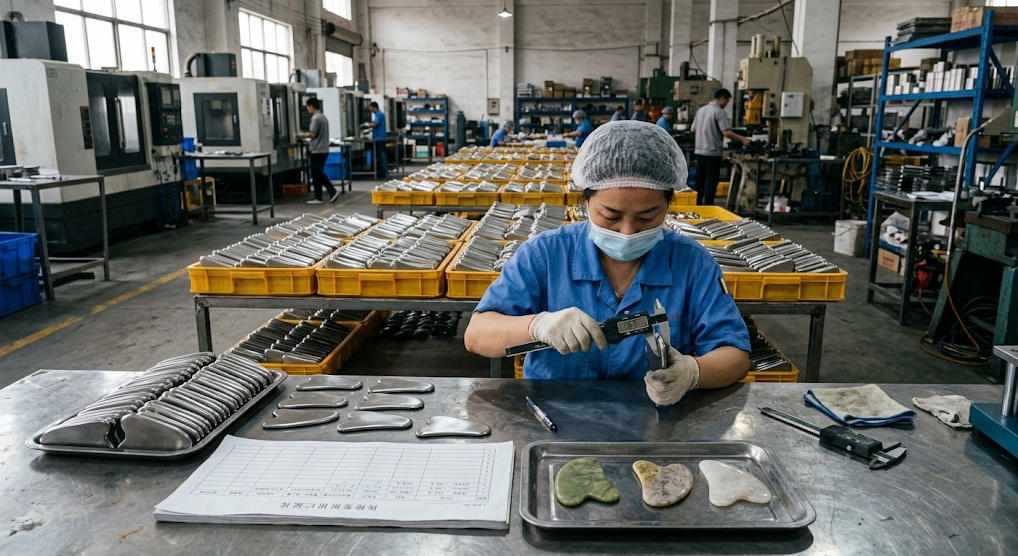
If you’ve ever placed a stainless steel gua sha wholesale order and then measured the incoming cartons against your spec sheet, you already know the real question isn’t whether steel looks more precise than stone on paper. It’s whether that precision holds up across 5,000, 50,000, or 200,000 pieces. Here’s what one year of order data actually showed: across roughly 230,000 stainless steel gua sha boards sold in a single best-selling style, 99.8% met a ±0.2mm thickness tolerance. Across roughly 350,000 stone gua sha boards sold in the same period, 96.3% met a ±1mm tolerance — a band five times wider to begin with. On the aftersales side, dimension-related returns sat at 5% for stainless steel versus 12.5% for stone. The rest of this piece walks through why that gap exists, what you can actually write into a purchase order because of it, and — just as important — where the limits of that consistency sit, because no material hits 100%.
The Stainless Steel Gua Sha Wholesale Numbers Behind This Report
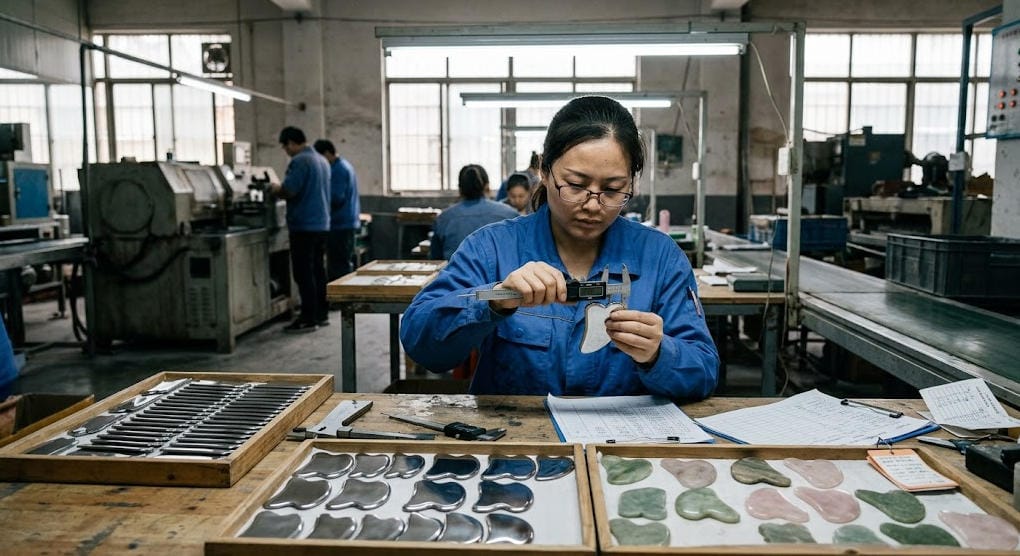
Numbers age fast in marketing copy, so it’s worth showing where these came from before going further. In September 2024, order data from the first half of that year was pulled for the best-selling gua sha style in the catalog, comparing a stainless steel version (standard thickness 4mm) against a stone version of the same shape (standard thickness 6mm). Roughly 230,000 stainless steel units and 350,000 stone units had shipped in that window. Measured against their respective tolerance bands, 99.8% of the stainless steel units landed within ±0.2mm, while 96.3% of the stone units landed within ±1mm.
That 3.5-point gap looks small until you notice the tolerance bands aren’t the same size. Stone was allowed five times more room to move and still missed the mark almost four times as often, proportionally. That’s the part a spec sheet alone won’t tell you — you have to compare pass rate and tolerance width together, or the comparison is misleading in the stone material’s favor.
A second dataset, covering all of 2025’s aftersales claims, adds the cost angle. Total aftersales cases for stainless steel gua sha sat near 2,000 pieces for the year; for stone, near 12,000. Of those, dimension-related complaints made up 5% of stainless steel cases (about 100 pieces) versus 12.5% of stone cases (about 1,500 pieces). If you’re pricing warranty reserves or return-handling labor into a stainless steel gua sha wholesale quote, that difference isn’t cosmetic — it’s a line item. So what does this mean for you practically? It means a stainless steel order gives you a narrower, more predictable return-rate range to budget against, which is exactly what a buyer needs when forecasting margin on a container-sized order.
| Metric (2024–2025 data) | Stainless Steel | Natural Stone |
|---|---|---|
| Standard thickness | 4mm | 6mm |
| Stated tolerance | ±0.2mm | ±1mm |
| Units sold in sample period | ~230,000 | ~350,000 |
| % within tolerance | 99.8% | 96.3% |
| Dimension-related aftersales | 5% (~100 pcs) | 12.5% (~1,500 pcs) |
Raw Material Control Before Your Stainless Steel Gua Sha Wholesale Order Ships
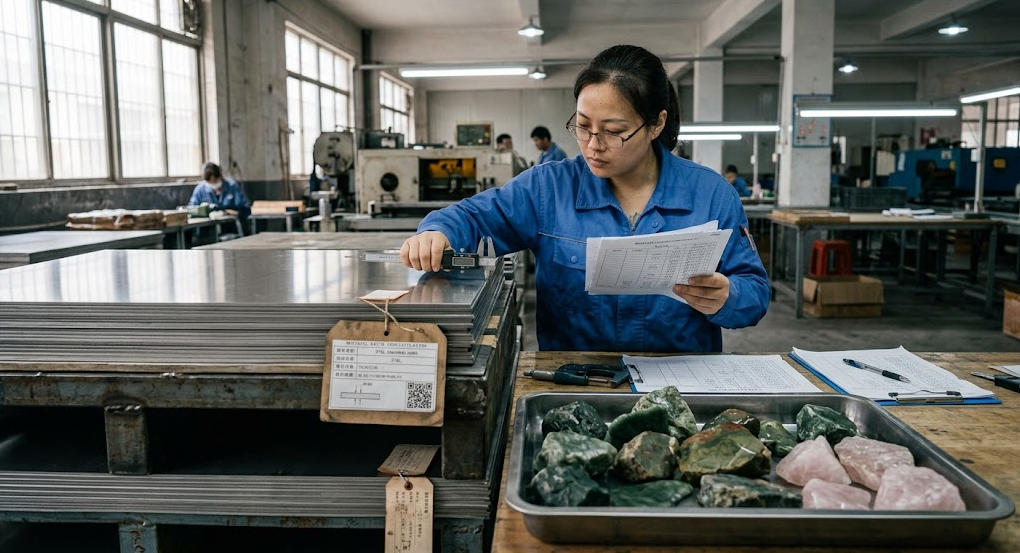
Consistency doesn’t start on the CNC bed. It starts with what the material looked like before anyone cut it, and this is where stainless steel and stone genuinely diverge as inputs, not just as finished products.
Why Natural Stone Variation Isn’t a Flaw
Natural stone — jade, jasper, rose quartz, whichever variety you’re sourcing — carries variation that comes from the earth, not from a factory error. Color depth, veining, crystal structure, small inclusions, natural fissures, translucency, and localized texture can all differ piece to piece, even within the same mining region. Gemological bodies treat this as an intrinsic property of the material rather than a defect: the Gemological Institute of America (GIA) notes that jadeite’s market value is judged specifically on color, transparency, and texture variation, precisely because that variation is expected. The International Gem Society (IGS) frames jade evaluation the same way — as a spectrum to assess, not a single fixed standard to match. You’re not buying a defective batch when a stone gua sha board looks slightly different from the one next to it. You’re buying a natural material doing what natural materials do.
What a Mill Certificate Locks In for Stainless Steel
Stainless steel enters production as standardized sheet, coil, or bar stock, and that changes what can be confirmed before cutting even begins. A stainless steel gua sha manufacturer can verify the grade — 316L being the common choice for skin-contact tools — along with sheet or bar thickness, hardness and mechanical properties, surface condition, supplier, and batch number, all against a mill certificate. Grade 316L itself sits inside a recognized specification family; ASTM’s A276/A276M standard defines the composition and mechanical requirements for stainless bar stock, and 316L (UNS S31603) is one of the grades covered under it. That means the input variable is pinned down in writing before the first cut, not discovered after the fact. So what does this mean for you? It means your stainless steel gua sha wholesale supplier can hand you a material spec sheet before production starts, rather than asking you to trust a visual sample — and you can hold that document against every future reorder.
CNC Programming and the Stainless Steel Gua Sha Wholesale Tolerance Advantage
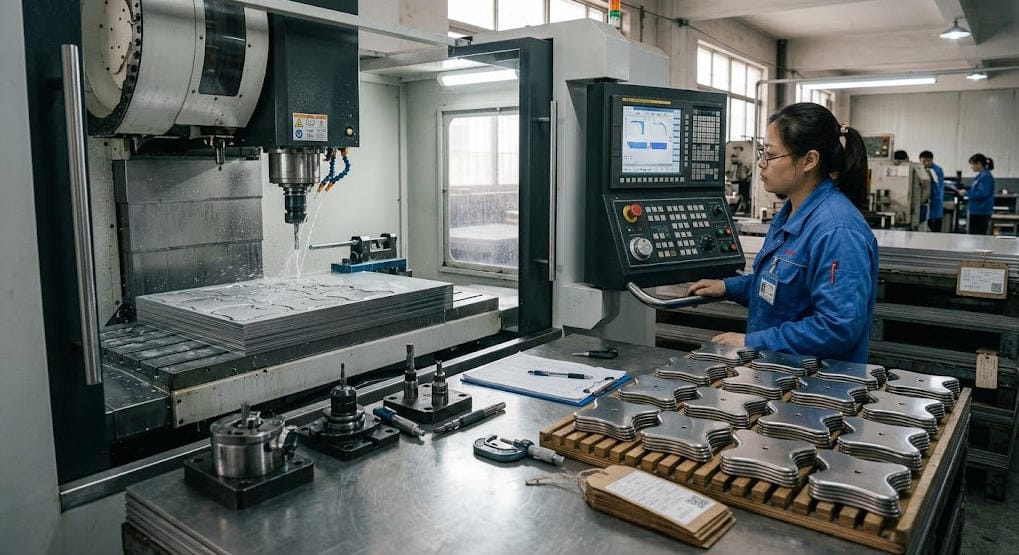
Standardized material is only half the story. What happens to it on the shop floor is the other half, and this is where digital manufacturing does most of the heavy lifting.
One File, Thousands of Identical Parts
A stainless steel gua sha board might be specified at 85 × 55mm, 3.0mm thick. Instead of a worker filing each piece by hand to match a template, a CNC program cuts the outline directly from that digital file — length, width, thickness, hole positions, hole diameter, curve radius, edge profile, the contact-face angle, even the logo placement, all controlled from the same source. The first unit off the machine and the ten-thousandth are cut from the identical digital model. That’s the mechanism, not a slogan — and it’s worth asking yourself: would you rather trust a worker’s hand-feel to stay consistent for ten thousand repetitions, or a file that doesn’t get tired on the night shift?
Where a ±0.10mm Number Actually Comes From
For certain critical dimensions, a tolerance as tight as ±0.10mm can be set in advance. That number isn’t universal, though, and any stainless steel gua sha manufacturer worth ordering from should tell you that plainly — actual achievable tolerance depends on part geometry, machine capability, material thickness, and the specific process used. A flat board with simple curves tolerates tighter numbers more easily than a piece with deep contouring or thin edges. This means you can ask your supplier for the tolerance table specific to your SKU, rather than accepting a generic “high precision” claim that isn’t tied to your actual product drawing.
Tooling Standardization Behind Every Repeat Stainless Steel Gua Sha Wholesale Order
Here’s a distinction that gets missed in most sourcing conversations: the advantage of stainless steel isn’t just that the machines are precise. It’s that the object being fed into the machines is already standardized, which is a different thing entirely.
When stainless steel gua sha production uses stamping, laser cutting, CNC machining, or a combination of the three, the tooling itself becomes a repeatable system. The logic is straightforward — the same design program, run through the same cutting tool, against the same material specification, produces the same geometry, batch after batch. Stone, even when CNC-cut, still carries variables the tooling can’t standardize away: the size of the rough block, its internal structure, how much of it is actually usable, and how much gets lost to processing waste. A block of stone might yield twelve usable boards or eight, depending entirely on what’s inside it. So what does this mean for your reorder timeline? It means a stainless steel design file, once approved, can be pulled out and run again in six months or two years with the same tooling and get you the same part — something a stone supplier genuinely cannot promise with the same confidence, through no fault of their own.
Writing Tolerances Into Your Stainless Steel Gua Sha Wholesale Purchase Order
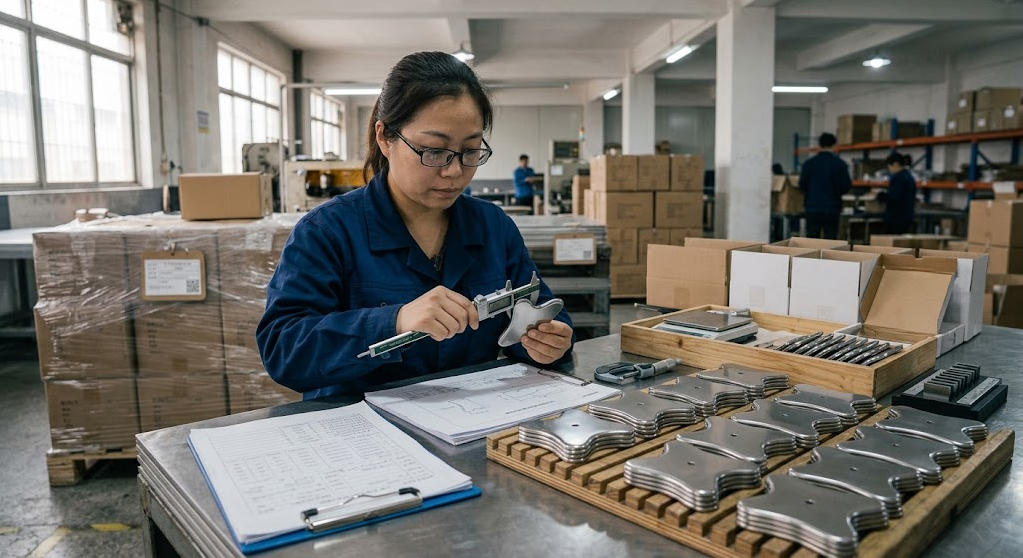
This is arguably the most actionable difference between the two materials, and it’s worth treating as a checklist you actually use rather than a nice idea.
What You Can Specify in Writing
Before production starts, you can specify — in the purchase order itself — the exact dimensions and allowed deviation for length, width, thickness, hole diameter, hole position, edge radius, surface roughness, and weight. That’s a level of specificity stone can’t fully support, because you can’t reasonably demand that “every unit’s color, texture, and internal structure must be identical” when some of that variation is a property of the material, not a manufacturing choice. For stone, the more workable approach is agreeing on an acceptable color and texture range upfront, rather than an absolute match.
How You Verify a Shipment After It Arrives
Once goods arrive, you can pull a sample set and measure it against the numbers written into the PO — not against a vague memory of what the sample looked like, but against a document both sides signed off on. If a shipment comes in outside spec, you have a written basis for the conversation, rather than a subjective disagreement about whether something “looks off.” This is the practical, do-it-yourself version of quality control: agree on the numbers first, measure against them second. A stainless steel gua sha wholesale buyer who skips this step is leaving a real cost-control tool unused — and it costs nothing extra to ask for it.
Surface Finishing and Edge Safety on a Stainless Steel Gua Sha Wholesale Batch
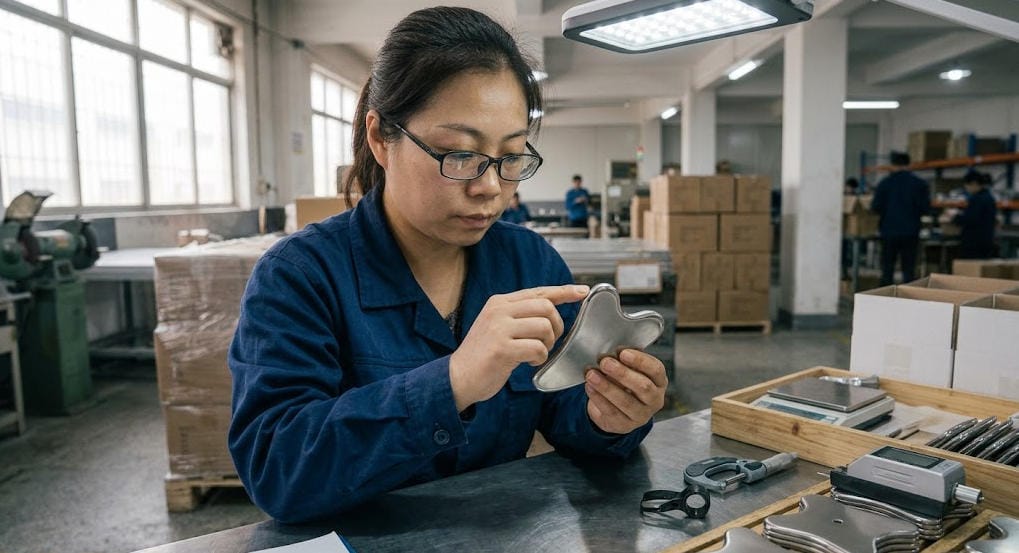
Dimensional accuracy gets most of the attention in sourcing conversations, but it isn’t the whole picture. For a tool that spends its working life sliding across skin, the finish and the edge geometry matter just as much as the millimeters on the drawing — arguably more, since that’s the part your end customer actually feels.
The Finishing Sequence, Step by Step
A typical production path for a stainless steel gua sha wholesale batch runs through CNC machining, deburring, coarse grinding, fine grinding, polishing, cleaning, and then QC inspection. Each of those stages has its own written requirement rather than being left to a worker’s judgment on the day. That sequence exists specifically because a board that passes dimensional inspection can still fail on feel — a burr the calipers won’t catch is still a burr your customer’s skin will catch. This means you can request the finishing flowchart alongside the dimensional spec sheet, and you should, because a supplier who can’t produce one probably isn’t running one consistently.
What Your Incoming QC Should Actually Check
On the skin-contact edge specifically, inspection should look for burrs, whether the edge cuts or catches when drawn across a fingertip, whether the curved surface flows without flat spots, visible tool marks, uneven polish, pitting or scratches, and whether the finish matches the confirmed sample. Notice that none of this shows up on a caliper reading. So what does this mean for your QC checklist? It means “consistency” for a stainless steel gua sha wholesale order has to include a hands-on feel check, not just a measurement pass — a batch can be dimensionally perfect and still ship with an edge nobody wants to hold.
The Golden Sample System Behind Every Stainless Steel Gua Sha Wholesale Shipment
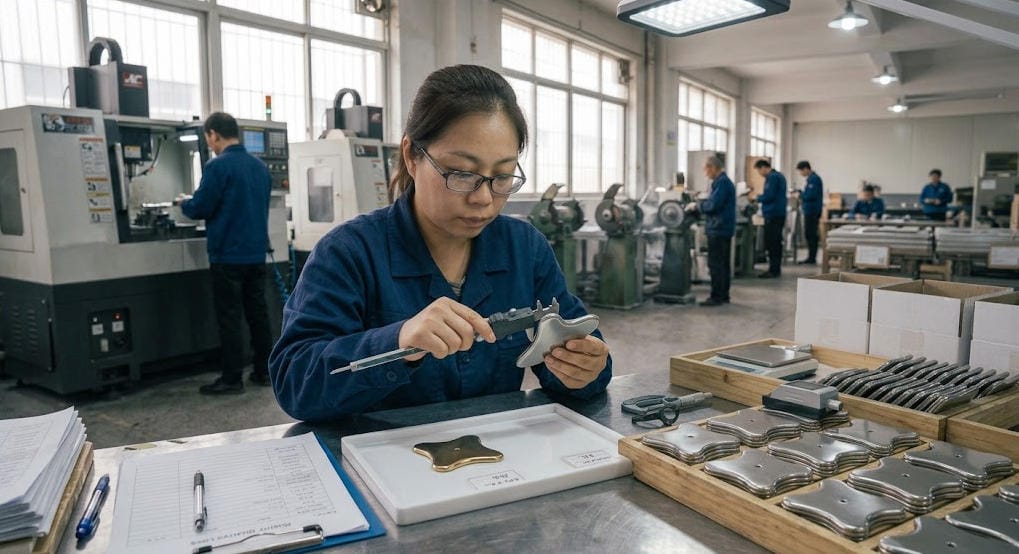
For OEM and ODM orders, one or a few units — the Golden Sample — get confirmed before mass production starts. Everything after that gets measured against that physical object, not against a worker’s memory of what “right” looks like. This is worth sitting with for a second: it moves the standard from a subjective impression to a fixed, physical reference that both sides already agreed on.
IQC, IPQC, FQC, OQC Explained in Plain Terms
A Golden Sample defines dimensions, weight, curve shape, edge structure, surface finish, polish level, logo placement, logo depth, and packaging. That reference then runs through four checkpoints: IQC (incoming material inspection, checking raw stock before it’s cut), IPQC (in-process inspection, checking dimensions while the batch is still running), FQC (final inspection on completed units), and OQC (outgoing inspection before the shipment leaves the building). Each checkpoint compares against the same physical sample, not four different interpretations of a spec sheet.
What Changes When a Sample Becomes the Standard
Here’s the practical shift: consistency control stops being about sorting out bad units at the very end and becomes about catching a deviation while it’s still small, somewhere in the middle of the run. If a dimension starts drifting on unit 400 of a 5,000-unit order, IPQC is what catches it — not a customer complaint three months later. So what does this mean for your risk exposure? It means a stainless steel gua sha manufacturer running this chain is finding problems while they’re still cheap to fix, which is a different value proposition than a supplier who only inspects what’s already finished and boxed.
Statistical Sampling for Stainless Steel Gua Sha Wholesale Batches
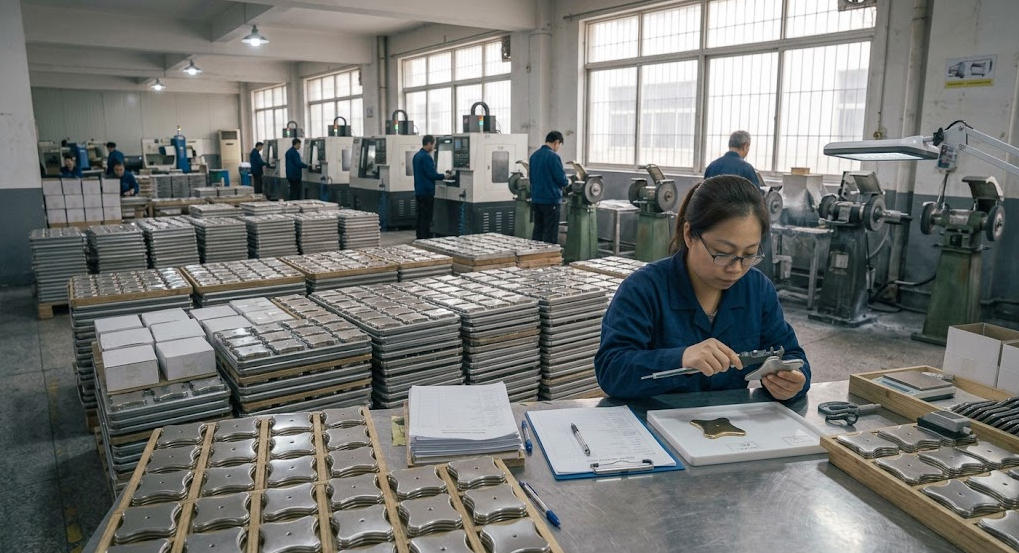
Once an order reaches a few thousand units, measuring every single piece by hand stops being realistic — and honestly, it stops being the right tool for the job anyway.
Catching Drift Before It Becomes a Return
For a 5,000-piece order, an agreed sampling plan checks a defined portion of the batch against dimensions, appearance, edges, finish, logo, packaging, assembly requirements, and any other specification written into the contract. If that sample shows a dimension trending away from target — not yet failing, just drifting — equipment or process settings can be adjusted before the drift turns into a pile of out-of-spec parts. This is the real difference between industrial manufacturing and handcraft production: the goal was never “every piece looks about the same.” The goal is a controlled, predictable distribution of measurements clustered tightly around a target value, which a well-run process can demonstrate and a hand-finished process generally can’t. Isn’t that the actual thing you’re paying for when you choose a stainless steel gua sha wholesale supplier over a workshop — not perfection, but predictability at scale?
Risk Disclosure — What Still Varies in a Stainless Steel Gua Sha Wholesale Shipment
Everything above makes a real case for stainless steel’s advantage. It would be dishonest to stop there, though, because stainless steel does not mean zero variation — and a supplier who tells you otherwise is a supplier you should be cautious of.
The Honest List of Remaining Variables
Real production still produces slight differences between material batches, minor sheet thickness deviation, CNC tool wear over the life of a production run, small variation in polish depth, occasional light scratches or burrs that slip past inspection, differences in surface treatment between runs, variation in logo depth, and small surface marks picked up during packing. None of these are hidden secrets — they’re the normal residual variation of any high-volume manufacturing process, and any experienced buyer should expect to see a small percentage of units carrying one or two of them.
Why This Doesn’t Cancel the Consistency Advantage
What stainless steel actually offers isn’t zero variation — it’s a narrower, better-defined, more measurable range of variation than natural stone can achieve, for the material reasons already covered. This means you should budget for a small, predictable percentage of minor cosmetic variance in any stainless steel gua sha wholesale shipment, the same way you’d budget for it in any precision-manufactured product — the point isn’t that defects vanish, it’s that their rate becomes something you can actually forecast.
Stainless Steel Gua Sha Quality vs Natural Stone: Two Different Control Philosophies
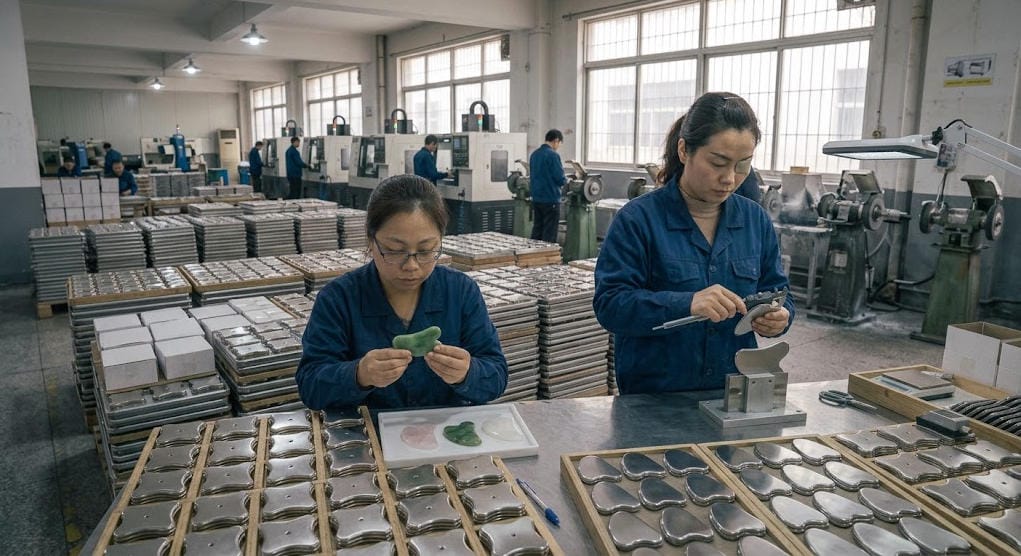
It’s worth stepping back and naming what’s actually different between these two materials, because it isn’t “one is good and one is bad.” It’s that they require different quality-control questions entirely.
What Gemological Standards Say About Natural Variation
For natural stone, the real quality question is whether the natural variation sits inside a range both sides already agreed was acceptable — color shift, texture change, natural structure, unacceptable cracking, and edge or surface condition. This is exactly why gemological institutions built entire evaluation frameworks around it rather than fixed matching standards: the Swiss Gemmological Institute (SSEF) runs dedicated jade testing and identification programs precisely because natural jade requires expert judgment to separate an inherent property from an actual defect, and the GIA’s own jade evaluation criteria are built the same way. Stone quality control, in other words, is fundamentally about telling “natural difference” apart from “genuine flaw” — a skilled, judgment-based task rather than a pure measurement one.
Why Stainless Steel Follows Industrial Tolerance Standards Instead
Stainless steel gua sha quality control asks a different question: does the deviation produced by the manufacturing process fall inside a stated numeric tolerance? That’s dimensions, hole position, edges, surface finish, polish, and logo match against a confirmed sample — governed by the same category of standard that machined metal parts follow generally, such as ISO 2768’s general tolerance framework for linear and angular dimensions. That’s why stainless steel gua sha quality control can be built as a digitized, standardized, repeatable inspection system in a way that’s structurally harder to replicate with a material whose acceptable variation is, by definition, a judgment call.
What This Means for Your Next Stainless Steel Gua Sha Wholesale Order
None of this is an argument that stone gua sha is inferior — it’s a different material with a different, equally legitimate quality-control logic built around natural variation. What it does mean is that if predictable, contract-specified tolerance is what your business actually needs — for retail consistency, for reducing warranty claims, for matching a fixed product photo across every unit you sell — stainless steel gives you a more measurable path to get there, backed by the order data at the top of this piece. Before your next stainless steel gua sha wholesale order, ask your supplier for three things in writing: the mill certificate for the steel grade, the tolerance table for your specific SKU, and the sampling plan they’ll run against your batch size. If they can hand you all three without hesitation, you’re looking at a manufacturer running the system described above — not just claiming to.