
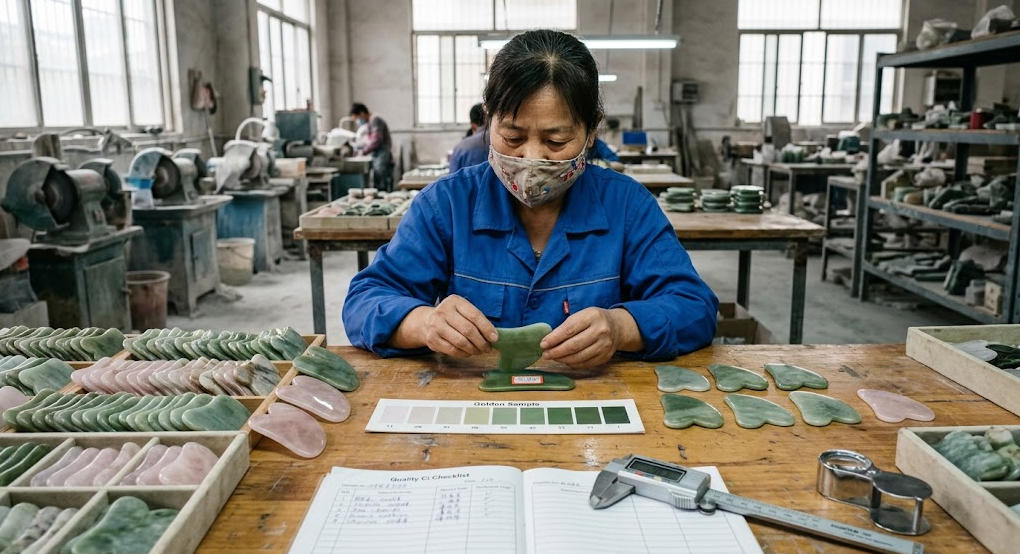
Let’s start with the number that actually matters. No honest gua sha wholesale supplier can promise a 100% pass rate on a natural stone order, and if one tells you otherwise, that claim is the first thing to question — not the last. On a typical 5,000-piece production run, even under tight process control, a portion of pieces will sit right at the edge of what your spec sheet allows for color, edge finish, or surface polish. That isn’t a factory failing you; it’s geology, because jade, amethyst, agate, and rose quartz are mined materials, not injection-molded plastic pulled from an identical mold every cycle. Once you understand that distinction, you stop chasing an impossible promise and start building the one thing that genuinely protects your order: a written, testable, jointly-agreed gua sha quality standard. This piece walks through why “100% flawless” claims don’t survive contact with real production, why gua sha wholesale risks exist even at well-run factories, and what a disciplined gua sha manufacturer should offer you instead.
100% Pass Rate Doesn’t Mean 100% Flawless — The Real Standard Behind Gua Sha Wholesale Orders
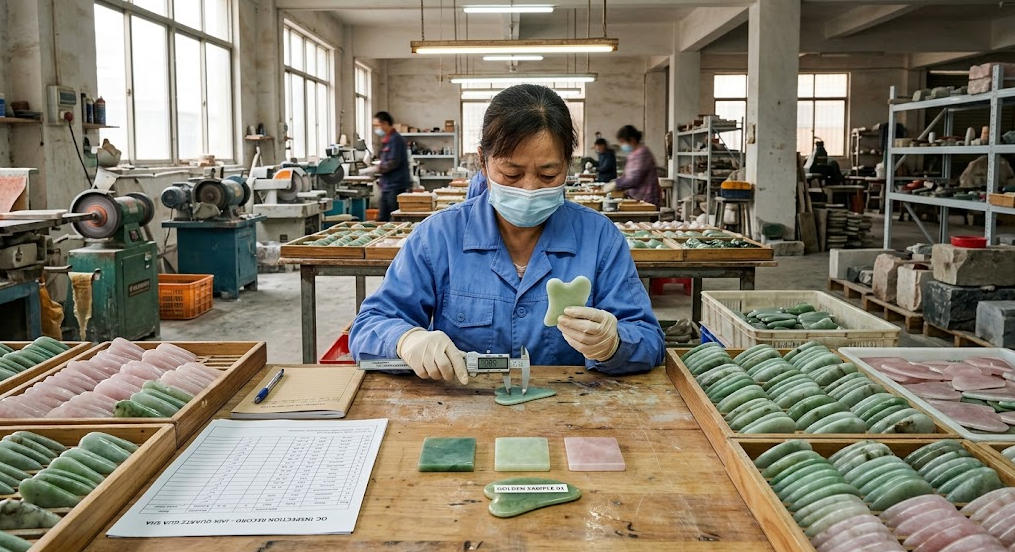
Somewhere between a sales pitch and a purchase order, the phrase “100% guaranteed” gets stretched to mean something it was never built to mean. A pass rate describes how many units in a lot meet an agreed specification. It says nothing about whether every one of those units looks, weighs, and feels identical under a loupe. Confusing the two is where most disputes in gua sha wholesale sourcing actually start, long before goods ever leave the factory floor. Is a 100% promise even measurable on a material this variable? Not in any way you could hold a supplier to.
What “Pass Rate” Actually Measures in a Production Lot
When a factory reports a pass rate, it’s measuring conformance against a defined tolerance, not the absence of every visible characteristic a stone can carry. Two pieces cut from the same rough block can show slightly different internal light reflection or a faint vein, and both can still sit inside an agreed color-difference range. You’re not buying uniformity when you order natural stone tools; you’re buying consistency within a band you set in advance, and that’s a meaningfully different purchase. This distinction changes what your inspection team should actually be checking: not “does every piece look the same,” but “does every piece sit inside the range we agreed on paper.” That’s a question a spec sheet can answer with a number, and a visual gut-check never will.
A Real-World Example: A 5,000-Piece Gua Sha Wholesale Order
Picture an order of 5,000 gua sha boards built against a written spec: dimensional tolerance of ±0.10 mm, no visible chipping on the working edge, no scratches under normal light, and color held within an agreed swatch range. A factory can run disciplined process control against every one of those lines and still deliver a lot where no two boards are optically identical, because they were never meant to be. This means your QC team can sign off on a shipment using the spec sheet as the only reference point, instead of relitigating a subjective impression piece by piece. That shift — from “does this look perfect” to “does this match what we agreed” — is what separates a gua sha wholesale buyer who gets predictable outcomes shipment after shipment from one who reopens the same argument every single time.
Why Natural Stone Can Never Be Machine-Consistent in Gua Sha Wholesale Production
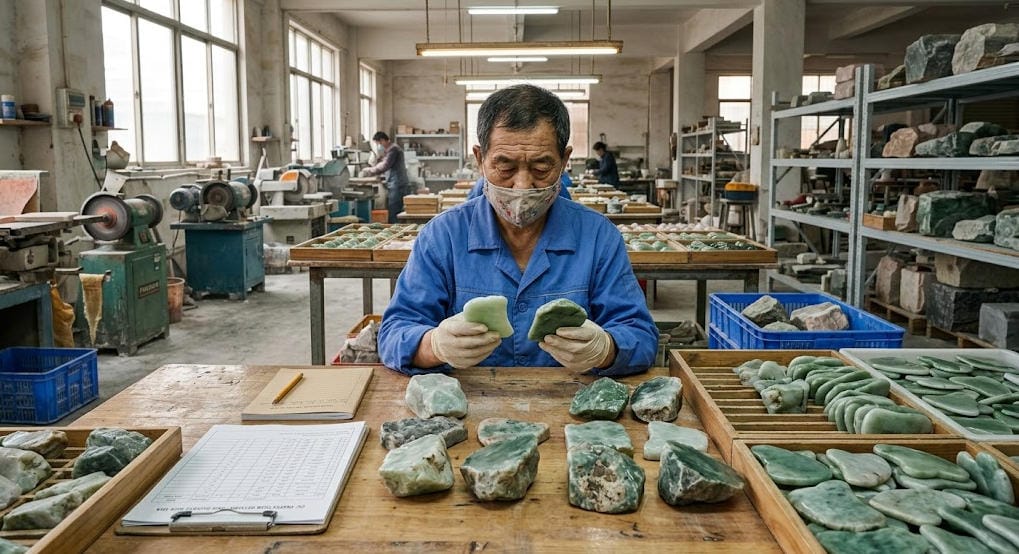
Here’s the part that catches buyers off guard when they’re used to sourcing electronics or molded plastics: the raw material itself is the variable, before a single cutting tool ever touches it. If your order runs on white jade, quartz, agate, amethyst, or green jade, you’re buying a geological product, and geology doesn’t ship with a tolerance sheet attached.
Color, Texture and Inclusions Vary Even Within One Rough Batch
Even rough stone pulled from a single mining lot can differ in color depth, internal texture, mineral inclusions, hairline structure, and translucency from one section to the next. The Gemological Institute of America notes that color and transparency rank among the most important value factors in jadeite, and that internal fractures and structural variation occur as part of the material’s natural formation, not as a manufacturing error (GIA, Jadeite Jade Quality Factors). A gua sha manufacturer can sort, grade, and color-match rough material before cutting to narrow that spread, but sorting reduces variation — it doesn’t erase what the earth put there millions of years ago. This means your production run will always carry some natural bandwidth in appearance, and the useful question isn’t how to eliminate that bandwidth, but how wide a range you’re willing to put in writing.
Why Natural Variation Isn’t a Defect in Gua Sha Wholesale Orders
This is the line that causes the most friction in gua sha wholesale risks conversations, so it’s worth stating plainly: a faint natural marking in a piece of agate is not automatically a flaw. The International Gem Society groups colored gemstones into clarity types precisely because some materials are “usually included” or “almost always included” as a matter of natural formation, not poor sourcing on the supplier’s side (IGS, GIA Gem Clarity Grading Codes). Whether a given mark counts against a shipment should come down to one thing only — what you and your supplier defined as acceptable before production started, not what looks unfamiliar to an eye that hasn’t handled much rough stone. So what does that mean for your next purchase order? It means your real leverage point isn’t demanding zero natural characteristics; it’s writing down, before the first cut is made, exactly which natural characteristics fall inside your accepted gua sha quality range and which ones don’t.
Ten Production Stages, Ten Chances for Natural Drift in Gua Sha Wholesale Manufacturing
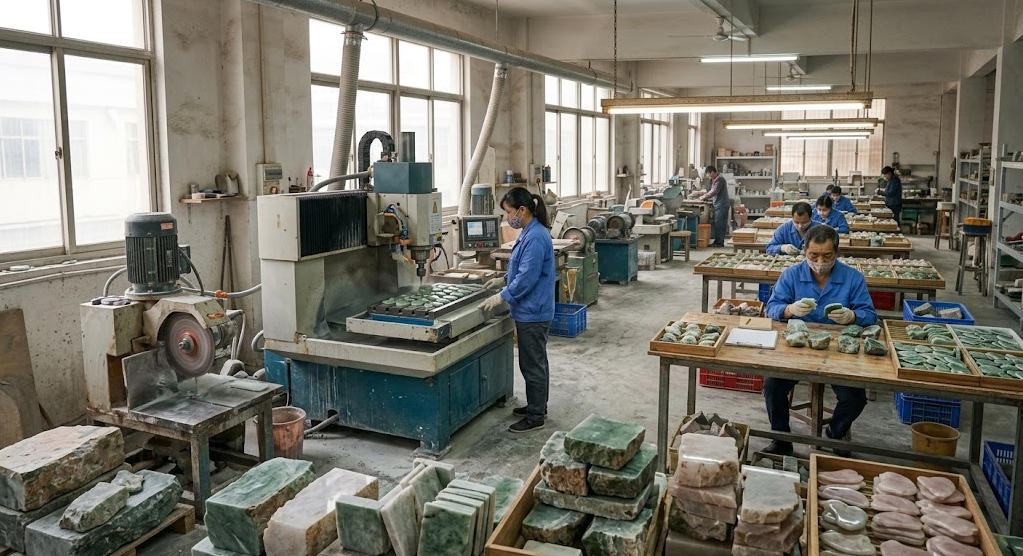
A finished gua sha board doesn’t come from a single cut. It moves through raw material screening, rough opening, coarse shaping, CNC forming, edge correction, fine grinding, polishing, cleaning, inspection, and packaging — ten distinct stages, each running on machines set to the same parameters for every piece in the batch. Yet identical settings don’t guarantee identical output, because the input material itself is never identical to begin with. Layer that reality onto ten sequential steps, and you get a production line where small, normal variation accumulates rather than cancels out.
From Rough Selection to Packaging: Where Variation Enters the Line
Dimensional drift can creep in during CNC forming, where a fractional difference in how a piece sits in the fixture shifts the final measurement by a hair. Edge correction sometimes needs a second pass because the stone’s grain runs slightly differently than the piece next to it on the same tray. Polishing can leave a marginally different sheen on two boards cut from the same slab, simply because their internal density isn’t perfectly uniform. None of this happens because a machine is poorly calibrated — it happens because natural stone doesn’t behave like a homogenous industrial input, even when every process parameter on the line stays fixed. This means that when you evaluate a gua sha wholesale factory, the right question isn’t “can you eliminate variation,” but “can you keep variation inside a range small enough that it never touches your accepted spec.”
What Happens When a Stone Reveals a Flaw Mid-Production
Sometimes a piece looks completely sound at rough-cutting stage and then shows a hairline crack the moment CNC forming exposes a fresh internal surface. This isn’t a quality-control lapse; it’s a structural characteristic that simply wasn’t visible until material was removed from around it. SSEF, the Swiss Gemmological Institute, documents this pattern directly in its gemological training on jade: internal structure, mineral banding, and natural weaknesses are properties of how the rock formed over geological time, and they don’t always announce themselves until the material has been worked (SSEF, Introduction to Jade). A responsible gua sha manufacturer treats this as an expected event to catch, not a surprise to hide. So what does that mean for you as a buyer? It means a factory that scraps a piece mid-line and logs the reason isn’t running a weak process — it’s running a process that’s actually watching.
Why Some Defects in Gua Sha Wholesale Orders Only Surface After Cutting Begins
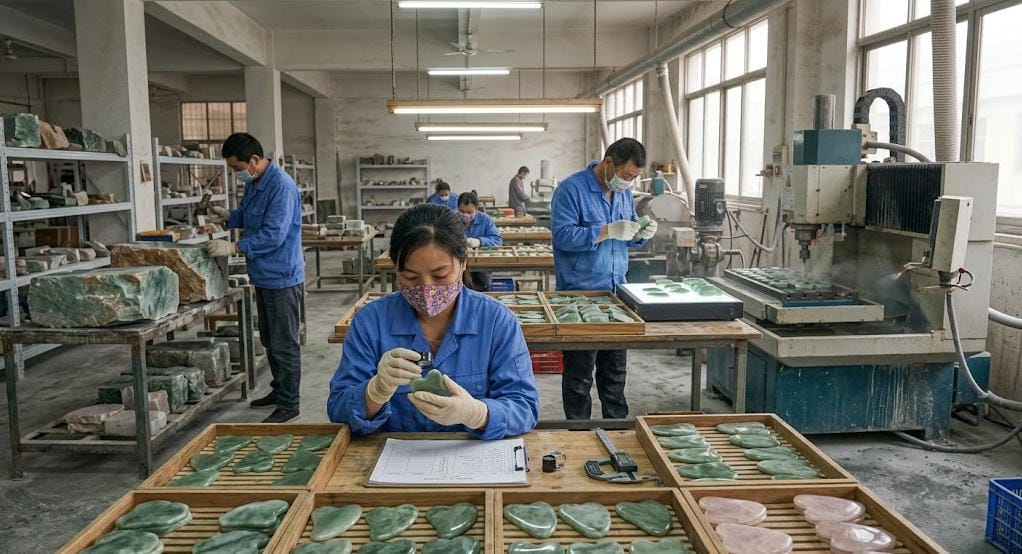
Raw material inspection happens on rough stone, often before it’s been fully opened. At that stage, a supplier can reasonably screen for obvious surface cracks, poor color zones, and heavy inclusions — but plenty of internal characteristics stay hidden until cutting, grinding, or polishing removes enough material to reveal them. That single fact is why raw-material checks alone can lower your gua sha wholesale risks, but they can never fully close them out on their own.
IQC, IPQC, FQC/OQC — The Three Checkpoints Raw-Material Screening Can’t Replace
This is exactly why mature factories build in more than one inspection gate rather than relying on a single check before shipment. Incoming Quality Control (IQC) screens rough material and components as they arrive. In-Process Quality Control (IPQC) checks parts mid-line, right after the stages most likely to expose a hidden flaw, such as CNC forming and fine grinding. Final and Outgoing Quality Control (FQC/OQC) verifies the finished, packed product against the agreed spec before it leaves the building. Each gate exists because it catches a different category of problem — IQC can’t see what only appears after cutting, and a single final check can’t tell you where in the process a flaw actually originated. This means that when a gua sha manufacturer shows you three separate checkpoints instead of one, they’re not adding bureaucracy; they’re closing three different windows where a defect could otherwise slip through undetected.
How Layered Inspection Actually Changes Your Risk Exposure
Here’s the practical difference this makes for your order: a factory running only a pre-packaging check is relying on the hope that nothing went wrong upstream, while a factory running IQC, IPQC, and FQC/OQC is actively hunting for problems at the three points where they’re statistically most likely to appear. Neither approach can promise a mythical 100% clean batch, because that promise was never realistic to begin with — but layered inspection measurably narrows the gap between what leaves the factory and what you actually agreed to buy. That’s a meaningful distinction worth asking about directly, because a supplier who can walk you through each of these three gates, in order, with a clear description of what each one is looking for, is telling you something a one-line “100% guaranteed” claim never could. It means your gua sha quality exposure on that order is being actively managed at multiple points, not hoped into place at just one.
Why a Serious Gua Sha Manufacturer Avoids the Words “100% Guaranteed”
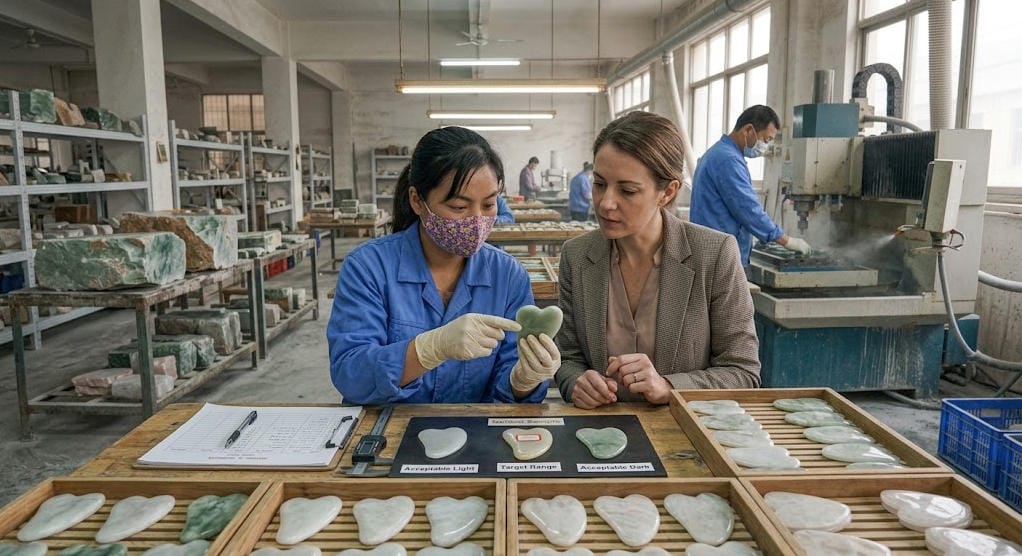
A promise of “100% guaranteed, zero problems” sounds reassuring on a sales call, but think about what it actually commits a supplier to. It means a single disputed piece, out of thousands, can be read as a broken promise — even if that piece falls well within normal natural variation. That’s not a safe claim to make about geological material, and any gua sha manufacturer who has run a real production floor knows it. The suppliers who avoid saying it aren’t hiding weaker quality; they’re refusing to sign a commitment that can’t survive contact with how stone actually behaves.
The Commercial Trap Behind an Absolute Promise
Here’s the mechanism at work: once “100%” is on the table, every ambiguous case gets resolved against the supplier by default, because the claim leaves no room for a legitimate natural characteristic to exist. A buyer who spots one piece with slightly deeper color than the rest of the batch has, technically, “caught” the supplier in a broken promise — even if that piece sits comfortably inside a reasonable color-difference range. This dynamic doesn’t protect buyers either, because it trains both sides to argue about wording instead of substance. So what should you take from this? It means your strongest position isn’t extracting a bigger promise from your supplier — it’s replacing that promise with a specification neither side has to argue about.
A Real Dispute Scenario: Whose Definition of “Defect” Wins?
Picture this exchange, because it happens constantly in gua sha wholesale sourcing: a buyer looks at a white jade board and says, “This one is noticeably darker than the others — reject it.” The factory looks at the same piece and says, “This falls within natural color variation, and it’s still inside the agreed swatch range.” Both statements can be true at the same time, and neither party is being dishonest. The only way to resolve that gap before it costs anyone time or money is to have settled, in writing, what “acceptable color range” meant before the order went into production — ideally against a physical color swatch both sides signed off on. Without that reference point, this exact disagreement will resurface on every shipment, regardless of how skilled the factory is or how reasonable the buyer is being.
Build Your Own Acceptable Quality Standard Before You Place a Gua Sha Wholesale Order
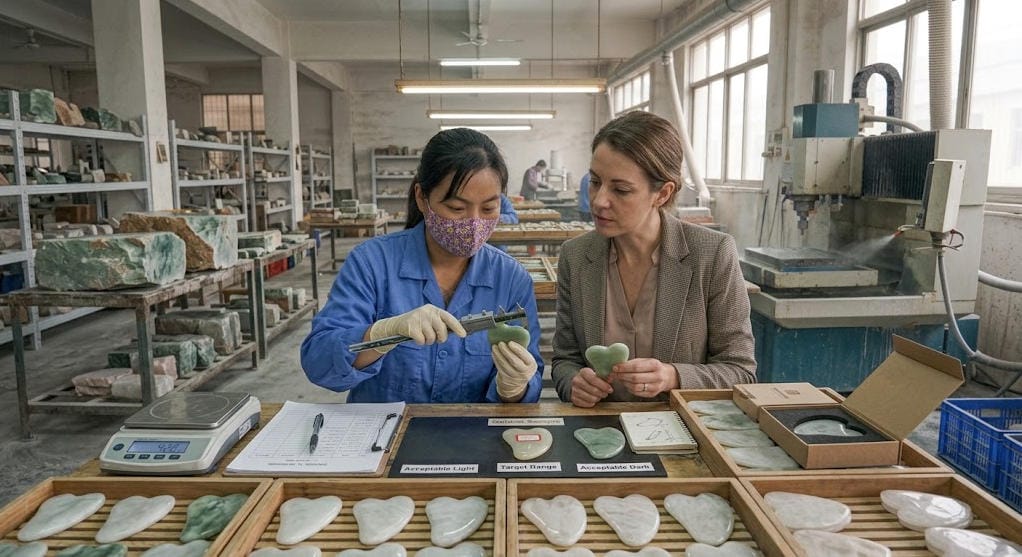
If “100% guaranteed” isn’t a workable standard, what replaces it? The answer isn’t complicated, but it does require doing some work before the deposit is paid rather than after the goods arrive. A written acceptable quality standard turns subjective disagreement into an objective checklist — and it’s the single most effective tool for lowering gua sha wholesale risks on any recurring order.
The Specifications to Lock Down Before Production Starts
At minimum, your pre-production agreement should nail down dimensional tolerance and allowed weight range, since these are the two figures most likely to drift across a large batch. It should also define which cracks are unacceptable versus which micro-fractures fall within normal tolerance, how visible edge chipping needs to be before it counts against the lot, and what surface finish — scratch level, polish gloss — is expected under normal lighting. Color deserves its own line item, ideally tied to a physical swatch rather than a verbal description, alongside a clear note on which natural textures count as expected characteristics rather than flaws. Round it out with packaging requirements covering drop-test resistance and labeling, plus your agreed sampling ratio and a documented process for how non-conforming units get handled — rework, replacement, or credit. This means that once this document exists, your gua sha quality conversation with any supplier stops being a debate and becomes a checklist both sides can point to.
How AQL Sampling Turns Trust Into a Measurable Number
You don’t need to inspect all 5,000 pieces to know whether a lot meets your standard — that’s precisely the problem acceptance sampling was built to solve. The ANSI/ASQ Z1.4 standard (internationally mirrored by ISO 2859) defines exactly how many units to pull from a given lot size and how many defects that sample can contain before the whole lot gets rejected, based on your chosen inspection level (Global Sources, Anatomy of the ANSI ASQ Z1.4 AQL Table). Applied to a gua sha wholesale order, this means you can set, say, a 2.5 AQL for minor cosmetic issues and a 0 AQL for critical defects like sharp cracks, and get a statistically defensible answer on whether to accept a 5,000-piece lot by inspecting only a few hundred pieces from it. That’s a dramatically lower inspection cost than checking every unit, and it gives you a number — not a feeling — to base your acceptance decision on. It means your quality control budget goes toward catching real risk instead of chasing an unreachable zero.
What to Actually Ask a Gua Sha Manufacturer Before You Sign
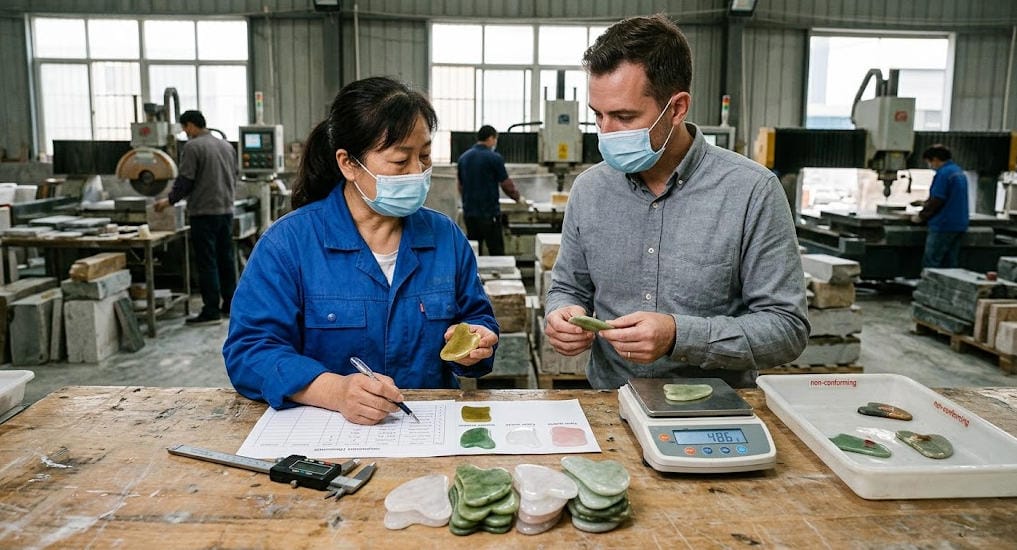
By now the pattern should be clear: the words “100% guaranteed” tell you almost nothing useful about a supplier, while a handful of specific process questions tell you almost everything. If a gua sha manufacturer can answer these clearly and consistently, your gua sha wholesale risks on that order drop substantially — not to zero, but to a level you can actually manage and plan around.
Seven Questions That Reveal Whether a Real Quality System Exists
Ask how rough material gets screened and graded before it ever reaches a cutting tool, and listen for specifics — color grouping, transparency checks, visual crack screening — rather than a vague “we check everything.” Ask how color difference gets measured and whether a physical swatch or reference sample is used, because “by eye” is not a repeatable method across a 5,000-piece run. Ask how dimensional tolerance is verified during CNC forming, not just at final packing, since that’s where drift is easiest to catch early and cheapest to correct. Ask whether they use a Golden Sample — a pre-approved reference piece both sides sign off on before mass production starts — because without one, “acceptable” gets redefined after the fact. Ask what their sampling ratio is for final inspection and whether it follows a recognized standard like AQL, or whether it’s an internal number nobody can explain. Ask, directly, what counts as a defect versus a natural characteristic on the specific material you’re ordering, and get the answer in writing. Finally, ask what happens when a lot fails inspection — rework, replacement, credit — because a supplier without an answer to that question hasn’t actually thought through gua sha quality failure, only gua sha quality success. This means a fifteen-minute conversation covering these seven points will tell you more about your real risk exposure than any guarantee printed on a product catalog.
Reading a Supplier’s Inspection Flow Instead of Its Marketing Copy
The most reliable signal isn’t a slogan — it’s whether a supplier can walk you, step by step, through raw material inspection, in-process checks, final inspection, sampling, isolation of non-conforming units, and rework or rejection, in that order, without hesitating. A supplier who can describe that flow in under two minutes has clearly run it before, because you don’t invent a process like that on the spot for a sales call. Compare that to a supplier whose only answer is a repeated assurance that “our gua sha quality is 100%, don’t worry” — that phrase, on its own, tells you nothing about how a single unit actually gets checked. So what should you do with this difference? It means you should weight a clear, walkable process description far more heavily than any confident-sounding promise, because one of those two things is verifiable and the other one isn’t.
Frequently Asked Questions About Gua Sha Wholesale Risks
1. Does a 100% pass rate mean the shipment has zero flaws?
No. A pass rate measures how many units meet your agreed specification, not whether every unit is visually identical. Natural material will always carry some variation that falls inside an accepted range, and that’s expected rather than a sign of poor gua sha quality.
2. What’s a reasonable defect rate to expect on a gua sha wholesale order?
There’s no single industry-wide number, because it depends entirely on your chosen AQL level and how tightly your specification is written. A 2.5 AQL for minor cosmetic points and a 0 AQL for critical structural defects is a common, workable starting point for natural stone tools, but the right figures should be negotiated and documented before production, not assumed.
3. How can I tell the difference between a natural characteristic and an actual defect?
he only durable answer is a pre-agreed reference — a written description plus a physical color swatch or approved sample — because relying on subjective judgment after the goods are made simply reopens the same argument covered earlier in this piece. This is exactly why gua sha wholesale risks concentrate so heavily around orders that skip this step.
4. Should I trust a supplier who won’t say “100% guaranteed”?
In most cases, yes — a supplier who avoids that phrase and instead offers a documented inspection flow, sampling ratio, and defect-handling policy is typically the one who has actually run high-volume production before. It means you’re seeing more transparency here than you would from a supplier who wants you to move on quickly.
A Closing Note on Manufacturing Experience
None of the process detail above is theoretical for this factory. Over more than twelve years of producing jade and crystal gua sha tools, we’ve watched the same disputes recur whenever a purchase order skipped a written quality standard, and we’ve watched them disappear once one was in place. If you’re planning a gua sha wholesale order and want to see what an actual IQC-to-OQC inspection flow looks like before you commit to a spec sheet, that’s a conversation this factory can walk you through directly, tolerance by tolerance.