

Here is the number that matters before you send a deposit: under the ANSI/ASQ Z1.4 sampling standard used across the sourcing industry, a general inspection at Level II on a 2,000-piece lot checks roughly 125 pieces — not the full order. That means most of what you buy is never individually inspected before it ships, which is exactly why gua sha after sale terms have to be written down before payment, not after a problem shows up. If you’re placing a gua sha wholesale order for 500, 2,000, or 10,000 pieces of jade, quartz, or agate tools, the clauses you confirm today decide how a disagreement gets resolved once the container lands — not the clauses you wish existed after it does.
This matters more for natural stone than for almost any other wholesale category, because a gua sha manufacturer working in jade and quartz is shaping material that differs from piece to piece by nature. “Defective” and “natural” can look identical to an untrained eye, and that single ambiguity is behind a large share of the disputes sourcing agents report on mineral and stone goods. What follows is what actually needs to be settled with your gua sha supplier before your deposit clears, and why each point protects your order — not just the factory’s paperwork.
Why Gua Sha After Sale Terms Must Be Locked Before You Pay

Once Payment Clears, “Obvious Defect” Becomes a Moving Target
Picture a 1,000-piece gua sha wholesale order. Before payment, you might assume that any visible flaw on arrival is the factory’s responsibility outright. The factory might assume something narrower: that only flaws caused by production — not the natural color drift, veining, or internal texture that comes with real stone — count as defects. Both positions can sound reasonable in isolation, and that’s the trap. The real issue is that “obvious flaw,” “minor flaw,” and “natural characteristic” were never defined while both sides could still negotiate freely. Once payment lands, you lose your strongest leverage to fix that ambiguity, because every conversation after that point happens from a weaker negotiating position. This isn’t about assuming bad faith on either side — it’s about recognizing that clear definitions, agreed before money moves, are what make a gua sha after sale claim enforceable instead of debatable.
Natural Stone Is Not an Industrial Standard Part
A CNC-milled plastic comb comes out identical every time; a piece of jade never does. White jade carries faint internal structure, quartz carries natural inclusions sometimes described as “cotton” or ice-like fracturing, agate carries its own banding, and amethyst shifts in depth of color from batch to batch. According to GIA’s overview of jadeite quality factors, color, transparency, and texture are the three characteristics that drive value in natural jade — and every one of them varies naturally within a single mining source. Is a faint internal cloud in a piece of white jade a defect, or is it simply what real stone looks like? Your contract can’t answer that question after the fact — it has to define, in writing, which natural traits are acceptable and which cross into a manufacturing defect, so guasha quality is judged against a standard both sides already agreed to.
Gua Sha After Sale Coverage Ends Where Subjective Taste Begins
Wholesale and retail disputes aren’t the same animal. If you order 2,000 pieces and 10 arrive with a visible crack, 8 have chipped edges, and 15 sit outside the agreed color range, that’s a quantifiable nonconformity you can point to and measure. If you simply feel the batch looks less vivid than the sample photo, that’s a judgment call, not a defect. Gua sha after sale coverage exists to resolve the first kind of problem — products that fail an agreed, written standard — not the second. Writing this distinction into the contract before payment keeps both sides arguing about facts instead of feelings, which is the entire point of confirming terms early.
Shipping Damage and Production Defects Are Not the Same Claim
A batch can leave the factory floor in full compliance with your Golden Sample and still arrive cracked, because international freight involves drops, compression, and handling that no factory controls once the container leaves the dock. This means the responsibility for a factory-side defect and the responsibility for a carrier-side break need two separate clauses, two separate categories of supporting evidence, and — as covered further down — two separate remedies. Confirming this split before you pay is what keeps a shipping accident from turning into a factory quality argument that neither side can actually win.
Setting the Quality Standard: Golden Sample, Natural Variation, and Color Tolerance

Golden Sample Beats “According to Buyer’s Requirements”
Every gua sha after sale clause rests on one foundation: a way to prove, after the fact, what “correct” was supposed to look like. Writing “according to buyer’s requirements” into a contract feels safe, but it isn’t — that phrase has no fixed reference point, so it means whatever each side wants it to mean once a disagreement starts. A dimension, a weight, a shape, a polish level, and an edge treatment described in a Technical Drawing or Specification Sheet, backed by an Approved Sample or Golden Sample physically held by both sides, closes that gap. This means you can point to an object, not an adjective, when deciding whether a batch passed or failed, and that single change removes most of the room for post-shipment argument.
Where GIA and IGS Draw the Line on Natural Characteristics
Natural crystal and jade orders need a second layer of definition that synthetic material never requires: which visual traits belong to the stone itself, not to a defect in production. The International Gem Society’s guide to gemstone inclusions explains that trapped crystals, fractures, and internal cavities form naturally as a mineral grows, and that certain inclusions are actually used to confirm a stone is genuine rather than synthetic. Applied to a gua sha order, that means a faint cloud in quartz or a subtle color band in agate is not automatically a manufacturing defect — it can be proof the material is what you paid for. This is why a serious gua sha manufacturer will walk you through which of these traits are acceptable before production starts, rather than leaving you to interpret them alone once the shipment lands.
Building a Three-Tier Color Reference Instead of Guessing
Color is where the largest share of after-sale disputes actually happen, because “close enough” means something different to every person looking at a stone. The approach used across the colored gemstone trade — and reflected in how labs such as SSEF describe jadeite color on formal reports — is to state a hue range rather than a single target, since uneven natural color is normal and expected in real jade. Applied to your order, this means building three physical references before production starts: a Lightest Acceptable sample, a Target sample, and a Darkest Acceptable sample. White jade and clear quartz can usually run on a simpler version of this system, while amethyst, agate, and green jade — where color shifts more between mining lots — need tighter batch sorting against all three references before packing. Once these samples exist, guasha quality stops being a feeling and becomes something you can hold in your hand and compare.
Defect Ratios and AQL: What “Acceptable” Means for Gua Sha After Sale Claims

Why “Supplier Will Replace Defects” Fails as a Clause
A clause that simply says defective product will be replaced sounds protective, but it tells you nothing about how many defects trigger that promise. How many chipped pieces should qualify for a replacement — one, or five hundred? Without a number, both technically fall under the identical sentence, which means the clause protects nobody in practice. A workable gua sha after sale clause separates minor cosmetic variation that falls inside an agreed tolerance from major defects that exceed it, and attaches remedies like replacement, credit, or refund only to the second category. That distinction is what turns “we’ll take care of it” into something a factory floor manager can apply consistently, batch after batch.
Reading an AQL Table Without a Quality Degree
If your gua sha supplier already uses AQL-based inspection, or you’re bringing in a third-party inspector, four terms need to be pinned down in the contract rather than left to the inspector’s judgment on the day: Inspection Level, AQL Level, sample size, and the split between Critical, Major, and Minor defects. The ANSI/ASQ Z1.4 standard that underlies most AQL inspection in consumer goods sets tighter tolerances for Major defects — the kind that affect function or resale — than for Minor ones, which are typically cosmetic. This means a gua sha wholesale order with, say, a 2.5 AQL for major defects and a 4.0 AQL for minor defects gives both sides a number to check on inspection day, instead of a debate about what “too many” means after you’ve already unpacked half the shipment.
Inspection Windows, Evidence, and Gua Sha After Sale Risk Under Incoterms
How Many Days You Actually Have to Report a Problem
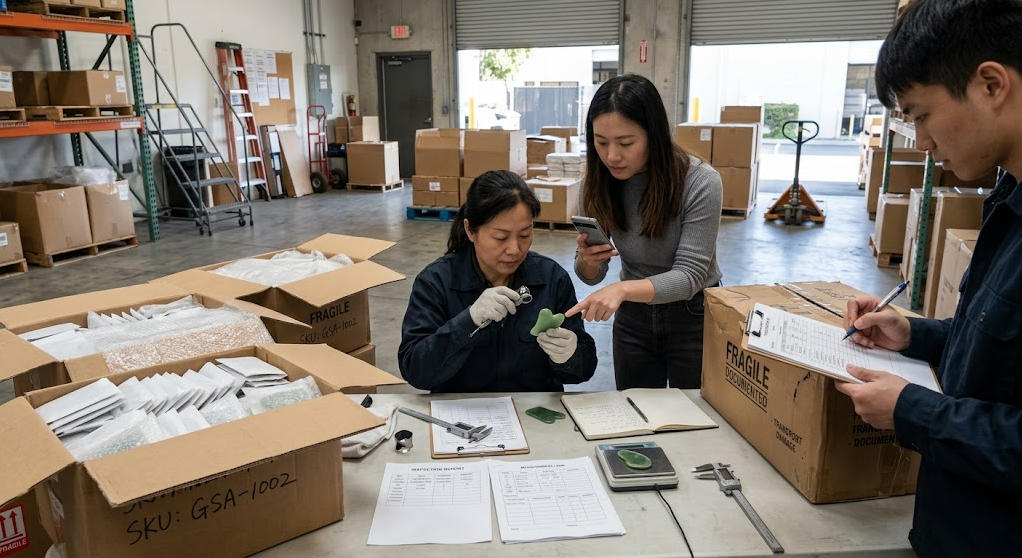
Without a deadline, a visible problem can surface 7 days after delivery, or 70. A gua sha manufacturer has no reliable way to tell, at day 70, whether a crack existed at the factory, happened in transit, or came from how the goods were stored after you received them. That’s why a working gua sha after sale clause states a concrete inspection window — commonly something close to “buyer shall inspect the goods within 7 days of receipt and notify the supplier of any visible quantity or quality discrepancy.” It also helps to separate visible problems, which this window covers, from hidden or latent defects, which may only surface after the product is in use and typically need a longer, separately defined reporting period. Setting this window before payment means you keep your claim rights instead of losing them to an argument about timing months later.
What Photos and Documents Turn a Claim Into a Resolution
A claim without documentation is just an assertion, and most gua sha supplier teams cannot act on an assertion alone. The evidence that actually moves a claim forward includes the order number, the affected SKU, the defective quantity, clear photos, video where the defect is hard to capture in a still image, and the batch number tied to that specific production run. For anything related to transit, add outer carton photos, interior packing photos, and a shot of the full pallet or carton stack before it’s disturbed — this is what separates a gua sha wholesale claim tied to production from one tied to a rough freight leg. Requiring this evidence upfront, in writing, means a legitimate claim gets resolved in days rather than weeks of back-and-forth about what actually happened.
Why EXW, FOB, CIF, and DDP Change Who Pays for Damage
Shipping damage and manufacturing defects need to sit in separate clauses, and the ICC’s official Incoterms 2020 rules are what actually decide where that line falls. Under EXW, risk transfers to you at the factory gate, so almost everything that happens after loading is your carrier’s problem, not the factory’s. Under DDP, the seller carries risk and cost all the way to the named destination, which shifts far more of the shipping conversation back onto the supplier. FOB and CIF sit in between, splitting responsibility at the point goods are loaded onto the vessel. This means your gua sha after sale clause and your Incoterm need to say the same thing — a contract that promises broad after-sale coverage while quoting EXW pricing is contradicting itself, and that contradiction is exactly what surfaces during a dispute, not before one.
Remedies and Exclusions: What Gua Sha After Sale Coverage Includes — and What It Doesn’t

Five Remedies a Gua Sha Supplier Should Put in Writing
Saying “after-sale support included” promises nothing until it’s paired with a specific mechanism for how support actually gets delivered. A gua sha supplier worth working with will spell out which remedy applies to which situation, because the right fix depends heavily on the scale of the problem. Replacement fits a small run of clearly defective pieces — a handful of cracked or chipped units inside an otherwise sound batch. Credit against your next order works well for a low-value, low-quantity issue where reshipping isn’t worth the freight cost on either side. Refund applies when the defect is serious enough, or widespread enough, that neither side wants to reship the material at all. Rework suits problems a factory can physically correct — a polish pass, a re-drill, a Logo correction — without touching the stone’s core integrity. Partial refund covers the middle ground: product that’s still sellable but fell short of one agreed spec, like a slightly narrower color match than the Target sample called for. Naming all five in your contract, and tying each to a defect threshold, means you’re negotiating from a menu instead of starting from zero when a problem actually appears.
Ten Situations No Contract Should Promise to Cover
A gua sha after sale clause is only half-written if it only lists what’s covered — the exclusions matter just as much, and skipping them creates false expectations on both sides. The situations that typically sit outside coverage include: normal natural texture and grain in the stone; color variation that falls within the agreed reference range; natural inclusions and internal structure consistent with the material type; damage caused by your own use or reprocessing of the goods; damage from improper storage after delivery; visible defects reported after the agreed inspection window has closed; damage from use outside the product’s normal conditions; and modification by a third party the manufacturer never approved. Two more worth naming explicitly are quantity shortages traced to the buyer’s own logistics handling, and packaging issues that occurred after the goods left the factory’s outer carton intact. The one thing to avoid here is an absolute line like “supplier is not responsible for any problem after delivery” — that phrasing is too broad to hold up in a real dispute and tends to make suppliers look evasive rather than precise. A specific, itemized exclusion list does the opposite: it shows you exactly where guasha quality responsibility ends, which protects your ability to make a fast, well-supported claim on everything that falls before that line.
Building a Gua Sha After Sale Closed Loop Instead of a Dispute Cycle

From “Pay, Ship, Argue” to a Sequence You Can Audit
Most disputes trace back to a simple structural problem: payment happens, then goods ship, then a problem appears, and only then do both sides start negotiating what should have been settled from the start. A gua sha manufacturer that wants to avoid that pattern builds the opposite sequence instead — confirm terms before payment, set the production standard, inspect before the goods leave the factory, inspect again on arrival, define what counts as a defect against that guasha quality standard, assign responsibility based on where the fault actually sits, and only then apply a remedy. Locking these terms down before you pay isn’t about the factory avoiding responsibility — it’s about fixing, in writing, what “correct” means before either side has anything at stake in disagreeing about it. For natural stone in particular, this sequence matters more as your order grows: the larger the gua sha wholesale quantity, the more expensive an undefined dispute becomes for both sides, and the more a written, pre-agreed structure protects the deal you actually meant to make.
Gua Sha After Sale FAQ
The questions below come up in nearly every conversation between a buyer and a gua sha manufacturer before a wholesale deposit is sent.
1. What counts as a defect in a gua sha wholesale order?
A defect is any deviation from your agreed Golden Sample, Technical Drawing, or Specification Sheet — visible cracks, chipped edges, out-of-tolerance dimensions, incorrect Logo placement, or color that falls outside your agreed reference range. Natural texture, internal structure, and color variation within that agreed range are not defects; they’re expected characteristics of the material, and a reliable gua sha manufacturer will confirm the difference with you before production, not after.
2. Who pays when a gua sha supplier’s shipment arrives damaged?
It depends entirely on your Incoterm and where risk transferred. Under EXW or FOB, risk generally passes to you earlier in the journey, so freight-related damage typically falls to your carrier or insurer. Under CIF or DDP, more of that risk sits with the supplier for longer. Your contract’s after-sale clause should point back to whichever Incoterm you agreed on, rather than leaving the two documents to contradict each other.
3. How much color variation is normal in natural jade or quartz guasha quality?
Some variation is always normal in natural stone — that’s part of what distinguishes it from synthetic or dyed material. The practical way to manage it is a three-tier color reference (Lightest Acceptable, Target, Darkest Acceptable) confirmed before production, so guasha quality on arrival gets measured against a physical standard both sides already agreed to, not against memory or a product photo taken under different lighting.
4. Your Gua Sha After Sale Checklist Before You Send Payment
None of this needs to be complicated, but it does need to be in writing before your deposit clears. Before you pay a gua sha supplier for your next order, confirm: the product specification and Golden Sample that define your guasha quality standard; the accepted color range and reference samples; which natural characteristics are excluded from defect claims; the defect categories that do trigger a claim; your defect tolerance or AQL level; your inspection window for visible and latent defects; the evidence required to file a claim; who carries shipping-damage risk under your Incoterm; which remedy applies to which defect scale; and how a disagreement gets resolved if the two sides can’t agree.
Your Gua Sha After Sale Checklist Before You Send Payment
None of this needs to be complicated, but it does need to be in writing before your deposit clears. Before you pay a gua sha supplier for your next order, confirm: the product specification and Golden Sample that define your guasha quality standard; the accepted color range and reference samples; which natural characteristics are excluded from defect claims; the defect categories that do trigger a claim; your defect tolerance or AQL level; your inspection window for visible and latent defects; the evidence required to file a claim; who carries shipping-damage risk under your Incoterm; which remedy applies to which defect scale; and how a disagreement gets resolved if the two sides can’t agree.
A gua sha wholesale order built on these terms doesn’t remove every risk — natural stone will always behave like natural stone. What it does is make sure that when something does go wrong, you and your gua sha manufacturer are arguing about a shared standard instead of two different ideas of what you paid for. That gap between a gua sha supplier‘s promise and what actually happens after delivery is what pre-payment terms are designed to close.